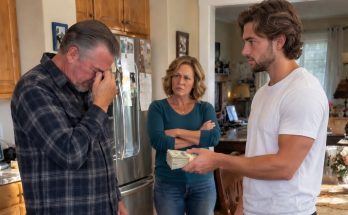
“Don’t overreact, Harold. It’s just a little smoke.”
My daughter-in-law spoke without even glancing in my direction.
She was standing next to the kitchen sink in the home my late wife had loved, a cigarette balanced between two manicured fingers as pale smoke curled upward toward the ceiling fan.
Rain pattered gently against the windows. A pot of vegetable soup bubbled quietly on the stove, while the digital clock over the oven read 7:18 p.m.
I had spent that afternoon at a cardiac rehabilitation session.
The cold weather had left my chest feeling tight, and my new medication still put a metallic flavor in my mouth.
“Kendra,” I said, “you remember what the cardiologist told me. Please smoke outside.”
She tapped her ash into the stainless-steel sink.
“Maybe you’re being too sensitive.”
“This is my house.”
That was when my son raised his eyes from the kitchen table.
Daniel was forty-two, although when he became angry, he looked remarkably like the moody teenager who had once blamed his teachers whenever he received a poor grade. An empty beer can rested beside his elbow. His phone shone near his plate, showing a sports score he apparently found more important than what was happening directly in front of him.
“Dad, enough,” he said.
“I simply asked her to smoke outdoors.”
“We live here too.”
“Yes. And I’m asking everyone to respect one simple rule.”
His chair scraped across the floor.
The noise sliced through the kitchen.
Kendra gave a slight smile while Daniel walked toward me. I assumed he would lower his voice and tell me to settle down.
That had always been his approach—making whoever challenged his behavior feel responsible for the conflict his actions created.
Instead, he came closer, grabbed my shoulder, and shoved me backward.
My hip hit the corner of the table.
The force was not strong enough to knock me down.
But it was enough to make me steady myself with both hands and enough to send the soup spoon rattling against its ceramic holder.
For several moments, nobody moved.
Daniel stared at his hand as though it belonged to another person.
Kendra showed no surprise.
She slowly took another drag from her cigarette.
“Maybe you should start thinking about assisted living,” she said. “Someplace where people are trained to deal with all these little emergencies.”
Daniel turned his back on me.
There was no apology.
He lifted his beer can, noticed that it was empty, then tossed it into the recycling bin.
I stayed beside the table, one hand resting firmly against the wood. My heart was racing much too fast.
The monitor beneath my shirt was recording every uneven beat, something neither of them appeared to remember.
Or maybe they remembered and simply did not care anymore.
Without another word, I left the kitchen.
Behind me, Kendra raised the window three inches.
It was exactly the sort of small compromise she could later point toward as evidence that she had behaved reasonably.
My name is Harold Bennett. I was seventy-one years old on the night my son decided that wanting clean air to breathe made me a burden.
For nearly all my adult years, I believed family troubles belonged behind closed doors.
That belief cost me far more than money.
It cost me space inside my own house.
It cost me the freedom to open my refrigerator without wondering whether my presence was bothering somebody.
It cost me the ability to speak at a normal volume.
More than anything, it cost me almost two years of pretending that the man sleeping down the hallway was still the boy I had raised.
The house sat along a peaceful street outside Knoxville, a two-story brick Colonial with white shutters, an oak front door, and a garden my wife, Eleanor, had cared for during thirty-seven years.
We purchased it when Daniel was six.
In those days, there were fewer houses in the neighborhood and far more open fields. Daniel rode his bike through unfinished cul-de-sacs while Eleanor planted roses beside the front walkway. I installed shelves in the living room, rebuilt the aging porch myself, and constructed a sunroom after retiring.
Every corner of that house held proof of the life we had shared.
Pencil lines along the pantry door tracked Daniel’s growth throughout high school.
A faded circle remained on the hardwood floor where Eleanor’s favorite rocking chair once rested.
Inside the upstairs linen closet, she had labeled the shelves using blue ink because she believed no family should ever lose valuable time looking for pillowcases.
Eleanor p@ssed away six years before Daniel and Kendra came to live with me.
Cancer took her slowly enough that we had time to organize the paperwork, yet far too quickly for either of us to prepare emotionally.
During the last year of her life, she insisted we sit down with an estate attorney named Samuel Pierce. She had always preferred making important decisions before circumstances turned them into emergencies.
“The house remains protected,” she told him.
Daniel attended the meeting that afternoon, although he spent most of it looking at messages on his phone.
Samuel established a survivorship trust. After one spouse p@ssed away, complete ownership of the house transferred to the surviving spouse. Daniel would inherit it only following the surviving spouse’s de:ath and only if the property had not already been sold, donated, or reassigned in another manner.
Eleanor also added an occupancy provision.
No adult family member staying in the house gained ownership or permanent residency rights simply by living there, helping pay for groceries, or receiving mail at that address.
At the time, the provision seemed completely unnecessary.
Daniel worked in Lexington. Kendra was employed by a regional furniture retailer. They owned a townhouse and frequently talked about eventually relocating somewhere with warmer weather.
Eleanor noticed my hesitation when Samuel described the clause.
“People can change when they think a house is already waiting for them,” she said.
I told her she was concerned about something that would never occur.
She gently squeezed my hand.
“I hope you’re right.”
Two years after she p@ssed away, Daniel phoned me from the parking lot of a hotel.
His position had disappeared during a company restructuring. Kendra had quit her job following an argument with her supervisor. Their townhouse payments had fallen behind, and the lender had started sending official notices.
“We just need three months,” Daniel said.
I was in the sunroom watering Eleanor’s orchids.
“You can stay in the guest bedroom.”
“Kendra needs somewhere to work.”
“There are two extra bedrooms.”
“What about the room Mom used for sewing?”
I glanced toward the closed door.
I had not stepped inside that room for months.
“We can make some space there.”
“Thanks, Dad. I knew you would understand.”
They moved in the next Saturday with a rented moving truck.
Three months turned into six.
Six stretched into a year.
By the time two years had gone by, Kendra had replaced the curtains, changed my dishes, relocated my medication to a kitchen drawer farther away from the coffee maker, and instructed delivery workers to place packages beneath “the homeowners’ awning.”
The first time I corrected her, she laughed.
“You know what I mean.”
I certainly did.
She meant the house already seemed like it belonged to them.
Daniel’s search for employment became an endless series of almost. He was almost hired at a logistics company. Almost contacted again by his previous employer. Almost prepared to launch his own consulting business.
He spent his mornings using his laptop and his afternoons watching sports. During some weeks, he made grocery deliveries using an app. During others, he claimed the mileage made the work pointless.
Kendra began selling home decorations through social media. She photographed merchandise inside my living room and referred to the property as “our East Tennessee project.”