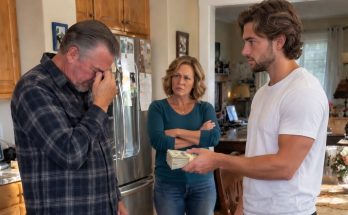
Whenever I accidentally appeared behind her, she lowered her phone and waited until I walked away.
I covered the property taxes.
I covered the insurance.
I covered the electric bill that climbed after Kendra packed the garage with photography lights and shipping supplies.
Daniel sometimes bought groceries. He considered his contribution toward the household.
Initially, I accepted the arrangement because grief had made the house unbearably silent. Hearing footsteps from upstairs provided some comfort. Sharing meals with another person reminded me of our family dinners before Eleanor grew sick.
Eventually, comfort became caution.
During winter, Kendra started smoking beside the back door.
When I complained, she said it was too cold outdoors.
Daniel asked me not to cause unnecessary arguments.
She shifted from the back doorway into the laundry room, and eventually toward the kitchen window.
Every boundary disappeared through steps small enough to debate but significant enough to transform the house.
She also began mentioning assisted living.
At first, she was indirect.
She placed brochures across the kitchen counter.
“Look how beautiful these places are,” she said. “They provide meals, transportation, and medical care.”
“I own a car.”
“For now.”
“I can cook.”
“You leave things burning on the stove.”
Once, I had forgotten a kettle while answering someone at the front door. Kendra turned that single mistake into a recurring problem.
Daniel eventually joined her.
“You’d be surrounded by people your own age,” he said.
“I already have friends.”
“Most of them are getting slower.”
“So am I. That doesn’t mean I should abandon my house.”
Whenever he replied, he wore a soft smile, carefully performing patience.
“Nobody is making you.”
Not yet, I thought.
The cigarette incident changed everything.
I walked upstairs and locked the door to my bedroom.
My fingers shook as I removed the cardiac monitor leads and examined the skin underneath. A reddish mark had appeared on my shoulder where Daniel had grabbed me.
I lowered myself onto the edge of my bed and listened.
Downstairs, Kendra was laughing.
The television grew louder.
A cupboard door shut.
Their evening continued as though nothing meaningful had occurred.
For the previous two years, I had stored a black folder containing important documents beneath the lowest drawer of my dresser.
Eleanor had called it our “final folder.”
Inside were certified copies of the property deed, the trust documents, my advance medical directive, investment records, insurance policies, and Samuel Pierce’s business card.
I removed the folder.
The leather around its edges had become soft with age.
Resting on top was a handwritten note from Eleanor.
Harold,
If you’re reading this because somebody has made you feel like a visitor in your own life, remember that being kind does not mean giving everything away.
Love,
E.
I had read those words countless times since her passing.
That evening, it seemed as though she had written it specifically for what was happening downstairs.
Underneath the folder sat a small plastic container holding a memory card.
The house had a simple security system, installed after several burglaries happened around the neighborhood. Cameras monitored the front porch, garage, rear entrance, and shared spaces throughout the first floor.
I paid for that system.
Daniel had complained that the cameras made him uneasy, so I switched off the visible indicator lights. He believed I had disabled the entire system.
I had not.
The kitchen camera captured movement rather than private conversations, but the home-assistant system stored voice commands and environmental notifications. Another small camera positioned in the hallway recorded the space beside the kitchen doorway.
I slipped the memory card into my old laptop.
The recording appeared.
There I stood beside the sink, with one hand braced against the counter.
Kendra held the cigarette.
Daniel stood up.
He walked across the kitchen and shoved my shoulder.
The camera angle made nothing appear worse than it actually was.
Somehow, that made watching it harder.
I saw myself grab the table’s edge while my daughter-in-law stood there smiling.
Then I shut the laptop.
I did not weep.
Grief had taught me that tears could be postponed without ever truly disappearing. They remain somewhere inside the body until enough silence arrives for them to surface.
That night, I had no space for them.
I photographed the red mark on my shoulder, stored the recording in three separate locations, and uploaded copies into an encrypted folder Samuel’s office had established for estate records.
Then I opened the trust documents.
The survivorship provisions remained exactly the way Eleanor had wanted them.
Legally, I was the sole owner.
Daniel held no present ownership interest.
The occupancy provision gave me the right to end permission for any adult family member residing in the house after proper written notice, especially when their behavior endangered my health, safety, or peaceful enjoyment of my property.
I found Samuel’s phone number and wrote a message.
I need to see you tomorrow. Bring the trust.
His answer came before midnight.
Nine o’clock. I’ll be there.
I slept for five hours.
It was the soundest sleep I had managed in months.
The following morning, I got dressed before Daniel and Kendra awakened.
I chose a navy sport coat, gray trousers, and the watch Eleanor had given me for our twenty-fifth wedding anniversary. I slipped the black folder into my briefcase and exited through the garage.
Samuel’s office was located on the second floor of a renovated brick building close to downtown Knoxville. The lobby carried the scent of coffee and aging paper. A receptionist named Joan welcomed me by name.
Samuel greeted me at the conference room entrance.
He was sixty-eight, with white hair, rimless spectacles, and the composed expression of a man who had spent decades watching families misinterpret legal documents they themselves had once signed.
“You told me to bring the trust.”
I set the folder down on the table.
“They’re trying to get me out.”
He listened without interrupting.
I explained the smoking, the assisted-living brochures, the altered rooms, the relocated medication, and their repeated pressure for me to move away.
Then I played the recording.
His expression stayed calm until Daniel’s hand landed on my shoulder.
Samuel stopped the video.
“Has anything like this happened before?”
“Not physically.”
“Verbally?”
“Yes.”
“Do you feel safe going back home?”
“I feel safe because they don’t understand the situation they’ve put themselves in.”
“That isn’t the same thing as feeling safe.”
“No.”
His eyes shifted toward the folder.
“What do you want to happen?”
“I want them gone.”
“Right away?”
“As soon as legally possible, but I want everything done correctly.”
He took off his glasses.
“Harold, after this notice is delivered, your relationship may never recover.”
“Our relationship didn’t survive what happened last night.”
“Are you certain?”
“They’re trying to put me into a facility because they want the house.”
“Can you prove that?”
“Not yet.”
He watched me carefully.
“Then we proceed only with what we can establish. The property belongs to you. They are living there with your permission. We end that permission under the trust and the state’s legal process. No revenge. No intimidation. No shortcuts.”
I nodded.
Samuel drafted an official termination notice requiring them to move out within thirty days. Given my health condition and the documented incident, he also coordinated a temporary household safety arrangement through civil counsel.
It specified that during the notice period, neither Daniel nor Kendra was permitted to interfere with my medication, access to any rooms, telephone, mail, finances, or visitors.
After I signed it, Samuel glanced at the photograph of Eleanor attached to the original trust documents.
“She planned everything carefully.”
“She usually did.”
“She included a transfer provision as well.”
“I remember.”
“If you decide you want the house to pass to someone other than Daniel, the trust permits you to redirect the property while you’re alive.”
“Not today.”
“All right.”
“But get the paperwork ready.”
Samuel nodded once.
The notice was delivered two days later.
A professional process server posted one copy on the front door and personally handed another to Daniel inside the living room.
I remained at the kitchen table sipping tea.
Daniel read the first page two times.
His expression shifted from confusion into disbelief.
“What is this?”
“A notice terminating your occupancy.”
“You’re throwing us out?”
“Yes.”
Kendra rushed downstairs with her phone in her hand.
“What did he give you?”
Daniel passed her the documents.
She skimmed through them quickly.
“This isn’t valid.”
“It came from Samuel Pierce.”
“You can’t force us out of our own house.”
I placed my cup of tea down.
“This is not your house.”
“You gave this place to us when we came here.”
“I gave you somewhere to live.”
“You told us we could build our lives here.”
“I told you that you could stay while rebuilding yours.”
Daniel stared at me as though he were seeing a stranger.
“Where exactly are we supposed to live?”
“You’re adults.”
“That’s all you have to say?”
“It’s the same response you gave me whenever I asked for control of my own rooms.”
Kendra moved closer to me.
“You’re confused. This property belonged to your wife’s estate.”
“Yes.”
“Daniel is her son.”
“Yes.”
“Then he owns half of it.”
“No.”
She smiled as though she had finally caught me making a mistake.
“You really should understand the law before embarrassing yourself.”
“I reviewed the trust.”
Daniel’s expression shifted.
“What trust?”
“The trust your mother established.”
“You never mentioned any trust to us.”
“You were present when we signed it.”
“I was in my twenties.”
“You were thirty-six.”
He looked over at Kendra.
She lowered the papers.
“What does the trust actually say?”
“That Eleanor’s ownership transferred entirely to me after her de:ath. I am the sole owner.”
“This is insane,” Daniel said.
“No,” I answered. “It is legally documented.”
His jaw became tense.
For one uncomfortable moment, I remembered the feeling of his hand against my shoulder.
Then someone knocked on the front door.
Samuel had arranged for a representative from a property-services company to be present during delivery of the notice because he did not want me handling the initial confrontation alone.
When I opened the door, a woman named Denise Marshall stepped inside.
She wore a gray business suit, held a tablet, and introduced herself as the independent occupancy coordinator.
Daniel took a step backward.