“YOU’RE NOT AT WAR!” SISTER MOCKED MY UNIFORM AT DAD’S FUNERAL—HER HUSBAND GASPED: “THE COLONEL?!”
Part 1
“Could you not afford a decent black dress?”
Jasmine’s voice cut through the quiet of the cemetery like a glass edge.
The funeral had already been hard enough. The sky over the small Ohio town hung low and gray, the kind of February sky that made every headstone look colder than it already was. A folded American flag rested near my father’s casket. Damp grass clung to the soles of my shoes. Somewhere behind us, traffic moved along the county road, soft and distant, as if the rest of the world had decided not to stop for grief.
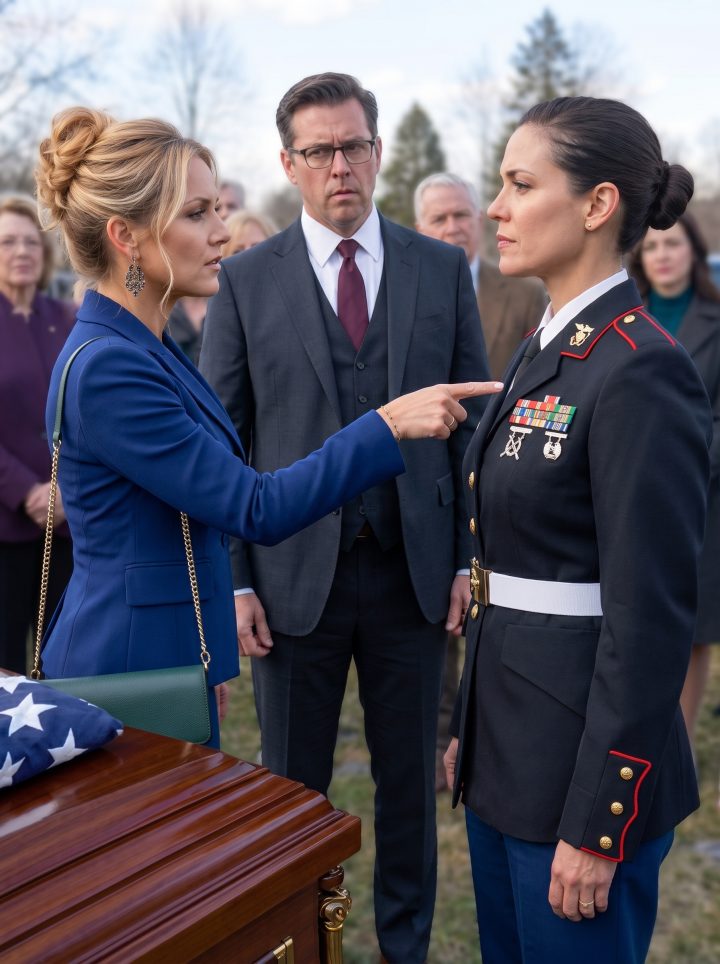
My sister stood across from me in a designer black silk dress, her hair pinned perfectly, her nails painted a deep red that looked almost too bright against all that mourning. She pointed one sharp fingernail straight at the ribbons on the chest of my Marine Corps dress blues.
“Relax, Sophie,” she sneered. “You’re not in a combat zone. I know you’re always desperate for attention, but this is Dad’s funeral. Don’t turn it into a circus.”
A few relatives behind her covered their mouths, pretending they were coughing.
They were laughing.
Right there, at the edge of my father’s grave, surrounded by people who shared my blood, I stood completely alone.
They had no idea.
Only hours before catching the flight home, I had stood in uniform under another cold sky and watched the Stars and Stripes settle over the caskets of two young Marines under my command. I had clenched my jaw until it hurt. I had bitten the inside of my cheek raw because I refused to break in front of their families.
I had buried men who trusted me.
Now I was standing in an Ohio cemetery while my own family treated me like an embarrassment.
The gravediggers began their work.
Thud.
Wet dirt struck the lid of the casket.
Thud.
Black mud broke against polished mahogany.
I did not move. Not one muscle in my face twitched. My eyes followed the rhythm of the dirt, tracking every motion out of habit more than choice. Jasmine did not even wait until the grave was filled. She turned on her thin stiletto heels and walked away.
The rest followed her as if she had blown a whistle.
Designer shoes crunched on gravel. Black coats swung in the wind. A parade of polished grief moved toward the expensive cars waiting beyond the cemetery road and the imported wine waiting at Jasmine’s house.
They left me standing beside a six-foot drop.
I looked down once.
Then I brushed a speck of dust from the red stripe running down the leg of my trousers. The fabric was crisp. The line was straight. Regulation perfect.
I turned with a precise about-face, my heel snapping against the pavement, and walked toward the parking lot.
I did not look back.
The rental car was a beat-up Ford SUV that smelled like stale cigarettes and pine air freshener. The kind of vehicle you get at the counter when the smiling clerk says, “It’s all we have left,” and hands you the keys before you can argue.
I reached for the rusted door handle.
Before I could pull it open, my phone buzzed against my ribs.
I took it from my breast pocket. The screen was cracked in the top right corner. A message from my mother glowed there.
When you get to the house for the wake, find a quiet corner to stand in. Ethan has important partners coming over. Don’t embarrass your sister.
I stared at the words.
Not one question about whether my flight had been safe.
Not one word about the man we had just lowered into the ground.
Just an order.
Stand in the corner.
Stay out of the way.
Do not embarrass Jasmine.
Hide the uniform.
My thumb hovered over the cracked glass. The sharp edge bit lightly into my skin, and I pressed hard enough to leave a mark. Then I locked the screen and tossed the phone onto the passenger seat.
I slid behind the wheel and shut the door.
The heavy clunk sealed me inside.
For a moment, I rested my forehead against the hot, cracked leather of the steering wheel. I closed my eyes and let the smell of the rental car fade.
Then I was not in an Ohio cemetery parking lot anymore.
I was back in the dirt.
Three years earlier, somewhere far from home, the air inside the bunker had been thick with diesel, sweat, dust, and cordite. Red tactical lights cast long shadows across the concrete walls. I sat on an ammunition crate with sand on my hands and a pen between my fingers, signing the authorization that sent every cent of my hazard pay directly into my mother’s bank account.
Dad’s hospital bills needed paying.
That was what I told myself.
That was what family meant.
That same night, the siren screamed.
“Incoming!”
The ground above us shook. The concussion rattled my teeth and drove dust into my eyes. We held our line. I survived. The money cleared the next morning.
For three years after that, my mother and sister never once called to ask if I was still breathing.
They took the money.
They used it to keep up their clean suburban story.
And now they wanted the woman who paid for it all to stand quietly in a corner like something they were ashamed to own.
My eyes opened.
The ache in my chest went cold.
Not broken.
Cold.
Clear.
I sat up straight and reached into the hidden pocket of the duffel bag on the floor. I bypassed my personal phone and pulled out a matte black secure device. The kind of phone that did not belong at funerals, country clubs, or suburban wakes.
My thumbs moved across the keypad with practiced speed.
Pull all current corporate files connected to Ethan Whitmore’s firm. Include Department of Defense bidding project 132. Status, ethics flags, partner involvement. Send immediately.
I hit send.
Then I slid the device back into the bag, turned the key in the ignition, and listened as the V8 engine caught with a rough, low growl.
I put the SUV in drive and pulled out of the cemetery lot, gravel snapping beneath the tires.
I was not hiding in a corner.
They wanted to treat me like a uniform with no name.
Fine.
The civilian battlefield had just opened its front door.
Part 2:
Jasmine’s house sat inside a gated community outside Columbus, the sort of neighborhood where every lawn looked professionally trimmed and every mailbox looked more expensive than my first car. American flags hung from several porches, stiff in the cold afternoon wind, clean and decorative, as if patriotism itself had been added by a design consultant.