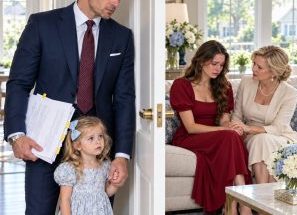
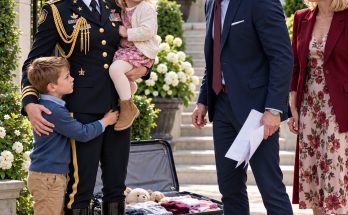
When I pushed open Jasmine’s heavy oak front door, the first thing that hit me was the air-conditioning.
It carried the sharp scent of Tom Ford cologne, expensive candles, and catered food. It swallowed whatever trace of cemetery dirt still clung to my boots.
The house was enormous. Vaulted ceilings. Polished hardwood floors. White orchids arranged everywhere in heavy glass vases. Not one or two. Dozens. It looked less like a wake and more like a luxury showroom preparing for a magazine shoot.
My family moved through the room in designer black dresses and tailored suits, holding crystal glasses filled with dark red wine. Ice clinked softly. Laughter rose too easily against the high walls.
This was not mourning.
This was networking with a casket in the background.
A waiter in a white shirt passed with a silver tray. His eyes landed on my dress blues, the brass buttons, the ribbons, the red stripe down my trousers. He paused, pulled the tray closer to his chest, and stepped aside as if he had accidentally entered the wrong room.
I walked past him without a word.
Near the bay windows, I found an empty corner.
The exact kind my mother had assigned to me.
I planted my boots shoulder-width apart, clasped my hands behind my back, and rested them at the base of my spine.
Parade rest.
Then I scanned the room.
Target acquisition.
My eyes found Jasmine immediately.
She stood in the center of the living room, surrounded by three corporate executives in gray suits. She held a silk handkerchief in one hand and dabbed at the corner of her eye, though her face was perfectly dry.
“It was just so hard,” Jasmine said, making sure her voice carried over the soft jazz playing from the hidden ceiling speakers. “The sleepless nights. Sitting by Dad’s bed for weeks. Ethan and I hired private nurses. We spared no expense. We just wanted him comfortable.”
The executives nodded with solemn approval.
My fingernails pressed into my palms.
Not one mention of the hazard pay.
Not one mention of the transfers I had sent from halfway across the world while the ground shook above me.
Not one mention of the money I earned in sand and fear so our father could die in a clean hospital bed instead of being moved to a county ward.
Jasmine wore the credit like jewelry.
She had used my sacrifice to decorate her image.
Then she had pointed at my uniform and called it a circus.
The muscles in my neck tightened.
In my memory, I heard Brigadier General Thomas Vance’s voice from years ago, rough and steady in the heat.
“Listen to me, Lewis. In uniform, loyalty is written in blood. Out there, it’s written on sand. The first selfish wind can blow it away.”
He had been right.
I squared my shoulders.
I did not belong in that room. These people lived among mirrors, credit lines, and rehearsed emotions. I had lived among brass casings, dust, and decisions that did not allow for pretending.
Then the crowd shifted.
An old man stepped out from the hallway.
He did not fit among the silk dresses and Rolex watches. His black suit was faded and poorly fitted, the shoulders hanging loose on a body that had once been stronger. On his left lapel, a small silver veteran pin caught the light.
Master Sergeant Miller.
He had served with my father in the first Gulf War.
He was the only person in that entire zip code who knew what mud and fear actually tasted like.
Miller ignored the waiters. He ignored the executives. He walked straight toward my corner, his scuffed black shoes sounding dull against the polished floor.
As he came closer, his eyes narrowed.
He looked at my jacket.
Not the way civilians looked at it.
Not like costume. Not like decoration.
He read it.
His gaze moved over the ribbons. Bronze Star. Combat Action Ribbon. Unit citations. Campaign medals. Each one a small square of color to everyone else, but to him, they were a map. A record of places, losses, and nights most people would never understand.
Then his eyes moved upward.
To my collar.
To the silver eagle pinned flat against the dark fabric.
Colonel.
Miller stopped three feet away.
Exactly three feet.
The old habit had never left him.
His posture changed. The slight bend of age disappeared. His spine pulled straight. The look in his eyes shifted from recognition to respect so immediate and complete that the room around us seemed to fade.
His right hand twitched at his side.
His fingers straightened.
He was about to salute.
He never got the chance.
A wave of red wine and expensive perfume pushed into the space between us.
Jasmine.
She swept in from the crowd and stepped directly between us, her sharp elbow catching Miller in the arm as she brushed him aside like a piece of furniture.
“Oh, Mr. Miller,” she said brightly, “you don’t need to pay any attention to Sophie.”
She turned toward me with a glossy smile that did not reach her eyes.
“She always loves playing dress-up.”
The words landed hard.
Jasmine took a slow sip from her glass, leaving a red mark on the rim.
“She makes such a huge scene out of these little soldier outfits. I guess when you don’t have a real career in the corporate world or a husband to take care of you, you have to find some way to feel special.”
The room went quiet enough for me to hear the ice settle in someone’s glass.
She was standing in a house dressed with flowers paid for by the money I had earned in combat. She was drinking wine bought in a life protected by people she mocked. And she was smiling as if she had said something clever.
Miller’s face darkened.
I saw the rage rise up his neck. His hands curled into fists. His mouth opened as he drew a sharp breath.
He was going to say it.
He was going to tell them exactly what the eagle meant. He was going to tell that room who they were insulting.
I looked at him.
One small movement.
One hard stare.
A brief, tactical blink.
Stand down.
It was not a request.
Miller caught it. His jaw clenched so hard I heard his teeth click. He swallowed the anger, stepped back, and obeyed.
Jasmine did not notice.
She thought she had won.
She flipped her hair over her shoulder and glanced toward a group of cousins near the kitchen island. They smirked back at her, champagne flutes raised, eager for the show.
They thought silence meant weakness.
They thought I was taking the insult because I knew my place.
Let them think it.
Let them dig as deep as they wanted.
The crowd parted again.
A man in a charcoal bespoke suit walked through with a half-empty glass of Pinot Noir in one hand.
Ethan Whitmore.
Jasmine’s husband.
Corporate defense lawyer. Smooth talker. Gold-rimmed glasses. Expensive watch. A man who had built his life around speaking in rooms where other people were paid to nod.
He stopped beside Jasmine and looked me over.
Not at me.
Over me.
His smirk lifted slowly.
“So, Sophie,” Ethan said, projecting his voice so half the room could hear. “What is it you actually do in the military? Day to day, I mean.”
I said nothing.
My hands remained clasped behind my back.
Ethan sipped his wine and gave the room a little pause, letting everyone lean in.
“Do you drive supply trucks? Manage a warehouse? Hand out blankets and boots to the grunts?”
A few people chuckled.
The sound scraped against me.
My relatives drifted closer, forming a loose half circle. They wanted to watch the wealthy lawyer put the family disappointment back in her place.
Jasmine leaned into her husband’s shoulder.
“She probably teaches new recruits how to scrub toilets,” she said. “Don’t ask her hard questions, Ethan. It’s embarrassing. If she actually did anything important, we would have seen her on the news by now.”
Ethan laughed.
My eyes moved past them.
Across the room, my mother sat on a white leather sofa near the stone fireplace. She held a cup of black coffee in both hands. Thick gold rings covered her fingers.
She heard every word.
She saw the circle forming around me.
She did not stand.
She did not defend me.
Instead, she set her cup down on the glass coffee table with a sharp clink and sighed, as if I were a difficult child causing trouble on purpose.
“Sophie,” my mother said, voice flat and tired, “I’ve told you this a hundred times. You should learn something from your sister.”
She gestured vaguely at the room, the flowers, the caterers, the high ceilings.
“Look at the life she built. At your age, you should be settling down. Find a nice corporate job. Make real money. Buy nice things. That would be better than running around in the dirt, sleeping outside, and dealing with crude soldiers. You are throwing your life away for nothing.”
For nothing.
Three years ago, I had sat in a dark bunker while the earth trembled hard enough to rattle my teeth. I had signed over every dollar of combat pay so my father could receive care. My mother had taken the money, used it, and now sat on a white leather sofa calling my sacrifice nothing.
That was the final cut.
Not because she misunderstood.
Because she did not care.
She cared about appearance. I did not fit her polished suburban picture, so I became something to hide.
The air in my lungs turned to ash.
Then the emotion burned away.
All that remained was calculation.
The patience was gone.
The red line had been crossed.
I stopped looking at the floor.
Slowly, I raised my head and looked directly into Ethan’s eyes.
The quiet daughter vanished.
Ethan’s smirk faltered.
A bead of sweat appeared at his temple. His fingers tightened around the stem of his wine glass. He did not understand what had shifted, but some old animal instinct in him finally woke up. He realized he was standing too close to someone he had badly misjudged.
I released my hands from behind my back and let my arms fall to my sides.
The brass buttons on my cuffs clicked softly.
The room seemed to pull in a breath.
I took one slow step forward into Ethan’s personal space.
The hardwood did not creak beneath my boots.
I said nothing at first.
I only looked at him.
The silence stretched until it became uncomfortable.
Ethan expected me to shrink. He expected an apology. He expected the family scapegoat to play the role, absorb the hit, and keep the peace.
I did not move.
I studied him instead.
The soft jaw. The loose posture. The weight shifted to one heel. The expensive suit on a man who had never truly been tested by anything he could not bill by the hour.
People who talk for a living hate silence.
It makes them feel small.
Finally, I spoke.
My voice was low. Controlled. Flat.
“Yes,” I said. “Sometimes my job is exactly that.”
No one laughed.
“Sometimes my job is keeping the wolves far enough away so you have the right to sit in this air-conditioned room, drink expensive wine, and judge the people standing watch.”
The words dropped into the room like stone.
My mother inhaled sharply.
Ethan felt the room turn against him. He felt the eyes of his corporate partners on the back of his neck. His ego could not tolerate that. Not in his own house. Not in front of his audience.
His face flushed.
He stepped closer, trying to take back the space, and pointed his wine glass toward my face.
“What is with that attitude, little girl?” he said. “You think you can come into my house and talk down to me? You think putting on a cheap blue suit makes you a hero?”
I did not blink.
“I know how the real world works,” Ethan continued. “I deal with the Department of Defense. I sit in rooms with generals, executives, real decision-makers. Not grunts.”
He laughed sharply.
“You think those little ribbons matter in the real world? They don’t. So what are you? Some low-level captain? A desk jockey major? Pushing papers and pretending you matter?”
Jasmine laughed beside him.
She believed he was burying me.
The cousins began smiling again.
The little kingdom was restoring itself. The wealthy lawyer was crushing the uniform. That was how the script was supposed to go.
I let him finish.
You do not interrupt a man when he is making a mistake that cannot be repaired.
I stepped fully out of the shadows and came to attention.
It was not a casual movement. It was precise. Drilled. Clean.
The pressed wool of my dress blues settled into place. The brass buttons caught the recessed lights. My combat-soled dress boots gave me an extra inch of height, and when my spine locked straight, Ethan had to look up.
His smirk faded.
Then the secure device in my breast pocket vibrated once.
A short, sharp pulse.
Confirmation.
The files on Ethan’s firm had arrived.
His firm. His Department of Defense bid. Project 132.
The trap did not need drama.
It only needed truth.
I opened my mouth.
“Colonel Sophie Lewis.”
The words landed hard.
The room froze.
“Commander of Strategic Task Force 132.”
Silence followed.
Absolute silence.
The title was not just a rank in that room.
It was a key.
It opened a door Ethan had been clawing at for six months.
Across the room, my mother dropped her saucer. It clattered against the glass coffee table.
Jasmine’s mouth parted.
The color drained from Ethan’s face so quickly he looked ill. His breathing stuttered. The glass in his hand tilted, and dark wine spilled onto the toe of one polished shoe.
He knew.
Of course he knew.
Strategic Task Force 132 was not a random line on a uniformed officer’s résumé. It was the designation printed across the top of the defense project his firm had been chasing with everything it had.
A five-hundred-million-dollar contract.
The bid that was supposed to make him a senior partner.
The project he had mentioned at dinners, golf outings, and private receptions as if it were already his.
He had spent the last several minutes publicly mocking the military career of the person whose assessment could determine whether his firm ever touched that project.
I tilted my head slightly.
“Are you ready to discuss my desk job now, Ethan?”
His heel caught the edge of the Persian rug as he stepped back. He stumbled, recovered, and still looked smaller than he had seconds earlier.
“M-Ma’am,” he whispered.
The word rang through the quiet room.
“I didn’t know,” he stammered. “I didn’t know the commander of the task force was you.”
Ten minutes earlier, he had called my uniform a cheap blue suit.
Now that same uniform had become the locked door standing between him and the future he had already spent in his mind.
Near the fireplace, Uncle Robert fumbled with an iPad. His thick fingers moved quickly across the screen. The blue glow reflected in his glasses.
He stopped.
His face changed.
“Oh my God,” he breathed. “There’s a Department of Defense press release from last week. She was just decorated. She’s leading the whole division.”
The words moved through the room like a cold draft.
People stepped back.
One by one, they opened space around Ethan and Jasmine.
In their world, loss of status was contagious, and suddenly Ethan looked infected.
Jasmine felt it. She looked around at the cousins, the executives, the family friends. Her perfect audience was retreating.
She grabbed Ethan’s sleeve.
“What is wrong with you?” she demanded, voice high and panicked. “So what if she’s a colonel? Who cares about some press release? She’s still Sophie. Don’t let her talk to you like that in our house.”
She did not understand.
She had spent her life believing that volume was power. She thought she could embarrass a problem until it disappeared. She thought she could still bully the girl who used to sit quietly at the dinner table.
She pulled Ethan’s sleeve again.
He snapped.
He turned on her so fast she let go.
“Shut your mouth, Jasmine.”
The room recoiled.
His voice cracked through the house, not controlled now, not polished. Fear had stripped the smooth corporate finish right off him.
Jasmine froze.
Her wine glass slipped from her fingers and shattered on the hardwood. Red wine spread at her feet. Her lower lip trembled as she looked toward our mother, waiting for rescue.
Our mother stared at the floor.
Jasmine looked toward the cousins.
No one moved.
The queen of that room had lost her crown the moment it stopped being useful.
I stood still.
I did not smile.
I did not gloat.
I simply watched the perfect family turn on itself under the smallest weight of consequence.
They did not love each other.
They loved the story they performed together.
And the second that story cracked, every one of them stepped away from the broken glass.
Part 3:
My mother rose from the white leather sofa unsteadily. One hand braced against the glass coffee table. The rings on her fingers clicked together as she reached toward me.