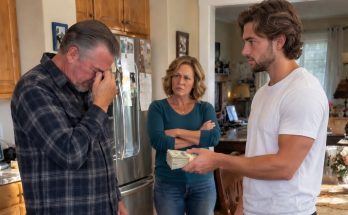
I pressed a hand against the wall.
Power of attorney.
After Robert died, I had signed papers naming Stuart as my agent if I ever became incapacitated.
But I was nowhere near incapacitated.
“The house should sell quickly,” Stuart continued. “The market in this neighborhood is hot right now. We could easily get 700,000, maybe more.”
“And once we pay for the Cedar Grove entrance fee and set aside enough to cover her monthly care, the rest is ours,” Jennifer added. “We could finally renovate our kitchen and take that European vacation.”
My knees weakened.
They weren’t worried about me.
They wanted my home of 40 years to finance their kitchen and European vacation.
“What about her pension?” Jennifer asked.
“It’s decent for a teacher,” Stuart replied. “About 4,000 a month. Not enough to maintain this place, but more than enough for her basic needs at Cedar Grove. The excess can go toward Max’s college fund.”
I bit my lip to remain silent.
They had planned my entire future without me.
A small room at Cedar Grove while they spent the money from my home.
“We should start moving some of the valuable stuff out gradually,” Jennifer suggested. “The silver, the antiques. She probably won’t even notice.”
“Next week,” Stuart agreed. “I’ll tell her I’m taking some things to be appraised for insurance purposes.”
I had heard enough.
Moving more quietly than I knew I could, I retreated to the kitchen.
My hands shook as I filled the kettle and tried to process what I had overheard.
Twenty minutes later, I heard them preparing to leave.
I turned on the radio so they would know I was there.
Stuart appeared in the doorway, startled.
“Mom, I didn’t know you were home. Where’s your car?”
“In the shop,” I said calmly, stirring my tea. “Jane dropped me off after lunch.”
For a moment, he looked flustered.
“We just stopped by to check if you needed anything.”
“How thoughtful,” I replied, holding his gaze. “I’m fine, thank you.”
After they left, I remained at the kitchen table until my tea went cold.
The betrayal felt physical.
My own son was planning to have me declared incompetent, sell my home, and place me in a retirement facility.
That evening, I entered Robert’s study and opened his desk drawer.
Behind several old folders sat the small fireproof box where we kept important papers.
I unlocked it with trembling hands.
Inside were documents Stuart knew nothing about.
Robert had understood finances far better than our son realized.
Beyond the house, there were investment accounts, stock certificates, and insurance policies.
During our marriage, I had trusted Robert to handle those matters and simply maintained everything after his death.
Now I spread the papers across his desk and started calculating.
My teacher’s pension was indeed about $4,000 a month, but Robert’s investments had grown significantly.
Altogether, I had nearly $1 million in assets, excluding the house.
I wasn’t a helpless old woman relying on my son.
I was financially independent.
The next morning, I scheduled an appointment with my bank’s financial adviser.
Then I called Martha Reynolds, a realtor I had known for years after teaching her children.
“Inz, what a lovely surprise,” Martha exclaimed when I walked into her office. “What can I do for you today?”
I inhaled.
“I’d like to sell my house, Martha. Quietly and quickly.”
Her eyebrows rose.
“Your beautiful Victorian? But you’ve lived there forever.”
“It’s time for a change,” I said firmly. “And Martha, I’d appreciate your discretion. I don’t want my son to know until it’s done.”
Confused, she nevertheless nodded.
“Of course, Inz. It’s your house. We can list it privately first. Minimize the publicity.”
Leaving her office, I felt something I hadn’t felt in years.
Power.
For too long, I had let Stuart control our relationship and make me feel insignificant.
I had tolerated his and Jennifer’s barely hidden contempt.
No more.
They believed I was a weak old woman they could manipulate.
They were about to learn otherwise.
For the next week, I lived two lives.
Outwardly, nothing changed. I shopped for groceries, attended book club, and politely answered whenever Stuart called to check on me.
Behind that facade, I was carrying out a plan that would change everything.
Martha privately listed the house.
Within 3 days, she called with remarkable news.
“Inz, you won’t believe this. I have a couple, the Hendersons, who’ve been looking for a historic Victorian in this neighborhood for months. They saw your house and fell in love. They’re offering full asking price, all cash, with a flexible closing date.”
I gripped the phone.
“That’s… that’s wonderful, Martha.”
“They’d like to see it again tomorrow if that works for you. And Inz, they don’t want to change a thing about it. They love the original woodwork, the stained glass, everything.”
Tears filled my eyes.
Robert had spent years restoring those Victorian details, stripping old paint from the banisters and repairing cracked stained glass.
Knowing the new owners appreciated his work made leaving easier.
“Tomorrow afternoon would be perfect,” I told her. “Stuart never visits on Wednesdays.”
Afterward, I sat at the kitchen table with my tea, considering my next move.
I needed somewhere Stuart wouldn’t immediately think to find me.
I opened my address book to R.
Rose Tillman, my college roommate, now lived in a retirement community in Florida.
We stayed in touch through Christmas cards and occasional calls.
I hadn’t seen her since Robert’s funeral, but a few months earlier she had mentioned having a spare bedroom whenever I wanted to visit.
Before I could reconsider, I called.
“Rose, it’s Inz Morrison.”
“Inz, what a wonderful surprise. How are you, dear?”
I hesitated over how much to reveal.
“I’m… I need a change, Rose. I remember you mentioned having a spare room.”
“Say no more,” Rose interrupted warmly. “The room is yours for as long as you want it. Sunshine Village is a lovely place. You’ll fit right in. When can I expect you?”
“How about 3 weeks from now? I need to tie up some loose ends here first.”
After our call, I listed everything left to do: arrange movers for what I wanted to keep, decide what to donate, forward my mail to a P.O. box, and move my banking to national institutions accessible from anywhere.
I also needed to update my will.
The house Stuart and Jennifer wanted so badly would soon be gone, and they wouldn’t receive the proceeds.
The following day, the Hendersons returned.
They were a pleasant couple in their 40s with two teenage children.
Watching them admire the craftsmanship and ask thoughtful questions about the house’s history made me even more confident.
“We can close in 2 weeks if that works for you,” Mr. Henderson said as they prepared to leave. “Our lease is up at the end of the month and we’re eager to move in.”
“2 weeks would be perfect,” I replied, surprised by the steadiness in my voice.
That evening, Stuart called.
“Mom, Jennifer and I are coming over for dinner on Sunday. There’s something important we want to discuss with you.”
I already knew what that discussion would be.
Cedar Grove, undoubtedly, complete with brochures and gentle pressure.
“That sounds lovely,” I said, adding warmth to my voice. “I’ll make your favorite pot roast.”
“Great. And Mom, maybe don’t mention it to the kids yet. This is more of an adult conversation.”
Of course.
They didn’t want my grandchildren watching them convince me I was incapable of living independently.
After the call, I scheduled the movers for the day after closing.
Then I arranged to donate most of my furniture to a local women’s shelter.
Finally, I booked an appointment to close my local bank accounts the day before leaving town.
With every step, the plan became more real and irreversible.
During quiet evenings, doubts sometimes surfaced.
Was I overreacting?
Was I treating Stuart unfairly?
Then I remembered the turkey and gravy across my blouse, and everyone watching my humiliation in silence.
I remembered Stuart and Jennifer calmly planning to take my house.
No.
I wasn’t overreacting.
I was finally defending myself.
Sunday came, bringing Stuart and Jennifer with a bottle of wine and forced smiles.
I served the pot roast I’d promised, chatting casually about the weather and Jennifer’s garden club.
After dessert—apple pie Stuart barely touched—he cleared his throat.
“Mom, we’ve been concerned about you living in this big house all alone.”
I slowly chewed another bite.
“Oh, we’ve been looking into some options,” Jennifer chimed in, reaching into her purse. “There’s a wonderful community called Cedar Grove. It’s not a nursing home,” she added quickly. “It’s a luxury retirement village with different levels of care.”
She pushed a glossy brochure toward me.
Smiling seniors played golf and relaxed in an elegant lounge on the cover.
“They have an opening next month,” Stuart said. “We’ve already put down a refundable deposit to hold it for you.”
I picked up the brochure and pretended to study it.
“That’s thoughtful of you.”
“It makes financial sense, Mom,” Stuart continued, encouraged by my response. “This house is worth a lot of money, but it’s a money pit in terms of maintenance. At Cedar Grove, everything would be taken care of for you.”
“And you’d have company,” Jennifer added. “Other people your age.”
I nodded thoughtfully.
“And what about the house? What would happen to it?”
They exchanged a quick glance.
“We’d help you sell it, of course,” Stuart said smoothly. “The proceeds would pay for Cedar Grove and give you a nice nest egg.”
“I see,” I said quietly. “Well, I appreciate you thinking of me. Let me consider it.”
They seemed surprised and delighted by my cooperation.
As they left, Stuart squeezed my shoulder.
“You’re making the right decision, Mom. You’ll be happier there. You’ll see.”
I smiled from the porch as their car disappeared.
They had no idea that in 10 days, the Hendersons would own this house and I would be heading toward a new life without Stuart, Jennifer, or Cedar Grove.
The next two weeks became a blur of quiet preparation.
Every day, I methodically prepared to leave while keeping everything outwardly normal.
Each morning before dawn, I spent an hour sorting through 65 years of belongings.
I was surprised by how little I truly needed.
My wedding china, carefully preserved for decades, would eventually belong to Lily—not become part of Stuart and Jennifer’s kitchen renovation.
I arranged storage with a trusted book-club friend.
Closing was scheduled for Thursday.
On Tuesday, I visited Benjamin Lewis, the attorney who had handled Robert’s estate.
“This is quite a change, Inz,” Benjamin said after hearing everything. “Are you sure about this?”
“More sure than I’ve been about anything in years,” I replied firmly.
He nodded and took notes.
“And you want to update your will to remove Stuart as a beneficiary?”
“Not completely,” I clarified. “I’m setting up a trust for my grandchildren’s education. But Stuart and Jennifer will no longer be primary beneficiaries.”
Benjamin looked up seriously.
“You know they could contest this, claiming you’re not of sound mind.”
I smiled thinly.
“That’s why I’d like you to arrange for an independent psychological evaluation today, if possible.”
By Wednesday evening, I had a notarized letter from a respected geriatric psychiatrist confirming my mental competence.
My will was updated.
Closing was the next morning, and nearly everything I owned had been packed for Florida, donated, or placed into storage.
I walked through my home one final time, touching familiar wallpaper and remembering the life Robert and I had built.
Christmas mornings with young Stuart opening presents by the fireplace.
Dinner parties filled with laughter.
Robert’s final days upstairs, holding my hand while we said goodbye.
In the master bedroom, I opened my jewelry box and removed the locket Robert had given me on our first anniversary.
Inside was a tiny photograph of us, young and smiling.
I fastened it around my neck.
Downstairs, I opened Robert’s desk and removed his small leather journal.
I had found it after his death but never read it, believing it too private.
Now I sat in his chair and opened a random page.
October 15th, 1995.
Stuart brought home another failing grade today. Inz spent hours helping him with his homework while I was at the office. She has infinite patience with him, more than I could ever muster. I worry about the boy. At 16, he shows little ambition beyond what benefits him immediately. Inz says he’ll grow out of it, but I see a selfishness in him that troubles me deeply.
I turned ahead several years.
June 3rd, 2005.