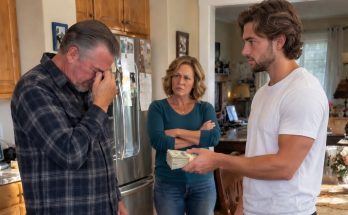
Stuart and Jennifer announced they’re buying a house far beyond their means. He hinted, not subtly, that he expects us to help with the down payment. Inz wants to give them the money. It’s what parents do, she says. But I wonder if we’re enabling behavior that will only get worse. I agreed to the loan, but I’ve documented it properly, despite Inz thinking that unnecessary. Stuart needs to learn financial responsibility sometime.
My throat tightened.
Robert had recognized what I refused to see.
Stuart’s entitlement.
His expectation that we would always rescue him.
I closed the journal and packed it.
Some truths hurt, but still need to be faced.
Thursday morning was bright and clear.
I dressed carefully in an old blue suit I rarely wore.
It felt appropriate for signing away the home where I had spent four decades.
Closing was smooth.
The Hendersons were excited and the lawyers efficient.
When everything was finished, Mrs. Henderson handed me a sealed envelope.
“We wanted you to have this,” she said warmly. “A small token of our appreciation for entrusting us with your beautiful home.”
Inside was a handwritten note thanking me and promising to cherish the house, along with a gift certificate to a local nursery.
“For your next garden, wherever it may be,” the note read.
I returned to the house—no longer mine—to complete my preparations.
The movers would arrive the next morning for the few pieces of furniture and boxes coming with me.
A rental car sat in the driveway, ready for my trip to Florida.
While checking the closets, my phone rang.
Stuart.
“Mom, I was thinking of stopping by tonight. Maybe we could discuss the Cedar Grove situation some more.”
I kept my tone casual.
“I’m afraid tonight’s not good, dear. My book club is meeting late. How about Sunday dinner instead?”
“Perfect,” he said, sounding pleased. “Jennifer found some great resources about transitioning to retirement living. We’ll bring those along.”
“That sounds lovely,” I replied. “I’ll see you Sunday at 5.”
I ended the call and looked around the increasingly empty house.
By Sunday at 5, I would be halfway to Florida while Stuart stood on the Hendersons’ porch, finally facing the consequences of his choices.
That evening, I walked through every room one last time.
The kitchen where I’d cooked thousands of family meals.
The living room where we celebrated birthdays and Christmases.
The bedroom where Robert and I shared our life.
I wasn’t simply leaving a house.
I was leaving decades of memories.
But the best parts weren’t staying behind.
I was carrying them with me.
As darkness settled, I sat on the porch swing listening to its familiar creak and watching fireflies appear in the garden.
Peace washed over me.
Tomorrow would be a new beginning.
My phone chimed with Rose’s message.
All ready for your arrival. Weather is beautiful here. Can’t wait to see you.
I smiled and replied.
Looking forward to it. Will call when I’m on the road.
Nobody else knew my plan—not my book-club friends, former colleagues, or neighbors.
I would write after settling in.
For now, I wanted my departure to be as quiet as Stuart and Jennifer’s plans for me had been.
As the evening cooled, I went inside for one last cup of tea in the kitchen that would soon belong to another family.
While the kettle whistled, I caught myself humming, something I hadn’t done in years.
Tomorrow, for the first time in decades, I would answer only to myself.
The idea was both frightening and exhilarating.
But beneath the anxiety, something stronger grew with every passing hour.
Hope.
Friday morning brought soft sunlight through my bedroom windows—technically the Hendersons’ windows now.
Despite it being my final night there, I had slept surprisingly well.
Perhaps because, for the first time in years, my life truly felt like mine.
The movers arrived promptly at 8.
Two young men quickly loaded the few possessions I had kept.
My reading chair, my grandmother’s small writing desk, three boxes of books, and five boxes of personal belongings.
Everything else had been donated, given away, or stored.
“Is that really all, ma’am?” one mover asked, puzzled by the small load.
“That’s all,” I confirmed with a smile. “I’m downsizing quite dramatically.”
By 10:00, they were gone, taking everything to a storage facility in another town until I requested delivery.
I deliberately chose somewhere 2 hours away, a place Stuart was unlikely to search.
I walked through the empty rooms one last time, checking for anything forgotten.
In the kitchen, I left the Hendersons a bottle of wine and a note wishing them happiness.
On the mantel, I placed a sealed envelope addressed to Stuart.
Inside was a short message.
Stuart, by the time you read this, I will be gone. I have sold the house and moved away. Please do not try to find me. When I am ready, I will contact you. I know about your plans for Cedar Grove. I know about your intentions to sell my home without my consent. I know everything. I raised you better than this. Mom.
Brief and direct.
No accusations or emotional outbursts.
Only facts.
He would understand exactly why I left.
At noon, I looked around once more, locked the door, and left the key beneath the mat for the Hendersons as arranged.
My rental car held only a suitcase, road snacks, and a small bag containing medications, important papers, and Robert’s journal.
Backing out of the driveway brought a wave of emotion.
40 years of memories lived inside that house.
Raising Stuart.
Loving Robert.
Building our life.
But the house was no longer my life.
It was only a building, now belonging to another family who would fill it with their own memories.
My first stop was the bank, where I closed my remaining local accounts and collected a cashier’s check for the house proceeds.
Combined with my other assets, I now had more than enough secured beyond Stuart’s reach to live comfortably for the rest of my life.
Then I went to the post office to forward my mail to a Florida P.O. box.
The clerk smiled while processing the form.
“Moving somewhere warm for retirement?” she asked conversationally.
“Something like that,” I replied, not elaborating.
My final stop was the cemetery.
I hadn’t told Robert about leaving, which felt strange.
For 5 years, I had regularly visited his grave, telling him about my days, worries, and small victories.
He had been my confidant in life, and I continued talking to him after his death.
I placed yellow roses—his favorite—beside the headstone.
“I’m leaving, Robert,” I said softly. “Not just the house, but Stuart, too. I know you would understand.”
I touched the cold stone.
“You saw what he was becoming long before I did. I was too busy making excuses for him, enabling him.”
A light breeze stirred the trees, and I chose to take it as Robert’s approval.
“I’m not sure when I’ll be back, but I’ll always carry you with me.”
My fingers touched the locket around my neck.
“Wish me luck.”
By 2:00, I was driving south on the interstate with Rose’s Florida address programmed into the GPS.
Every mile away from my old life made me feel lighter.
I had never been adventurous.
Teaching elementary school in the same town for 35 years hardly made me a thrill-seeker.
But at 65, I was beginning the boldest adventure of my life.
I imagined Stuart arriving Sunday.
He and Jennifer would pull into the driveway at 5, expecting me to be making dinner and ready for another Cedar Grove discussion.
Instead, strangers would answer the door and hand him my letter.
How would he react?
Anger, certainly.
Disbelief, probably.
Maybe concern—though likely more for his lost inheritance than for me.
I pushed those thoughts aside.
Stuart’s feelings were no longer my responsibility.
For decades, I had placed his needs, wants, and convenience before mine.
I built my life around being available to him even as his respect for me disappeared.