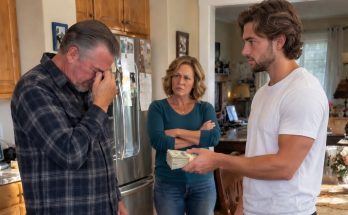
I stood frozen as gravy ran down my favorite blue blouse, the one I had carefully ironed that morning. Stuart’s words hung in the sudden silence.
My hands shook as I tried wiping the mess with a napkin far too small for it.
I’m Inz Morrison, 65, a retired elementary school teacher who spent 35 years shaping young minds, a widow for 5 years, and apparently a useless old woman according to my own son.
Thanksgiving dinner had been perfect until then.
I’d spent three days preparing everything—baking pumpkin and pecan pies from scratch, hand-rolling dough for my famous cranberry tarts, and roasting a 20 lb turkey until golden.
The table gleamed with my late mother’s china and crystal glasses reserved for special occasions.
Stuart had been drinking since arriving with Jennifer, his wife of 15 years. I noticed his slight sway and overly loud laugh but said nothing.
I never commented on his drinking anymore. Not since Christmas 5 years ago, when he told me to stop nagging.
“Mom, when are you going to sell this ridiculous house?” Stuart had asked suddenly halfway through the meal. “It’s way too big for just you.”
“I’m not planning to sell,” I replied quietly, passing the mashed potatoes to my granddaughter, Lily. “This is my home.”
“It’s impractical,” Jennifer chimed in, her voice sweet, but her eyes cold. “Think of the maintenance, the property taxes. At your age, you should be downsizing.”
“At my age?” I repeated, feeling a familiar tightness in my chest. “I’m only 65, not 95.”
Stuart snorted. “You can barely take care of yourself. Last week, you couldn’t even remember where you put your glasses.”
“They were on my head,” I admitted with a small laugh, trying to lighten the mood. “That happens to everyone.”
“Not to everyone,” Jennifer said. “Just people who should consider assisted living options.”
I put down my fork, suddenly unable to eat.
“I’m not going to any nursing home. I’m perfectly capable of living independently.”
“For now,” Stuart muttered. “But let’s be realistic. Dad left you this house, but he didn’t leave you the means to maintain it forever. Your teacher’s pension isn’t going to cover everything indefinitely.”
That wasn’t true.
Robert had left me financially comfortable, with investments Stuart knew nothing about. I kept that to myself. I rarely discussed money with him because it seemed to be the only thing he genuinely valued.
“I was thinking,” I said instead, trying to change the subject. “Maybe we could all go see the Christmas lights in the park next weekend. They’re doing a special display this year.”
“Christmas lights?”
Stuart laughed sharply.
“Mom, are you even listening? We’re talking about your future here. Our future. This house is the only real asset you have.”
“My future is not up for discussion at Thanksgiving dinner,” I said firmly. “Now, who wants more cranberry sauce?”
That was when it happened.
Stuart’s face turned alarmingly red. He shot up so fast his chair crashed backward, startling everyone.
Before I could react, he grabbed the platter holding the remaining turkey and hurled it toward me.
“Go back to the nursing home, you useless old woman!” he shouted, his voice slurring slightly. “You’re nothing but a burden to everyone.”
The turkey struck my chest, leaving gravy, stuffing, and meat across my blouse and lap. The china platter clattered to the floor without breaking.
The table went silent.
My grandchildren, Lily and Max, stared wide-eyed, their forks frozen in midair.
Jennifer didn’t look shocked.
She looked amused, one corner of her mouth lifting.
Nobody helped me.
Nobody challenged Stuart.
Gathering what dignity I had left, I slowly stood, clutching the napkin in my trembling hand.
“Excuse me,” I whispered, my voice barely audible. “I need to change.”
As I walked away, Jennifer said softly, “See, she can’t even handle a little family discussion without falling apart.”
Inside my bedroom, I removed the ruined blouse and sat on the bed.
I didn’t cry.
The tears simply wouldn’t come.
Instead, an eerie calm settled over me.
I changed into a clean sweater, washed my face, and returned downstairs.
They had resumed eating as though nothing had happened.
Stuart had refilled his wine. Jennifer checked her phone beneath the table. Only my grandchildren seemed uncomfortable, refusing to meet my eyes.
I sat down and picked up my fork.
“Who wants dessert?” I asked with a smile that didn’t reach my eyes.
That night, after everyone left, I stood in the kitchen among dirty dishes and leftovers.
The house felt emptier than it had even during the 5 years since Robert died.
I picked up a framed photograph of Stuart as a little boy, smiling gap-toothed in my arms.
“What happened to you?” I whispered to the image of my son. “When did you start seeing me as nothing but a house and a bank account?”
I didn’t have an answer.
But I knew one thing.
Something inside me had broken that day, something polite smiles and pretending could no longer repair.
For the first time, a cold determination formed inside me.
I would never let anyone humiliate me that way again.
Not my son.
Not anyone.
A week after the Thanksgiving disaster, I was still moving through my days in disbelief.
The image of gravy running down my blouse while Stuart’s words echoed around the dining room kept replaying in my head.
I barely slept or ate.
The betrayal hurt more deeply than I wanted to admit.
That Tuesday afternoon, I was dusting the living-room shelves when the front door opened.
I wasn’t expecting anyone, but Stuart still had the emergency key I’d given him years earlier.
I tensed, not ready to see him.
Instead of coming toward me, however, I heard him and Jennifer whispering in the foyer.
“I don’t think she’s home,” Jennifer said. “Her car’s gone.”
My car was only at the shop for routine maintenance. A neighbor had dropped me home after lunch.
“Good,” Stuart replied. “I need to check something in Dad’s old office anyway.”
I froze behind the wall separating the living room from the entryway.
My heart pounded as they headed toward Robert’s study, a room I had kept largely unchanged since his death.
It had become my sanctuary, filled with his books and the lingering scent of pipe tobacco.
I quietly moved closer to the hallway, staying hidden.
Their voices carried clearly from the study.
“The sooner we get her into Cedar Grove, the better,” Jennifer was saying. “My cousin says they have an opening next month in their assisted living wing.”
Cedar Grove.
The expensive retirement community outside town.
I had passed it many times but never imagined living there.
“Mom won’t go willingly,” Stuart replied. “You saw how she reacted at Thanksgiving.”
Jennifer laughed softly.
“Well, your little turkey tantrum didn’t exactly help the cause, did it?”
“I lost my temper,” Stuart said defensively. “But you have to admit she’s getting worse. The forgetfulness, the stubbornness.”
“We just need to document the incidents,” Jennifer said in a practical tone that chilled me. “Dr. Campbell is on board to help evaluate her. Once we establish diminished capacity, the power of attorney kicks in.”