Then I requested that the hospital preserve the clothing with the rest of the evidence instead of sending it home with me.
Late that afternoon, Denise came back with a police officer whose badge kept catching the fluorescent light.
I gave my statement without guessing about the seconds I had not witnessed, and I separated what I had seen from what my family had admitted afterward.
The officer asked whether Vanessa had ever hurt Emma before.
“No.”
“Had she treated the children differently?”
I remembered birthday dinners where Lily opened presents first, sleepovers Emma was too young to attend even after Lily had been allowed at the same age, and the small rules that always seemed to bend in one direction.
I gave him the examples and stopped before turning them into motives I could not prove.
He asked about the seat.
At my parents’ house, Lily had a booster chair at the smaller breakfast table, although both girls used whichever chair was open when we ate outside or ordered pizza in the living room.
That morning was the first time anyone had treated the chair like a boundary worth enforcing.
The officer wrote that down.
Around four, Vanessa sent a longer message.
She claimed Emma had run behind her while she carried the pan from the stove, causing her to turn too quickly and lose her grip.
The explanation contradicted Mom’s statement that Vanessa had been moving Emma back to my table.
I replied with one sentence.
“Do not contact me again except through the investigator.”
Vanessa answered anyway.
“You know how impulsive Emma gets when she is excited.”
I took screenshots and blocked her number.
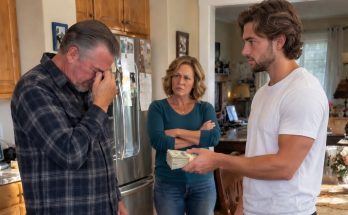
The next morning, Dad came to the hospital alone.
Security called upstairs, and I agreed to meet him in a consultation room away from Emma.
He carried the pink cup from breakfast inside a grocery bag.
“I thought she might want this,” he said.
I left it inside the bag.
Dad smelled like the peppermint gum he chewed while driving, and he kept rubbing his thumb across a scratch in the table instead of looking at me.
“Tell me what you saw.”
He said Vanessa had been standing beside Lily when Mom told her to put Emma back where she belonged.
He said Vanessa picked up the skillet, stepped toward Emma, and told her that taking another child’s place was not cute.
“What happened next?”
Dad pressed his lips together.
“She swung her arm.”
“Did the pan slip?”
“No.”
The word was quiet.
I asked why he had picked up the cup instead of helping Emma.
He stared at the grocery bag.
“Your mother told me not to make the room look worse when people arrived.”
“Who was arriving?”
“No one yet.”
He admitted rinsing the pan after I drove away, then drying it and putting it beneath the stove because Mom said Lily should not have to see it.
I opened the consultation room door and called Denise.
Dad stepped backward.
“I came here to explain this to you, not to make a police statement.”
“You cleaned the pan after your granddaughter was carried out unconscious.”
“Your mother was panicking.”
I asked Denise to bring the officer’s contact information, and Dad left before she returned.
For several hours, his admission felt like the first solid thing I had been given.
Then the officer called and told me Dad had denied saying Vanessa swung the pan.
According to his new statement, he had been near the sink and only heard the crash.
He admitted moving the cup but denied touching the skillet.
The room tilted even though I was sitting down.
I wrote everything Dad had told me while the order of his sentences was still clear, but my notes could not turn his private admission into an independent witness statement.
Something I had gained was gone again.
That evening, Lily called from Dad’s phone.
I answered because I saw his name and expected another correction.
Instead, Lily whispered, “Aunt Rachel?”
I walked into the hallway so Emma would not wake.
“Where are you?”
“In Grandpa’s room.”
“Are you safe?”
“Yes.”
She asked whether Emma would still want to play grocery store with her.
I said Emma loved her and none of this was Lily’s fault.
Lily breathed against the phone.
“Mommy told her to get up, and Grandma said make her because you were coming back.”
A door opened on Lily’s side.
The call ended.
I gave the call time and exact words to Denise, who notified the investigator and requested that Lily be interviewed away from the adults who had been discussing the incident around her.
By morning, my mother had sent a message accusing me of frightening Lily with questions.
I had asked her three.
Where are you, are you safe, and would Emma still play with her.
I forwarded that message too.
The hospital vending machine took a dollar without dropping the crackers, and I pressed the return button six times before walking away.
Near noon, Mom emailed an offer to pay every medical bill, every follow-up appointment, and any time I missed from work.
The offer required me to tell the investigator that I believed the injury had been accidental.
She called it a way to protect both girls from a public family conflict.
I forwarded the email without replying.
The investigator later told me the offer mattered because it showed the family understood my original statement created consequences they wanted changed.
It did not prove who had thrown the pan, but it changed how Mom’s later explanations were read.
The pressure shifted after that.
Vanessa stopped sending apologies and began sending practical instructions through Dad, including the name of a lawyer and a request that Emma’s medical records remain private.
Mom removed me from the family message thread, then emailed to say she had done it for my peace.
I saved the email.
Two days after the injury, Lily gave an initial statement with my parents nearby and said the pan had fallen.
The investigator warned me that a second interview might not happen quickly because children should not be questioned repeatedly without safeguards.