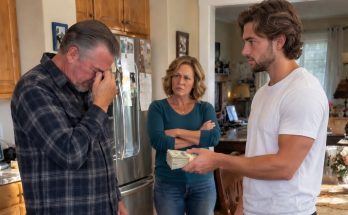
I understood the rule and hated the delay.
Emma underwent another examination that afternoon.
I held a straw to her mouth while the doctor checked the swelling, and she drank three sips before turning away because the water tasted like the paper cup.
When the examination ended, she asked for her yellow sweatshirt.
I told her the hospital was keeping it safe.
“Because it has syrup?”
“Because it was with you.”
She accepted that and asked me to draw a cat on the back of the meal receipt.
Mine looked like a square with ears.
She laughed once, then touched her cheek and stopped.
Before discharge, the hospital helped me request an emergency protective order against Vanessa and provided records supporting temporary restrictions on contact with Emma.
The first order did not include my mother because her messages could still be framed as instructions to move a child rather than cause an injury.
It felt like reaching a locked door with half the correct key.
I took Emma home five days after breakfast.
She wore a soft gray hood because sunlight bothered her, and I carried her past the kitchen without asking whether she wanted food.
For the first night, she slept beside me with the hall light on.
My phone stayed face down on the dresser, but every vibration woke me.
Nothing came from Vanessa.
Dad sent a photo of Emma’s shoes by the front door at my parents’ house and asked where he should leave them.
I told him to give them to the investigator with anything else removed from the kitchen.
He did not answer.
For several days, that seemed like the shape of the ending.
Emma was home.
Vanessa could not contact her.
My mother remained outside the order, Dad had withdrawn his account, and Lily’s only formal statement called the impact an accident.
The investigation was open, but the facts appeared divided between messages that hinted and witnesses who retreated.
I filled prescriptions, scheduled follow-up visits, and learned which side of Emma’s bed let me help her sit without pulling at the dressing.
Sometime that week, she ate half a banana while watching a cartoon about a bus that had lost one wheel.
She left the other half on the blue plate and asked whether buses got headaches.
I said probably not.
The second interview with Lily happened the following week under conditions arranged by the child-protection team.
Neither Vanessa nor my parents were in the room.
I was not there either.
The investigator called afterward and asked me to come to the station without Emma.
I arranged for Marisol’s sister, whom Emma had met twice during discharge planning, to sit with her in the hospital family room during a follow-up visit.
At the station, the investigator placed no recording in front of me and gave no dramatic warning.
He read from his notes.
Lily had said Emma sat down because her own plate was on the larger table and she thought the smaller table was for children.
Vanessa told her to leave Lily’s seat.
Emma reached for another bite of eggs.
Mom told Vanessa, “Make her understand before Rachel comes back.”
Vanessa lifted the pan from the stove, carried it three steps, and swung it toward Emma while saying, “You do not take what belongs to Lily.”
Lily said the pan struck Emma before hitting the floor.
After I carried Emma outside, Mom told Dad to rinse the pan and told Lily that it had slipped.
The investigator said Lily demonstrated the movement more than once and corrected the interviewer when the interviewer described it as dropping.
“She said it did not drop,” he told me.
I put both hands beneath the table because my nails were cutting into my palms.
“What happens now?”
He said Lily’s statement would be considered with the texts, the medical evidence, my mother’s offer to pay for a changed account, and Dad’s inconsistent versions.
No single piece had to carry the entire case anymore.
Two days later, Dad returned to the investigator and gave a recorded statement.
He admitted that his first account to me had been accurate and that Mom had asked him to withdraw it because Vanessa could lose access to Lily during the investigation.
He also admitted washing the pan.
I listened only to the summary.
The county filed charges against Vanessa related to the assault and the danger created for a child, while investigators referred my mother’s actions for separate review because of the instruction, cleanup, and attempts to change witness accounts.
The court extended the no-contact order protecting Emma and added my mother after reviewing the new evidence.
The order did not repair Emma’s face, restore the week she lost, or make Lily’s home simple.
It created distance.
I used it.
Dad asked whether telling the truth in the end meant he could visit Emma.
I said no.
He had watched her leave without shoes, cleaned the kitchen, reversed his statement, and returned only after Lily spoke without him in the room.
His final honesty belonged in the case file, not in Emma’s recovery.
Months later, Emma still asked before sitting in unfamiliar chairs.
At preschool, her teacher let her pick a place during snack instead of assigning one, and she began choosing the end of the table where she could see the door.
Her scar changed slowly, and the doctors avoided promises about what it would look like later.
I did the same.
When she asked whether Aunt Vanessa had thrown the pan because she was bad, I told her Vanessa had done something dangerous and adults were handling the consequences.
Emma considered that while peeling the paper from a purple crayon.
“Grandma told her to?”
“Yes.”
She nodded once and returned to her drawing.
I stopped attending family breakfasts, stopped carrying messages between relatives, and stopped treating silence as neutrality.
The case was still moving when Emma returned to preschool, and I stopped asking my parents for updates.
At home, she began eating breakfast beside me again.
The extra seat now holds her paint box.