She accidentally texted a billionaire asking for fifty dollars to buy baby formula. What he did next changed three lives forever.
It was eleven forty-seven at night on New Year’s Eve, and Clara Simmons was not watching the countdown.
She was standing in the middle of her studio apartment in the Bronx, holding her eight-month-old daughter against her chest, bouncing gently with the desperate, mechanical rhythm of a mother who has run out of everything except the will to keep going. Lily had been crying for forty minutes. Not the soft, sleepy fussing of a baby who needs a diaper change. The hard, hitching wail of a baby who is hungry.
The formula canister on the kitchen counter was empty. Clara had already turned it upside down and tapped it twice, the way you shake a salt shaker when you know it is gone but cannot quite accept it yet. A thin white dust had settled on the counter. That was all that was left.
Her checking account had four dollars and eleven cents in it. She knew this without looking because she had checked it seventeen times since Thursday.
Outside, the neighborhood was loud with the anticipation of a new year. Horns, laughter, a television turned up too high through the wall. The world was celebrating and Clara was standing in her dim apartment under a flickering overhead bulb with a hungry baby and an empty can and twelve days left before the eviction notice on her kitchen table became something she could not ignore anymore.
The stack of red-stamped envelopes had been sitting there for three weeks. She moved them to the counter to eat dinner. She moved them back to the table when she needed the counter. She had stopped reading them after the second one because reading them did not change what was inside.
She shifted Lily to her other shoulder and reached for her phone.
She needed to text Mrs. Evelyn.
Helen Evelyn was the woman who ran the small neighborhood shelter two blocks over, a warm, round woman with reading glasses always pushed up into her silver hair who had quietly helped Clara more times than Clara had ever said out loud. A bag of groceries slipped under the door. A ten tucked inside a birthday card with no name on it. Small kindnesses that arrived without fanfare, the way real kindness usually does.
Clara typed fast, one-handed, the way mothers learn to do everything.
Hi, it’s Clara from 4B. I hate to ask but Lily is crying and I don’t have anything left in the can. Could I borrow fifty dollars until Friday? I’ll pay you back the moment I get paid. I’m so sorry to bother you this late.
She hit send.
She kept bouncing Lily. The baby’s cries were slowing down slightly, shifting from fury to exhaustion, which was almost worse.
Three minutes passed.
Her phone buzzed.
She assumed it would be Mrs. Evelyn’s familiar warmth. It would say something like of course honey, come down now, or I’ll have my nephew bring something up. That was the kind of woman Helen Evelyn was.
Instead, the message read: Who is this?
Clara frowned. She typed back: Clara Simmons. From the building on Mercer Street. I’m so sorry if I have the wrong number, I thought this was Helen.
Another pause. Then: This isn’t Helen. But I heard you. What’s the address?
Clara stared at the screen.
She did not respond. Her first thought was that it was a drunk person texting on New Year’s Eve. Her second thought was that it was something worse. She put her phone face-down on the counter and kept bouncing Lily, who had quieted slightly but was making small, broken sounds against Clara’s shoulder that were somehow more heartbreaking than the full crying had been.
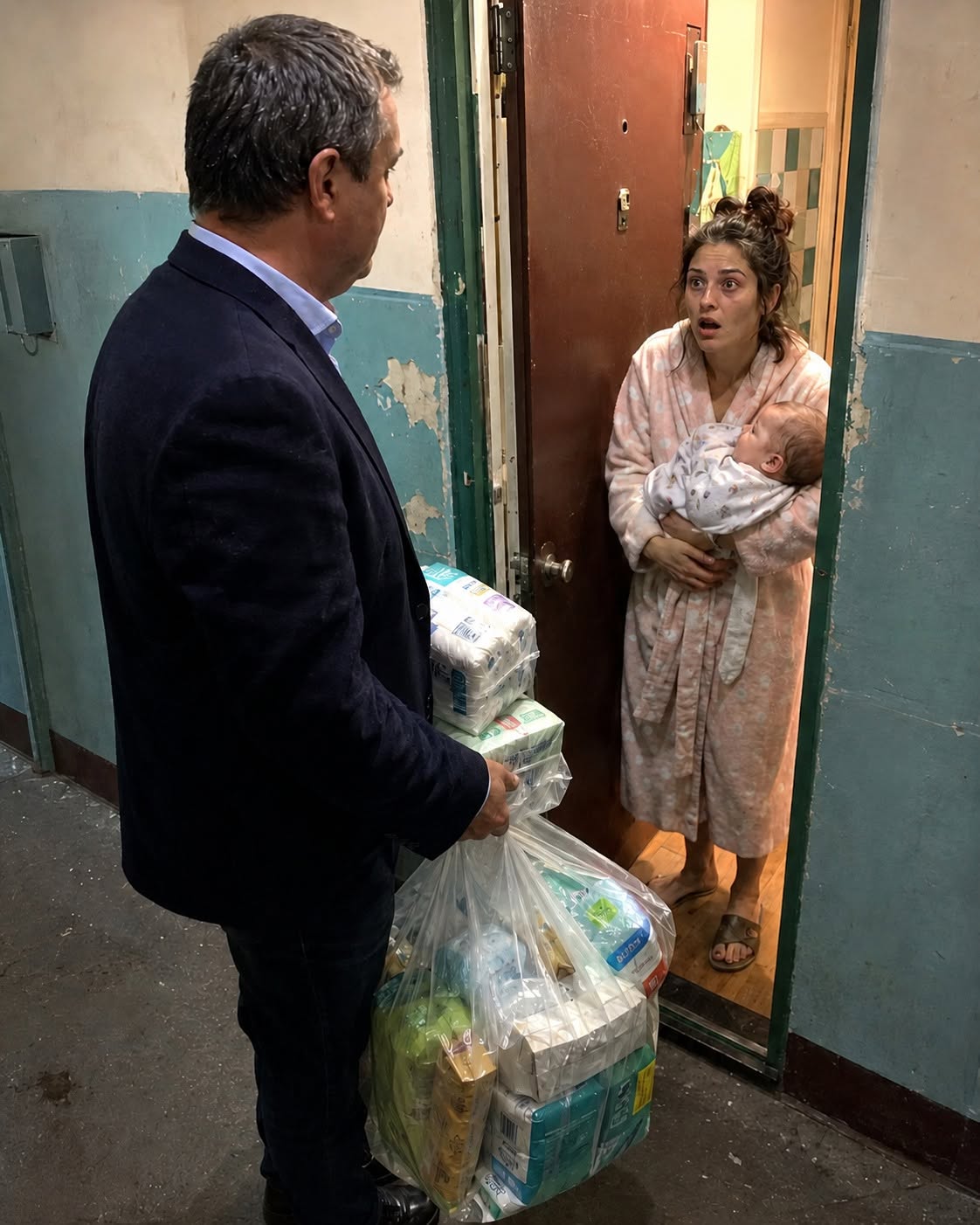
Twenty minutes later, there was a knock at her door.
Clara went still.

She was not expecting anyone. It was almost midnight. She had not buzzed anyone up and her building’s front door lock had been broken for two months, which was a complaint she had filed with the landlord four times without response, so really anyone could walk in from the street, which was exactly the kind of thought that flooded her mind as she stood three feet from the door with her baby on her hip.
She moved to the peephole.
The man in the hallway did not look like anyone she had ever seen in her building. He was tall, somewhere in his early forties, in a cashmere overcoat that probably cost more than her monthly rent. He was holding two large paper bags from what looked like an all-night pharmacy and a deli, and through the gap in one of the bags she could see the bright label of a formula canister.
She unlatched the chain, then stopped. The chain stayed on.
“Who are you?” she asked through the crack.
“My name is Ethan,” the man said. His voice was even and calm, the kind of voice that had learned to stay that way on purpose. “You texted the wrong number tonight. I got the message. I’m not here to frighten you. I brought the formula.”
Clara’s heart was hammering. The chain was between them and she held it with one hand and held Lily with the other and tried to think clearly, which is nearly impossible when your baby has been crying for an hour and a stranger is standing in your hallway with formula and an overcoat that costs more than your car.
“I didn’t tell you my address,” she said.
There was a pause. A short one. Then: “No. You didn’t. I had my assistant look up the number you texted from. That was a habit, not a right, and I realize how that sounds. I’m sorry.” He shifted the bags slightly and she could see his expression through the crack. He looked uncomfortable in the way that people look when they have done something technically effective but instinctively wrong. “I grew up in Queens. My mother couldn’t afford formula either. I couldn’t ignore the message.”
Clara looked at the bags. She looked at his face. She looked at Lily, whose small fist was curling and uncurling against her collarbone.
She unlatched the chain.
She stepped back into the dim warmth of the studio. He came in slowly, taking in the space without any visible judgment, though his sharp eyes moved over it in one efficient sweep the way people do when they are used to assessing things quickly. The flickering bulb. The bare counter. The red-stamped stack of envelopes on the table.
He set the bags down on the counter.
“Where’s her bottle?” he asked.
“The sink,” Clara said. Her voice came out smaller than she intended.
He did not hesitate. He shed the cashmere coat and laid it over the back of a mismatched chair. He rolled up his sleeves. He went to the sink, washed his hands, found the clean plastic bottle, opened the formula canister, and began measuring with a quiet efficiency that was completely out of place and somehow the most reassuring thing Clara had seen in months.
She stood in the middle of her apartment watching a stranger in a dress shirt make her daughter’s bottle under her broken light, and she did not know whether to cry or laugh or both.
When he handed her the warm bottle his expression was careful and soft. “Here. Feed her.”
Clara sank onto the sofa. She cradled Lily close and brought the bottle to her lips and the moment the nipple touched the baby’s mouth, the crying stopped.
The apartment went quiet.
Not empty quiet. Full quiet. The kind that rushes in after a long noise and feels like something physical. The only sound was the small, steady rhythm of Lily drinking, urgent at first and then slowing into the deep, satisfied pull of a baby who has finally gotten what she needed.
Clara closed her eyes. The tears came before she could stop them, fast and hot down her cheeks, and she did not try to stop them because she was too tired and too relieved and because no one was looking at her with pity. The man had moved to stand near the counter, giving her space, looking at the window.