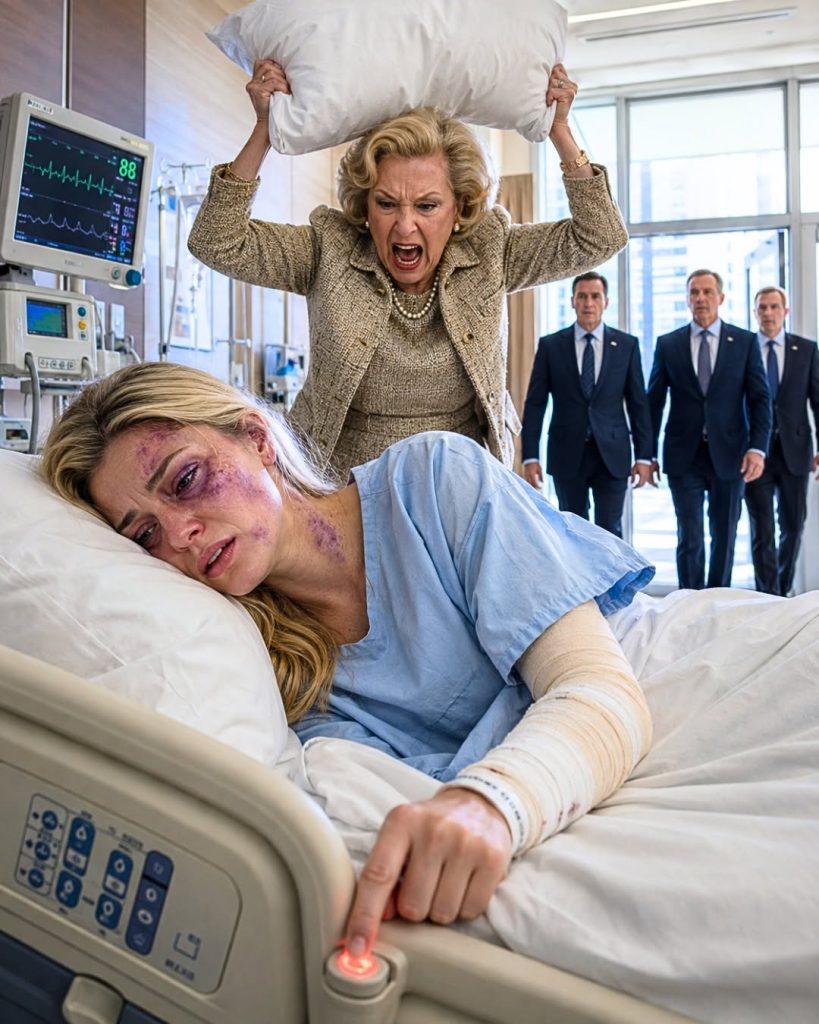
The pillow descended over my face like a white curtain, soft as mercy and heavy as murder.
Through the cotton pressed tightly against my nose and mouth, I could smell hospital detergent—sharp, sterile, unforgiving—mixing with the sweet, expensive cloud of Chanel No. 5. It was her perfume. For two years, I had suffocated beneath that scent at country club dinners and charity luncheons.
Tonight, the suffocation was literal.
Above me, my mother-in-law, Vivian Prescott, smiled as she tried to kill me.
“You should have died when you fell, you cheap little mistake,” Vivian whispered.
She leaned more of her weight into the pillow. The icy platinum edge of her diamond bracelet scraped against my bruised cheek. The metal felt brutally cold against my swollen skin, while inside my chest, my lungs began to burn.
“But I’ll finish it now,” she murmured, her voice low and almost musical, “so my son can finally be free of you.”
I could not fight her. I could not even lift my arms. My body was trapped inside a hard medical prison from collarbone to ankles. A full-body cast. Two cracked ribs. Three fractured vertebrae. One suspicious, almost fatal fall from the third-floor balcony of my own home.
The doctors called it a miracle.
The nurses said I was the luckiest woman in the trauma ward.
Vivian thought I was an inconvenience that refused to die.
My lungs screamed for air. My pulse hammered against the plaster encasing me, frantic and useless. The body’s first instinct when oxygen disappears is panic—to thrash, to claw, to fight.
I examined that instinct, recognized it as pointless, and shut it down.
I did not panic.
I did not move.
I held my breath with a calm that frightened even me.
For two years, Vivian had conducted a quiet war against me. She called me “charity in heels” to her friends. She viewed me as a former waitress who had somehow tricked her golden son, Adrian Prescott, into marrying beneath his bloodline.
At family dinners, she would lift her wineglass, look directly at me with her red, precise mouth, and say, “Some women are born to inherit silver, Hannah. Others are merely taught how to polish it.”
Adrian never defended me.
He would stare at his plate and mumble, “Mom doesn’t mean it that way, Hannah. She’s just old-fashioned.”
But the balcony changed everything.
Beneath the pillow, black sparks began dancing at the edges of my vision. Vivian pressed harder, her manicured fingers digging into the mattress beside my head.
“Goodbye, Hannah,” she breathed, trembling with excitement.
I lay inside the darkness and began to count.
One.
Two.
Three.
I needed her committed. I needed the sound of her breath, the pressure of her body, the unmistakable proof that this was not panic or accident.
Four.
Five.
Six.
The burn in my chest became a strange, heavy numbness. My fingers, the only part of me free from the cast, twitched against the bedsheet.
Seven.
Eight.
Nine.
At ten, my thumb curled inward and found the small rubber button hidden in my palm.
I pressed it.
Nothing happened.
No alarm. No flashing lights. No siren.
Only Vivian’s breathing, the pillow against my face, and the rush of blood in my ears.
For two terrible seconds, I thought the device had failed. I thought I had designed the perfect trap and stepped into it myself.
Then the heavy wooden door of my private hospital suite exploded inward with a deafening crash.
To understand why I ended up in a plaster tomb waiting for my mother-in-law to smother me, you have to understand the Prescott family.
They were old money. Not loud wealth. Not flashy wealth. The kind of wealth that owns land, names buildings, and assumes the world will bend before it. Adrian was the heir to a real estate empire: beautiful, polished, perfectly dressed, and weak all the way through.
I had been Hannah Blake before I married him. I was a forensic accountant for the state attorney’s office, trained to follow dirty money through shell companies, fake charities, and offshore accounts. I understood greed intimately.
I thought I understood Adrian.
I thought his weakness was gentleness.
I was wrong.
Our marriage didn’t collapse all at once. It eroded. Vivian’s insults became background noise. Adrian’s silence became habit. His need for approval became a third person in our marriage.
Then, three nights ago, everything failed.
We were standing on the balcony outside our bedroom at the Prescott estate, looking over manicured lawns and the dark line of trees beyond them. The night was cold enough to sting my skin.
Adrian paced in front of me, holding legal documents in one trembling hand.
“It’s just an adjustment,” he said. “My wealth manager says we should increase your life insurance policy to five million. Estate planning. Tax protection. Nothing dramatic.”
I leaned against the iron railing, arms folded. “I checked the numbers, Adrian. There is no liquidity issue. And I don’t need a five-million-dollar death benefit. Who are you protecting?”
“I’m protecting us,” he snapped. “Why do you have to audit everything? Why can’t you just sign a document like a normal wife?”
“Because I’m not a normal wife,” I said. “I’m someone who knows sudden life insurance increases often come before sudden deaths.”
It was a dark joke. The kind of joke someone makes after years of prosecuting fraud.
Adrian did not laugh.
He went still.
Then the French doors opened behind me.
Vivian’s voice floated out, smooth and lethal. “Adrian, darling? Is she making trouble again?”
I turned to look at her.
In that fraction of a second, Adrian grabbed my wrist and yanked.
I stumbled hard against the balcony railing.
It should have held. It was bolted into stone. It should have resisted my weight easily.
Instead, it screamed.
The entire section tore free and swung outward into the dark.
Gravity took me.
I remember the freezing air ripping past my face. I remember the stone patio rushing toward me. I remember twisting my body at the last instant, trying not to land on my skull.
The impact shattered the world into white pain.
When I woke in the ICU, the beep of a heart monitor was the only proof that I was still alive. Adrian sat beside my bed with his face in his hands, performing devastated husband perfectly.
Vivian stood next to him, stroking my fingers while nurses passed.
“My poor, clumsy daughter-in-law,” she whispered, dabbing dry eyes with a silk handkerchief. “She must have slipped. Such a tragedy.”
I could not speak. A breathing tube was taped to my mouth.
But my eyes were open.
And my mind went to work.