Part 2 of 2
I did not answer him.
I put Jude in his car seat, buckled him with shaking hands, and told Ivy to bring her coat.
Miriam followed us to the driveway.
“You’re going to embarrass yourself,” she said.
I remember the porch light humming above her.
I remember the small flag by our mailbox snapping once in the February wind.
I remember thinking that embarrassment was a strange thing to fear when my baby could barely breathe.
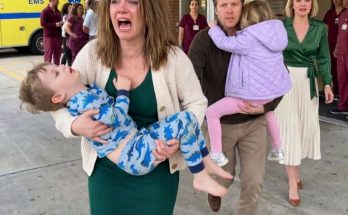
The ER intake desk was busy.
A toddler cried behind us.
Someone coughed into a sweatshirt sleeve.
I gave the nurse Jude’s age, temperature, symptoms, and medication history.
The form asked whether he had been given anything else.
I wrote, “Grandmother gave unknown herbal mixture.”
My hand shook when I wrote it, but I wrote it anyway.
That note mattered later.
Dr. Sterling came in after Jude was placed in a pediatric room.
He looked tired.
Not cruel.
Tired.
That is part of why what happened next stung so much.
He glanced at the monitor, checked Jude’s chart, and listened while Hunter explained that I had “a history of anxiety around the kids.”
Miriam stood beside him, nodding in gentle agreement.
I told the doctor Jude had been burning up all day.
I told him his behavior changed after I left him with Miriam.
I told him she admitted giving him an herbal mixture.
Dr. Sterling’s expression barely moved.
“New mothers often panic over nothing,” he said.
There are sentences that do not sound violent until they land on a woman already carrying too much.
Miriam smirked.
Hunter added, “She’s always overly anxious.”
The nurse by the IV line paused.
The monitor kept beeping.
Jude whimpered once, then went quiet again.
I had been dismissed in kitchens, bedrooms, hallways, and therapy offices, but hearing it beside my feverish child was different.
It burned through the last thread holding my politeness together.
Still, I said nothing.
I rocked Jude.
Then Ivy stepped out from behind my chair.
She was so small in that room.
Her coat sleeves hung over her hands, and Mr. Paws was pressed to her chest.
“Dr. Sterling,” she asked, voice shaking, “should I tell you what Grandma gave the baby instead of his real medicine?”
The room changed.
Dr. Sterling’s eyes moved from Ivy to Miriam, then down to the intake form where my note sat in black ink.
He crouched in front of Ivy.
“You can tell me what you saw.”
Miriam laughed too quickly.
“She’s seven. She makes up stories with that bear.”
Ivy did not look at her.
She looked at Jude.
“Grandma said Mommy’s medicine was poison,” she whispered. “She poured it in the sink.”
Hunter’s phone slipped lower in his hand.
The nurse turned toward the counter, picked up the chart, and opened the medication page.
Ivy swallowed hard.
“Then she gave him brown drops from the little bottle by her tea.”
Miriam’s face drained.
Dr. Sterling stood up.
“Call pediatric toxicology,” he told the nurse. “Now.”
Everything after that happened fast in the way emergencies do, with no room left for anybody’s pride.
The nurse documented the statement.
Dr. Sterling asked me for the pediatrician’s instructions again, and this time he listened.
Another nurse came in.
Jude was assessed more closely.
His breathing, pupils, hydration, temperature trend, and medication history were all written down in a way that made Miriam’s old confidence look suddenly thin.
Hunter turned toward his mother.
“What did you give him?”
She lifted her chin.
“A harmless family remedy.”
The doctor’s voice sharpened.
“What was in it?”
Miriam blinked.
“It was natural.”
“That is not an ingredient.”
For the first time in years, Hunter had no polished sentence ready.
Ivy started crying then.
Not loudly.
Just tears sliding down her cheeks while she clutched Mr. Paws so hard the bear’s flattened ear bent sideways.
I wanted to comfort her, but Jude was still in my arms, and the nurse was asking me to shift him so she could check his line.
So Hunter did the first useful thing he had done all day.
He knelt beside Ivy.
She stepped back from him.
That was when he understood he had not only failed me.
He had failed the child who had been watching all of it.
The hospital incident report was opened before midnight.
Dr. Sterling apologized to me in the hallway, quietly and directly.
He did not make excuses.
He said, “I should have taken the unknown substance seriously the moment you mentioned it.”
I wanted that apology to fix something.
It did not.
But it named the thing that had happened, and after months of being told I imagined problems, a named thing felt like oxygen.
Jude stabilized slowly.
Not in one cinematic rush.
In small changes.
His breathing eased.
His eyes responded better to light.
His temperature began to move in the right direction.
A nurse brought me water and a warm blanket, and I realized my whole body was shaking.
Hunter sat two chairs away with his elbows on his knees.
Miriam sat across from us, silent now, her purse clutched in both hands.
Nobody called me dramatic.
Nobody called me anxious.
Nobody told me Mom had a point.
Near 2:00 a.m., Ivy fell asleep curled against my side, Mr. Paws tucked between us.
Jude slept in the hospital crib, still monitored, still small, still my baby.
Hunter finally whispered, “Quinn.”
I looked at him, and the apology on his face arrived too late to be useful.
“I didn’t know,” he said.
“Yes, you did,” I answered.
He stared at me.
“You didn’t know about the drops,” I said. “But you knew I was scared. You knew I was asking you to look at our son. You knew your mother was crossing lines. You just decided my fear was easier to doubt than her confidence.”
He covered his mouth with one hand.
Miriam made a small sound, like she might object.
I turned toward her.
“Do not.”
That one sentence stopped her.
By morning, Jude was doing better.
The doctor explained what they would monitor, what symptoms to watch for, and how to follow up with our pediatrician.
A social worker spoke with me privately.
I answered every question honestly.
I did not exaggerate.
I did not soften.
I gave times.
I gave temperatures.
I gave the exact words I remembered.
At 7:18 a.m., 101.0.
At 1:06 p.m., 102.3.
At 7:14 p.m., 104.2.
Unknown herbal mixture.
Infant medicine poured out.
Child witness statement.
For months, Hunter and Miriam had made me feel like my memory was a fog.
That morning, my memory became a record.
When we left the hospital, Miriam did not ride home with us.
Hunter arranged for his sister to pick her up.
I did not ask where she went.
I only cared that she did not cross my threshold.
At home, the nursery still smelled faintly like baby lotion and the lavender detergent Miriam always criticized.
The notepad sat beside the rocking chair.
The diaper bag was open on the floor.
A tiny sock had fallen near the crib.
Ordinary things looked different after danger.
They looked like evidence of the life I had almost let other people manage away from me.
Hunter stood in the doorway.
“I’ll tell her she can’t come back,” he said.
“No,” I replied. “I will tell her. And then you will decide whether you want to be a husband and father or just your mother’s witness.”
He flinched because it was true.
Two days later, I changed the locks.
Not because I wanted drama.
Because my children needed a home where medical instructions were followed, where a fever was not a debate, and where a grandmother’s pride did not outrank a baby’s breathing.
Hunter started counseling without his mother in the room.
I did not promise him forgiveness.
I promised him terms.
He would attend pediatric appointments.
He would stop using my anxiety as a weapon.
He would never again let Miriam override medical care.
And if he ever called me dramatic while one of our children was in danger, he would be saying it from somewhere outside my house.
Miriam sent messages for weeks.
Some were angry.
Some were tearful.
Some claimed I had turned Ivy against her.
I saved them all.
Not because I wanted revenge.
Because documentation had become the language people finally understood.
The hardest conversation was with Ivy.
She asked if she had been bad for telling.
I sat on her bed beside the faded quilt, held Mr. Paws between us, and told her the truth.
“You protected your brother.”
Her lower lip trembled.
“Grandma said Mommy would get mad if I talked.”
“I am not mad,” I said. “I am proud of you.”
She touched the bear’s ear.
“Would Grandpa be proud?”
I could barely answer.
“Yes,” I said. “He would say you did exactly what a good doctor does. You told the truth so somebody could help.”
That made her cry harder, but they were different tears.
Jude recovered.
Slowly, then all at once, as babies sometimes do.
His smile came back first.
Then his reaching hands.
Then the little laugh that made Ivy crawl into his play mat and announce that Mr. Paws had cleared him for visitors.
Our house did not become peaceful overnight.
Peace is not a switch.
It is a boundary repeated until the people who benefited from your silence realize the old door is closed.
But the air changed.
The nursery felt like mine again.
The kitchen no longer tightened around my ribs.
The porch swing creaked in the cold, and the small flag by the mailbox snapped in the wind, and I stood there one morning holding Jude while Ivy ran down the driveway with her backpack bouncing.
Hunter came out behind me with two paper coffee cups.
He offered one.
I took it.
That was not forgiveness.
It was a morning.
Sometimes that is where rebuilding starts, and sometimes that is all it is.
Months later, I found the original hospital intake copy in a folder with Jude’s discharge papers.
There it was in my handwriting, shaky but readable.
Grandmother gave unknown herbal mixture.
I stared at the sentence for a long time.
It was ugly.
It was also proof.
I had not imagined the danger.
I had not invented the fear.
I had not been a hysterical new mother panicking over nothing.
My baby had been burning up, and the people closest to me had treated my terror like an inconvenience.
Then my seven-year-old daughter lifted her teddy bear and told the truth.
An entire room had taught me to wonder if I deserved to be believed.
My child reminded me that being believed was never supposed to be a favor.