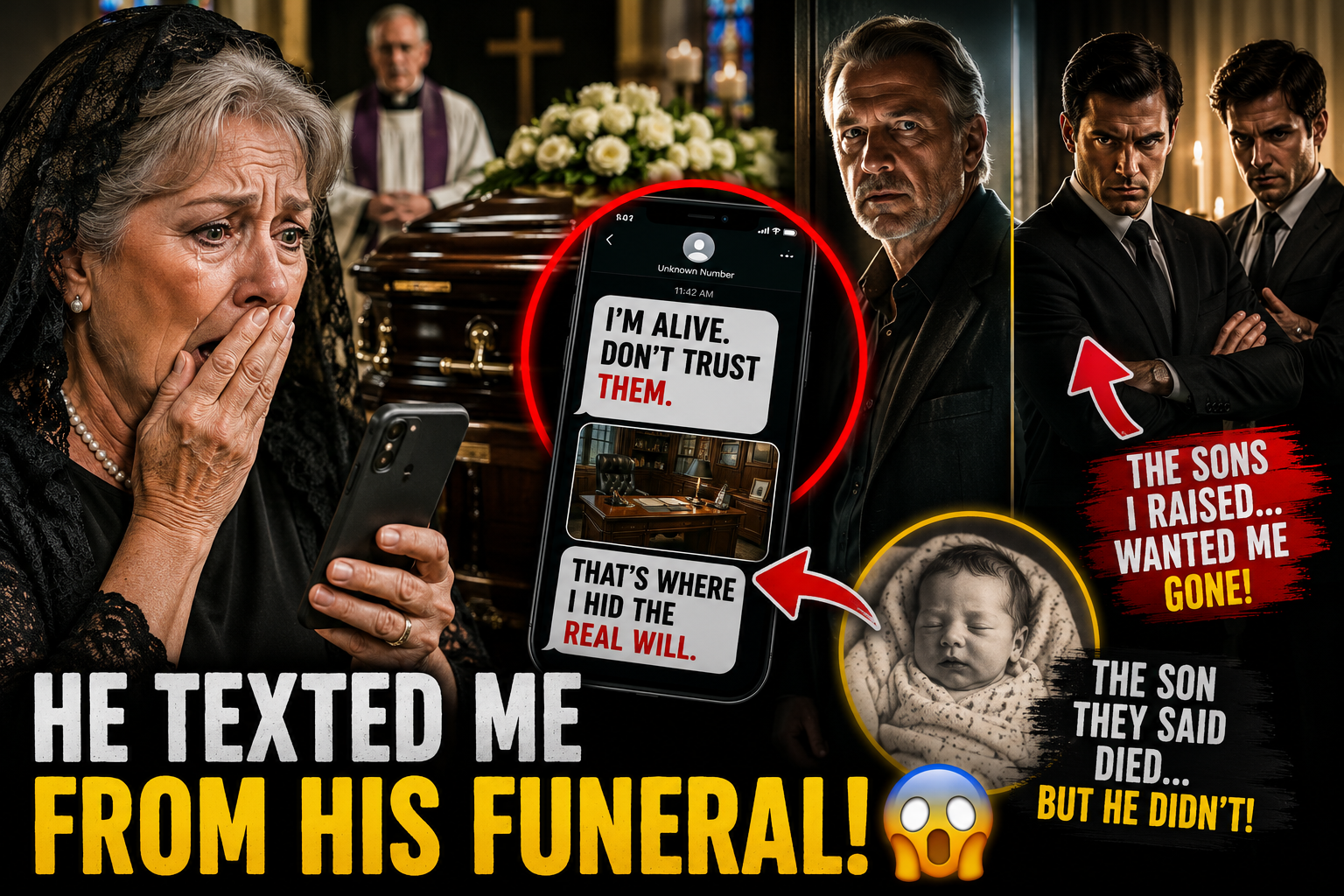
“If you want to know who died in my place, go to the ranch in Austin and ask for the son Charles and Hector believed they buried when he was a newborn.”
I read the message three times inside the cab. I didn’t understand. Or I didn’t want to understand. Mr. Arthur drove without turning on the radio, both hands steady on the wheel. Left behind was Beverly Hills, my home, my sons, the closed casket, and forty-three years of marriage turned into an impossible question. —”Mr. Arthur,” I whispered, “is Robert alive?” The old chauffeur looked through the rearview mirror. —”Yes, Mrs. Teresa.” I covered my mouth. My weeping came out strange. It wasn’t a clean relief. It was rage, fear, love, and betrayal all twisted together. —”And the man in the casket?” Mr. Arthur took entirely too long to answer. —”He needs to be the one to tell you that.”
At dawn, Austin appeared with its clear sky, its dry hills, and that earth that smells different after the rain. Mr. Arthur took a dirt road between mesquite trees, cacti, and old stone walls. The ranch wasn’t elegant. It was a low, white house with hydrangeas and a well in the center of the courtyard. And there was Robert. Alive. Sitting on a wooden chair, with a few days’ stubble, a bandage on his arm, and eyes full of guilt. I got out of the cab without knowing whether to run toward him or hit him. He stood up. —”Teresita.”
I slapped him. Not hard. Just enough for him to understand that a woman doesn’t mourn her husband in front of a casket as part of a strategy and then hug him as if nothing happened. —”I wept for you in front of your sons,” I said. “I wept for you in front of a casket.” Robert lowered his head. —”Forgive me.” —”Don’t start with that. Speak.”
We walked into the kitchen. A woman from the ranch served us coffee, but nobody touched it. Robert placed a folder on the table. His hands were trembling. —”Charles and Hector wanted to declare you incompetent,” he said. “They already had a doctor willing to testify that your grief had altered your mind. They wanted to control your accounts, sell the house, and present a forged will.” I felt a wave of nausea. —”I overheard them.” —”They were also drugging me.” I looked at the vial in my purse. —”With this?” He nodded. —”Small doses. Sedatives. Just enough to make me seem confused, slow, tired. They told me it was just old age. I started to suspect something when Charles insisted on bringing me coffee every single night.” I remembered my son walking into the study with a smile. “Dad, rest. You can’t handle all of this anymore.” My eyes burned. —”And you faked your death?” —”Not from the beginning. My plan was to leave the house, file a police report, and protect you. But then Raphael died.”
The name pierced right through me. Raphael. My firstborn son. The baby who, according to everyone, died just two days after he was born. They told me he was born weak. They sedated me. When I woke up, Robert was crying by my bedside, and my mother-in-law was saying that God knew why He did things. I never saw the body. Only a tiny white box. —”No,” I said. Robert closed his eyes. —”Raphael didn’t die back then.”
I stood up so fast the chair fell backward. —”What did you say?” —”My mother gave him away.” The air in the room turned to poison. —”Your mother?” —”She said the boy was born sick, that we would spend our entire lives in hospitals, that you wouldn’t survive the strain. I was young. I was desperate. I believed he died because they told me the same lie they told you. Eight months ago, Raphael found me.”
I gripped the edge of the table. —”You knew him for eight months and you didn’t tell me?” Robert wept. —”He didn’t want me to. He grew up believing we had abandoned him. By the time he learned the truth, his heart was already failing. He was terrified of showing up only to die all over again in your arms.” I felt something ancient rip open deep inside me. A pain that didn’t belong to a widow. It belonged to a robbed mother. —”I had the right to hold him.” —”Yes.” —”I had the right to know his voice.” —”Yes.” —”I had the right to say goodbye.” Robert didn’t defend himself. That only infuriated me more.
He led me to a small bedroom. There was a made bed, a candle, a folded shirt, and a portrait. Raphael. Nearly forty years old. Robert’s eyes. My mouth. My exact way of tilting his head. I approached the portrait and completely broke down. —”My boy…”
On the table lay a letter. “Momma Teresa.” I opened it with useless, trembling hands. “Forgive me for arriving late. They told me you didn’t want me because I was born sick. When I met Dad, I understood that we had been robbed too. I didn’t want to make you suffer, but I needed you to know that I lived. That I felt fear. That I dreamed of your voice even though I couldn’t remember it. If you ever read this, don’t think I died without a mother. I imagined you my entire life.”
I collapsed onto the bed. I wept for the baby I never got to cradle. For the boy I never saw walk. For the man who died calling me Momma on a piece of paper. Robert stayed by the door. He was smart to do so. If he had stepped closer, I would have hated him. If he had walked away, I would have hated him just the same.
When I could finally breathe, I asked: —”How did he end up in that casket?” Robert sat across from me. —”Raphael died here, three days ago. The doctor signed his death certificate with his real name. But Charles and Hector didn’t know I had fled the Beverly Hills house. They entered my study at night. They believed they found me dead on the daybed because Raphael looked so much like me. Thinner, with a beard, covered up. Mr. Arthur let them get confused.” —”You let them bury our son under your name?” —”They weren’t going to bury him. They were going to cremate him tomorrow morning. Fast. To erase all the evidence.”
Rage dried my tears instantly. —”We are going back today.” —”Yes.” —”And this time, you don’t send me messages like a ghost. This time, you walk right beside me.” Robert nodded.
Counselor Montalvo arrived before noon—an old notary public and long-time friend of Robert’s. He brought certified copies, videos, DNA test records, the authentic will, and a flash drive containing recordings. —”Mrs. Teresa,” —he said—, “your sons didn’t just try to alter the estate succession. There are clear indicators of chemical tampering and financial elder abuse. And regarding you, an attempt to forcibly compromise your legal capacity through fraudulent deception.” I looked at Robert. —”The will?” Montalvo opened the folder. —”The family estate is left entirely to you with total control and life estate rights. The primary bank accounts as well. Charles and Hector were only designated to receive a portion if they respected your explicit will and didn’t attempt to declare you incompetent, pressure you, or forge documents. Since they violated those terms, they are entirely disinherited.” —”They violated them.” —”Then they have lost far more than money.”
I tucked Raphael’s letter safely against my chest. —”Let’s go.”
We returned to Los Angeles before nightfall. I didn’t go hiding in the shadows. I sat straight up in the backseat, with the black veil stuffed inside my purse and a heart turned into a solid, unyielding ruin.
When we arrived at the funeral home, Charles was aggressively arguing with the director. —”My father wanted an immediate cremation,” —he was saying—. “My mother is not in the proper mental condition to make these decisions.” Hector was speaking into his phone nearby. —”Yes, doctor. As soon as she returns, we’ll sedate her. She’s completely delusional.”
I walked right into the room. —”Delusional about what, son?” Hector whirled around. He turned ghostly white. Charles stepped toward me with a well-rehearsed expression of deep concern. —”Mom, where were you? You had us half to death with worry.”
Then Robert walked in right behind me. Charles’s entire face collapsed. Hector stumbled backward until he crashed right into a standing floral arrangement. —”Dad…”