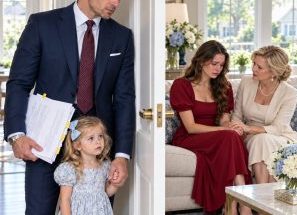
The Night He Mistook My House for His Kingdom
When my husband told me his parents and sister would be moving into my house that very day, he said it with the casual authority of a man who had repeated the decision to himself so many times he had begun to mistake it for a right. He was standing barefoot on the marble floor of the kitchen, a beer bottle hanging loosely from one hand, his tie already off, his sleeves rolled to the elbow as though exhaustion itself had promoted him to master of everything in sight. The house behind him still smelled faintly of fresh paint, cedar cabinetry, and the expensive, quiet kind of newness I had dreamed about for years. We had been living there for exactly two nights.
“My parents and my sister are moving in today,” he said. “And I don’t want to hear a single complaint about it.”
For one suspended second, I thought I had misunderstood him, not because the words were unclear, but because they were so large, so presumptuous, so deeply revealing that my mind briefly refused to let them belong to the man I had married.
My name is Victoria Hale, and I bought that house with money I earned after selling the software company I built from a borrowed desk, a secondhand laptop, and ten years of exhaustion no one ever romanticized while I was living through it. There was no mortgage. No shared down payment. No family money. No husband’s contribution hidden in some sentimental footnote. I paid for every square foot myself. Still, in front of other people, my husband had liked to say things such as “We finally got our dream home,” because men like Owen tend to believe that standing near a woman’s achievement long enough eventually allows them to rename it.
I set my wineglass down carefully.
“Your sister too?” I asked. “Chloe, the one who got divorced last month?”
He did not look at me when he answered.
“She needs a fresh start. And my parents are getting older. There’s plenty of space here.”
“You didn’t discuss any of this with me.”
That made him turn.
The expression on his face was not apologetic, not even defensive. It was annoyed, as if my surprise were less a reaction than an inconvenience.
“Don’t start being dramatic, Victoria.”
I held his gaze.
“I’m not being dramatic. I’m asking why you made decisions about my home without speaking to me.”
He let out a short, contemptuous laugh.
“Your home?”
“Yes,” I said. “My home.”
He took a step closer then, and there was something in his face I had seen only in fragments before, something colder than arrogance and more primitive than entitlement. It was the expression of a man who believes proximity has become ownership.
“Victoria,” he said, lowering his voice as if that made the moment more rational, “this house is mine too. You bought it while you were married to me. Everything you have belongs to this marriage, which means it belongs to me. And if you’re planning to cause problems for my family, then you should adjust your attitude right now, because in this house, I make the decisions.”
There it was.
Not misunderstanding.
Not miscommunication.
Not a bad week, stress, or the awkwardness of newly married life.
Just the truth, finally willing to introduce itself without costume.
The Marriage I Had Mistaken for Partnership
The strange thing about revelation is that once it arrives, it retroactively illuminates everything that came before it. Standing in that kitchen, listening to Owen declare ownership over what I had earned long before he ever entered my life, I suddenly saw our marriage not as it had felt to me, but as it had always functioned for him.
He had loved telling people I was brilliant.
He had loved introducing me as the wife who “did all the smart tech stuff.”
He had loved the vacations, the tailored furniture, the social access, the polished admiration that attached itself to him simply because he stood beside me in public.
What he had not loved was the reality that I was independently powerful.
He had no language for partnership when partnership meant equality rather than absorption.
The signs had been there, of course. The way he referred to my long workdays as “cute little marathons.” The way he said “our future” whenever we were discussing my investments. The way his mother, Denise, would ask sly questions about title structures and estate planning under the guise of harmless interest. The way Chloe once joked over dinner, “If I ever marry rich, remind me to skip the part where I pretend not to notice the paperwork.” Everyone had laughed, including Owen. I had laughed too, because intelligent women often make the mistake of thinking that recognizing disrespect is the same thing as responding to it.
It isn’t.
That night, after he delivered his decree, he walked upstairs as though the conversation were finished.
The next morning he left early.
At the door, with his keys already in hand, he said, “I’m picking them up from the airport. By the time I get back, I expect you to understand how this is going to work.”
I looked at him and smiled.
Not warmly.
Just enough.
“Of course,” I said.
The moment the door closed behind him, I opened every financial account connected to our household operations and found what I suppose I should have expected by then: several unauthorized transfers already made under the description Family Support, moving substantial amounts into external accounts linked to his parents. Not impulsive. Not recent. Not accidental.
He had already begun taking.
That discovery did not upset me nearly as much as it should have.