PART 1
Dr. Robert Wright had spent thirty-two years teaching himself not to react.
He had stood beside mothers who screamed, fathers who fainted, babies who arrived too early, too quiet, too blue. He had delivered children during storms, during blackouts, during nights when every hallway smelled of antiseptic and fear. People trusted him because he did not tremble. He did not panic. He did not let the emotions in the room become his own.
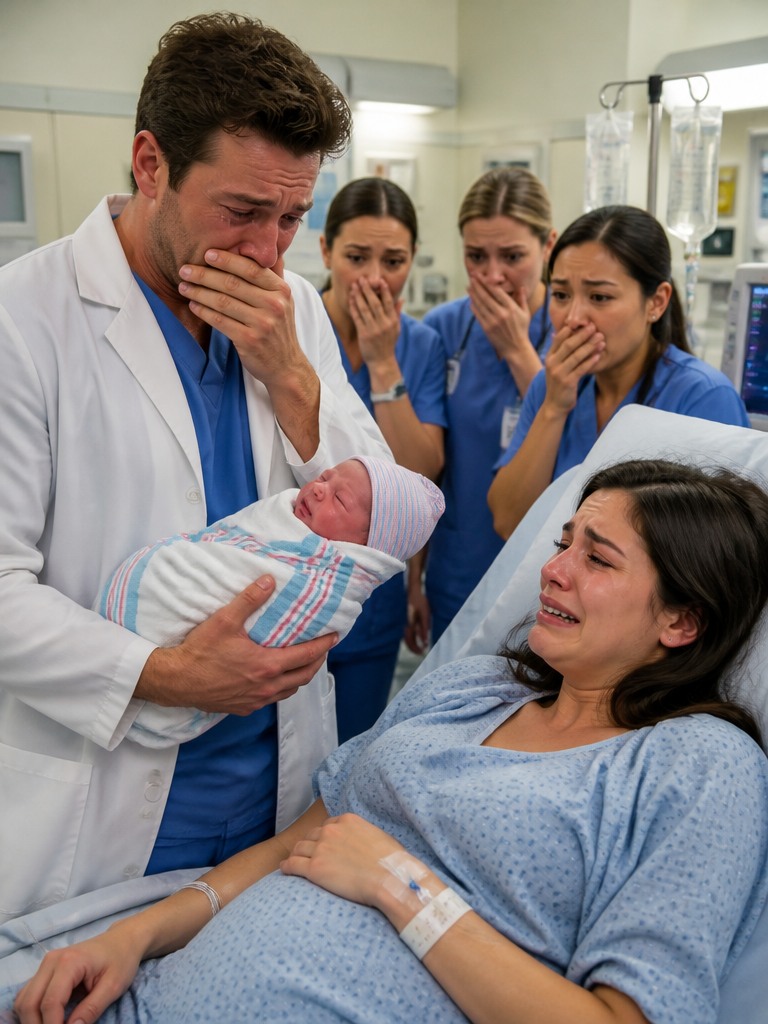
But now, in Delivery Room Four, with the winter light pressing gray against the windows, Robert Wright stared at Joanna’s newborn son and felt the floor vanish beneath him.
The baby was small, wrinkled, furious at the cold, his tiny fists curled near his cheeks. A nurse had tucked him into a white blanket with blue stripes. His skin was flushed from crying. His dark hair lay damp against his head.
But it was not the hair.
It was not the face.
It was the mark.
Just beneath the baby’s left collarbone, where the blanket had slipped, there was a birthmark shaped like a broken crescent. Pale at the edges, darker at the center, almost like a small moon split by shadow.
Robert’s breath caught.
For a moment, he was no longer in the hospital.
He was standing in another room, decades earlier, holding another newborn with that same mark beneath the left collarbone.
A child who had disappeared.
A child he had believed was gone forever.
“Doctor?” the nurse asked quietly.
Her voice brought him back, but not completely.
Joanna noticed then. She was exhausted, pale, her hair damp at her temples, her body still trembling from labor. But a mother sees everything when it comes to her child.
“Is something wrong?” she whispered.
Robert opened his mouth.
No sound came out.
The nurse drew the baby closer to her chest. “Dr. Wright?”
Robert wiped quickly at his eyes, as though ashamed of them. His hand shook so badly that he tucked it into the pocket of his coat.
“No,” he said at last, but the word sounded too fragile. “No, nothing is wrong with the child.”
Joanna’s expression tightened. “Then why are you crying?”
The room went quiet.
Outside in the hallway, someone laughed. A cart squeaked past the door. Somewhere, another baby began to cry. Ordinary hospital sounds, careless and distant, while Joanna’s entire world balanced on Robert Wright’s answer.
He looked at her chart again.
Joanna Ellis. Twenty-eight. No emergency contact listed. No spouse present. Father of child: not provided.
His eyes moved back to her face.
“May I ask,” he said carefully, “the father’s name?”
Joanna’s fingers curled into the sheets.
The question struck harder than it should have. She had spent seven months learning how not to flinch at his name. She had spoken it to landlords, nurses, government forms, and strangers who assumed there was a man somewhere waiting to arrive. Every time, it left a small cut.
“Why?” she asked.
Robert swallowed. “Because I need to know.”
The nurse shifted uncomfortably. “Doctor, perhaps this can wait.”
“No,” Joanna said, her voice still weak but firm. “If you’re asking because something is wrong with my baby, then you tell me now.”
Robert’s face changed. Not into the calm doctor’s mask everyone knew, but into the face of an old man suddenly carrying a weight too heavy to hide.
“Nothing is wrong with him,” he said again. “But I believe…” He stopped. “I believe I may know his family.”
Joanna stared.
His family.
For months, that word had meant only her. Her hands over her stomach. Her voice in an empty room. Her body standing for hours at the diner until her ankles swelled. Her alone, always alone.
“The father’s name,” Robert repeated gently.
Joanna looked toward the baby, still cradled in the nurse’s arms.
“Logan,” she said.
Robert closed his eyes.
The nurse’s face went still.
“Logan Wright?” Robert asked.
Joanna’s heart slammed once against her ribs.
She had never told the hospital Logan’s last name. She had refused, not out of pride, but because writing it down felt like giving him a place he had abandoned.
“How do you know that?” she whispered.
Robert opened his eyes.
Because he is my son.
The words should have been simple.
Instead, they came from him like a confession.
Joanna did not move.
For a second, she thought the exhaustion had finally broken something inside her. Perhaps she had misheard. Perhaps there was another Logan Wright somewhere, another man with the same careless hands and the same soft way of leaving.
But Robert’s expression confirmed everything.
“My son,” he said. “Logan is my son.”
The nurse inhaled sharply.
Joanna’s lips parted, but no words came.
Robert took one step closer, then stopped, as if afraid she might tell him to leave. “I didn’t know,” he said. “I swear to you, I did not know about the pregnancy.”
Something inside Joanna, something buried deep beneath months of hunger, rent notices, back pain, fear, and loneliness, lifted its head.
“You didn’t know,” she repeated.
“No.”
“He left me,” she said.
Robert looked as though she had struck him.