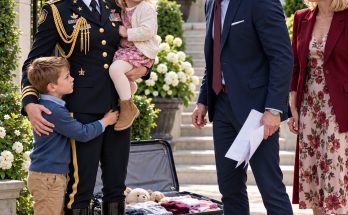
My sister laughed when she saw me standing in my military dress blues on my wedding day, and for one strange second, I noticed everything except her face.
The preparation room at Marine Corps Base Quantico smelled like old wood polish and fresh lilies.
The light over the mirror was warm enough to soften the edges of the room, but not enough to soften what was waiting on the chair across from me.
An ivory designer gown hung there in clear plastic, untouched, expensive, perfect, and unwanted.
My mother had mailed it two weeks earlier without a note.
No phone call.
No question.
No “Are you happy?”
Just a gown, boxed and delivered like a final correction.
That was how my family loved when they remembered to love at all.
They sent instructions and called them care.
I stood in front of the mirror and fastened the last button of my dress blues with hands that had signed casualty letters, held radios through dust and smoke, and stayed steady in places where fear had a sound of its own.
That morning, those same hands trembled.
Not from doubt.
From the strange weight of finally letting myself be seen.
The midnight-blue jacket sat sharp against my shoulders.
My medals rested where they belonged.
The four silver stars beneath the warm light looked almost unreal, even to me.
General Rebecca Hayes.
I had worn that title in briefing rooms, command centers, memorial services, and hearings where every word had to be exact.
Still, seeing it on my own wedding day felt different.
The uniform was not a costume.
It was not a statement meant to irritate anyone.
It was the skin my life had earned.
Outside the door, guests were arriving.
Dress shoes clicked against stone.
Someone laughed softly, then went quiet.
A man cleared his throat near the hallway, and farther away a group of Marines joked for half a second before discipline settled over them like a door closing.
At the altar, Daniel Mercer was waiting.
Daniel was not a loud man, and maybe that was why I trusted him.
He did not perform love for an audience.
He showed up with coffee before long hearings, kept spare batteries in the kitchen drawer because he knew I forgot them, and once drove three hours in bad weather just to sit beside me in a hospital waiting room after one of my former Marines had been injured.
When I told him I might wear my dress blues, I expected the pause people always gave me when they were trying to decide how much of me was convenient.
He did not pause.
“If the uniform helped shape your life,” he said, “then wear it proudly.”
Then he looked at me like the answer had been obvious.
“I’m not marrying a costume, Rebecca. I’m marrying you.”
That sentence had carried me through the last two weeks.
It carried me that morning, too, until my phone buzzed on the makeup table beside the printed chapel schedule.