PART 1
“Mom, I gave your house to my in-laws. The doctors said you were probably going to die anyway.”
Those words came out of my only son’s mouth as casually as someone commenting on the weather.
But for me—lying in that hospital bed, barely able to move, my throat dry and my body numb—every syllable sliced through my heart like a blade.
I had just awakened from a coma that lasted six months.
Half a year where my body lay unconscious while my soul fought desperately to return.
And the first thing I heard when I opened my eyes?
Not “Thank God you’re alive.”
Not “Mom, I was terrified of losing you.”
No.
The first thing my son did was inform me that he had handed away the home I spent my entire life building.
My name is Margaret Alvarez. I’m sixty years old, and this is the story of how life forced me to destroy my own bloodline in order to reclaim my dignity.
I grew up in a tiny Texas town and moved to San Antonio when I was young.
I became a widow when my son Daniel was only eight years old.
His father, a hardworking construction worker, died after falling from a job site.
That day, I promised myself my boy would never go without anything.
I cleaned houses in wealthy neighborhoods where women looked down at me like I was invisible.
Later, I sold breakfast tacos and coffee from a small food cart outside a church every morning before sunrise.
I saved every dollar.
My clothes were patched.
My shoes were worn thin.
But Daniel always had clean sneakers, school supplies, and lunch money.
I paid for his accounting degree by working from dawn until nearly midnight every day.
Eventually, I bought myself a small house.
It wasn’t fancy.
But it was mine.
Brick walls.
White shutters.
A tiny front porch.
And in the backyard, I planted a lemon tree that became my greatest pride.
That house was our refuge.
Daniel graduated college, landed a good accounting job, and for a while, I believed every sacrifice had been worth it.
Then he met Vanessa.
Vanessa came from what she proudly called “a respectable family.”
In reality, her parents had gone bankrupt years earlier after failed business deals, but they still pretended to be upper class.
Vanessa had expensive nails, cold eyes, and the habit of criticizing everything.
The moment she stepped into my home, she started insulting it.
My curtains looked “cheap.”
My wooden furniture looked “old-fashioned.”
My kitchen looked “embarrassing.”
And Daniel?
Blinded by love, he slowly drifted away from me.
They married in a wedding I helped pay for, though I felt more like an unwanted guest than the groom’s mother.
After that, Daniel’s visits turned into occasional text messages every couple of weeks.
Then one afternoon in May, while preparing food for my catering orders, the world suddenly tilted sideways.
The room spun.
My legs gave out beneath me.
A stroke.
I collapsed onto the kitchen floor while the smell of spices and fresh lemons drifted through the open window.
Six months later, I woke up surrounded by the sound of machines beeping.
When the nurse realized I was conscious, she nearly screamed and immediately called my son.
It took Daniel two hours to arrive.
He walked into the room beside Vanessa.
He looked exhausted.
She looked flawless, scrolling through her phone with complete boredom.
No hugs.
No tears.
No relief.
“Wow, Mom,” Daniel said stiffly while crossing his arms at the foot of my bed. “It’s kind of a miracle you woke up.”
Then his voice turned practical.
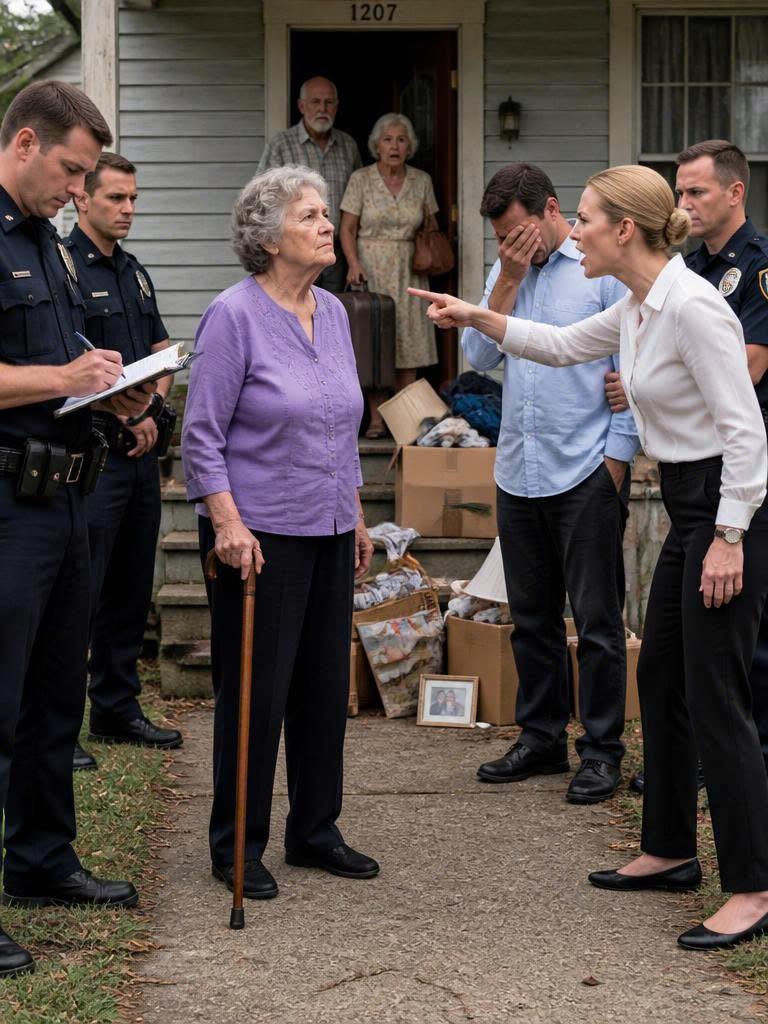
“There’s something you need to know. I let Vanessa’s parents move into your house. We honestly thought you weren’t going to survive… so you’ll probably need to figure out somewhere else to stay once you’re discharged.”
The silence inside that room became unbearable.
Vanessa didn’t even bother looking up from her phone.
What neither of them knew—what the doctors never imagined and what my son was about to learn the hard way—was that coma patients sometimes hear everything.
And I had heard everything during those six months.
Their conversations.
Their greed.
Vanessa’s complaints.
Their plans for my house.
As I stared at them standing there, believing I was weak, defeated, helpless…