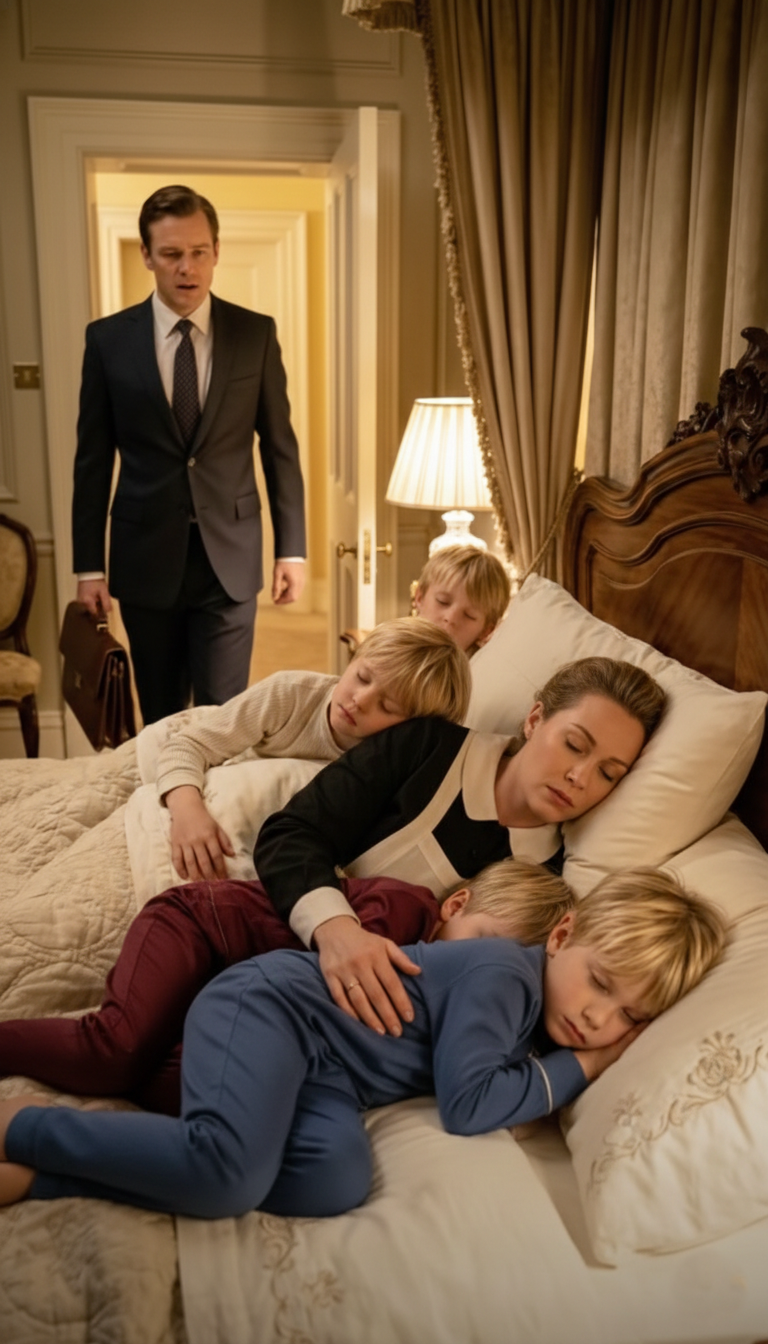
The House on Briar Crest Hill
In the small river city of Millhaven, Ohio, there stood a glass-and-limestone house that caught the late afternoon sun and reflected it back across the valley like a silent signal, and for years the neighbors had spoken about it in lowered voices, not because of loud parties or flashing patrol cars, but because of the three small children who seemed to turn that grand place into a storm all their own.
The house belonged to Russell Hawthorne, a software architect whose logistics company powered half the distribution networks in the Midwest, and although his work required precision, forecasts, and clean lines of code, nothing inside his home followed an orderly script once his four-year-old triplets were awake. Caregivers came and went with alarming speed, each one arriving with optimism and leaving with the brittle politeness of someone who had endured more than expected, and by the end of that spring the staff had begun to treat the nursery wing as if it were a separate climate zone, unpredictable and best approached with caution.
Russell did not consider himself a man prone to desperation, yet after the twelfth resignation in five weeks he found himself sitting alone in his office, staring at three unfinished mugs of coffee that had gone cold while he tried to negotiate both a merger and the unraveling of his household, and he admitted quietly, to no one in particular, that he did not know how to reach his own children.
A Quiet Arrival
The next applicant did not match the pattern of the others, because she did not stride through the foyer in bright heels or clutch a leather portfolio thick with certifications; instead, she arrived in a sensible navy coat, her silver-threaded hair drawn back into a smooth knot, her posture composed in a way that suggested long practice rather than nervous ambition. Her name was Eleanor Whitaker, and she carried herself with the calm assurance of someone who had seen every version of childhood and had never mistaken noise for wickedness.
Russell met her in the study, a room lined with screens and market projections that pulsed softly against the dark wood shelves, and although he attempted a professional tone, fatigue weighed on his words as he explained the history of short stays and sudden departures.
“Mrs. Whitaker, I want to be honest with you,” he said, pressing his fingertips together as though he were negotiating a contract. “My children are not easy. We have tried structure, incentives, specialists. Nothing seems to hold.”
Eleanor listened without interruption, her eyes steady, and when he finished she nodded once, not as if she accepted a challenge, but as if she had been handed a map she already understood.
“Every child is trying to say something,” she replied gently. “Sometimes they just do not know the language yet.”
She did not ask for a higher salary, nor did she request elaborate accommodations. She asked only to meet the children before discussing schedules or strategies, which unsettled Russell more than any negotiation would have, because it suggested she believed the answer lay not in policy but in presence.
The Morning of the Song
At precisely seven the following morning, the usual chaos broke across the marble floors like a sudden summer storm, and the triplets—Alden with his reckless grin, Beatrice with her watchful eyes, and Colin who rarely stood still long enough to finish a thought—raced through the great room, hurling foam blocks and shouting over one another as though volume itself might secure them a place in the world.
Previous caregivers had attempted to corral the noise with raised voices or stern ultimatums, yet Eleanor did something so unexpected that even the housekeeper paused in the doorway to watch. She lowered herself carefully onto the cool stone floor, folded her hands in her lap, closed her eyes, and began to hum a melody so soft that it seemed almost private, the kind of tune a grandmother might sing while washing dishes at dusk.
The children slowed first out of confusion, then out of curiosity, because the sound did not compete with them or demand obedience; it simply existed, steady and warm, and within moments Alden stood nearest to her, his chest rising and falling as he tried to decide whether this was a trick. Beatrice approached next, clutching a doll whose hair had been cut unevenly in some earlier fit of restlessness, and Colin shuffled closer with a small wooden truck dragging behind him.
Eleanor opened her eyes and smiled, not the strained smile of someone bracing for impact, but one that suggested she was glad they had come.
“Would you like to hear a story about three explorers who built their own island?” she asked softly.
The question did not command; it invited, and for the first time in months the cavernous room grew quiet enough for Russell, who had been watching from the hallway, to hear his own breath.
What She Saw
The change did not happen overnight, because children do not transform like furniture rearranged in a room, yet over the following weeks the shouting softened into conversation, and the crashes of thrown toys became less frequent as laughter began to take their place. The staff whispered in disbelief that Mrs. Whitaker had lasted longer than anyone expected, and some even lingered in doorways just to observe the way she knelt to meet the children at eye level instead of towering above them with authority.
One afternoon, when Alden had flung a wooden train against the window in a flare of frustration, Eleanor did not scold him; she crouched beside him and asked, in a voice so even it carried no accusation, “What were you hoping would happen when you threw it?”
He hesitated, his small shoulders rising in a shrug that felt older than his years. “If it’s loud,” he muttered, “Dad looks up from his phone.”
That quiet admission settled into Eleanor’s heart like a stone dropped into still water, and when she later watched Beatrice trace circles on the glass or saw Colin tug insistently at Russell’s sleeve only to be gently redirected by an assistant, she recognized a pattern that had nothing to do with defiance and everything to do with longing.
The Garden Conversation
Behind the pool, partially hidden by overgrown hedges, there was a neglected corner of the property where weeds had claimed the paving stones and a dry fountain leaned slightly to one side, and it was there that the children began to build a small shelter from branches and fallen leaves, concentrating with a seriousness that had rarely appeared during structured activities.
Russell discovered them one late afternoon while pacing through a conference call, and he ended the call abruptly when he saw dirt smudging their expensive clothes.
“What is going on here?” he demanded, irritation tightening his voice. “This area is not safe. There are better places to play.”
The children froze, their fragile structure trembling in the breeze, and Eleanor rose slowly to face him.
“They are making something that feels like their own,” she explained. “A space where they can decide the rules.”
Russell’s jaw tightened. “They need boundaries, not fantasies. The world does not bend for improvised forts.”
Eleanor met his gaze without flinching. “They are not asking the world to bend. They are asking you to sit down with them.”
The words lingered between them long after the children resumed stacking branches, and that night Russell found himself awake, replaying her tone rather than her argument, because beneath her calm there had been an ache he recognized but had worked very hard to bury.
The Staircase to the Past
The following morning, instead of retreating to his office after a hurried coffee, Russell remained at the breakfast table while the triplets colored beside him, and when Beatrice looked up and said softly, “Good morning, Dad,” without prompting, the simple phrase felt like a door opening in a long-sealed room.
After the dishes were cleared, Eleanor approached him with measured steps.
“There is something I believe you should see,” she said.
She led him toward the oldest wing of the house, where a narrow staircase climbed toward the attic, and she explained that the children often tried to wander upward, growing agitated when redirected. The attic smelled of cedar and forgotten seasons, its corners crowded with covered furniture and labeled boxes, and in one shadowed corner stood a small rocking horse with chipped paint and a faded saddle.
Russell drew in a sharp breath, because the sight of it struck him with a force he had not allowed himself to feel in years, and as he pulled back the sheet covering a nearby crate he found photographs he had not touched since the month his wife, Lillian, had been lost in a collision on a rain-slick highway. She had been returning from a boutique with that very rocking horse strapped into the back seat, a gift for the babies she had carried, and although the children had arrived safely through emergency measures, Russell had sealed away the memory as if closing a file he could not bear to reopen.
He sank onto a dusty trunk, his composure dissolving under the weight of recollection, and the children, who had followed quietly behind, stood watching him with wide eyes.
Colin stepped forward first and touched the photograph. “Is that Mommy?” he whispered.
Beatrice traced the curve of the rocking horse. “She liked this?”
Alden did not speak; he wrapped his arms around Russell’s waist with a fierceness that surprised them both.
In that cramped attic, surrounded by relics of a future once imagined differently, Russell understood what Eleanor had seen from the beginning: their outbursts were not signs of wildness but signals of absence, attempts to shake loose a story that had been locked away.
A Different Kind of Wealth
Grief, when ignored, does not vanish; it seeps into walls and routines, and Russell had mistaken productivity for healing, convincing himself that providing every comfort would compensate for what could not be replaced. Yet comfort without connection had left his children orbiting him like satellites, bright and restless, unsure whether they would ever be invited into the center.
That evening, seated on the floor of the great room where the chaos had once reigned, Russell placed the rocking horse between them and began to tell stories of Lillian’s laughter, of her stubborn love for old bookstores, of the way she had insisted on choosing a toy that would last beyond trends and batteries. He spoke haltingly at first, then with growing steadiness, and the children listened as though each detail stitched something torn back into place.
Eleanor watched from the doorway, her hands folded, and when Russell’s voice faltered he did not retreat into silence as he once might have; instead he reached for his children and said plainly, “I thought keeping busy would protect us. I see now that it kept me away.”
The triplets did not transform into serene portraits of obedience, because they were still four and full of motion, yet their energy shifted from desperate noise to shared curiosity, and the house on Briar Crest Hill gradually lost its reputation as a place of turmoil. Russell reduced his travel, guarded his evenings as fiercely as he once guarded quarterly reports, and made a habit of kneeling on the marble floor to build improbable structures of blocks while laughter echoed upward to the high ceilings.
Eleanor remained not merely as an employee, but as a quiet guardian of perspective, reminding them through song and steady presence that attention is a language children understand instinctively, and that even the most impressive architecture cannot substitute for the simple act of being seen.
In time, the rumors that once circled Millhaven faded, replaced by stories of a family who had learned that abundance is not measured in square footage or market share, but in mornings shared around a table and in the courage to revisit rooms long avoided. And if one were to pass the house at dusk, when the windows glowed softly against the darkening sky, one might hear the faint rhythm of a rocking horse and the low murmur of a father reading aloud, proof that sometimes the most valuable inheritance is not what is stored away, but what is remembered together.