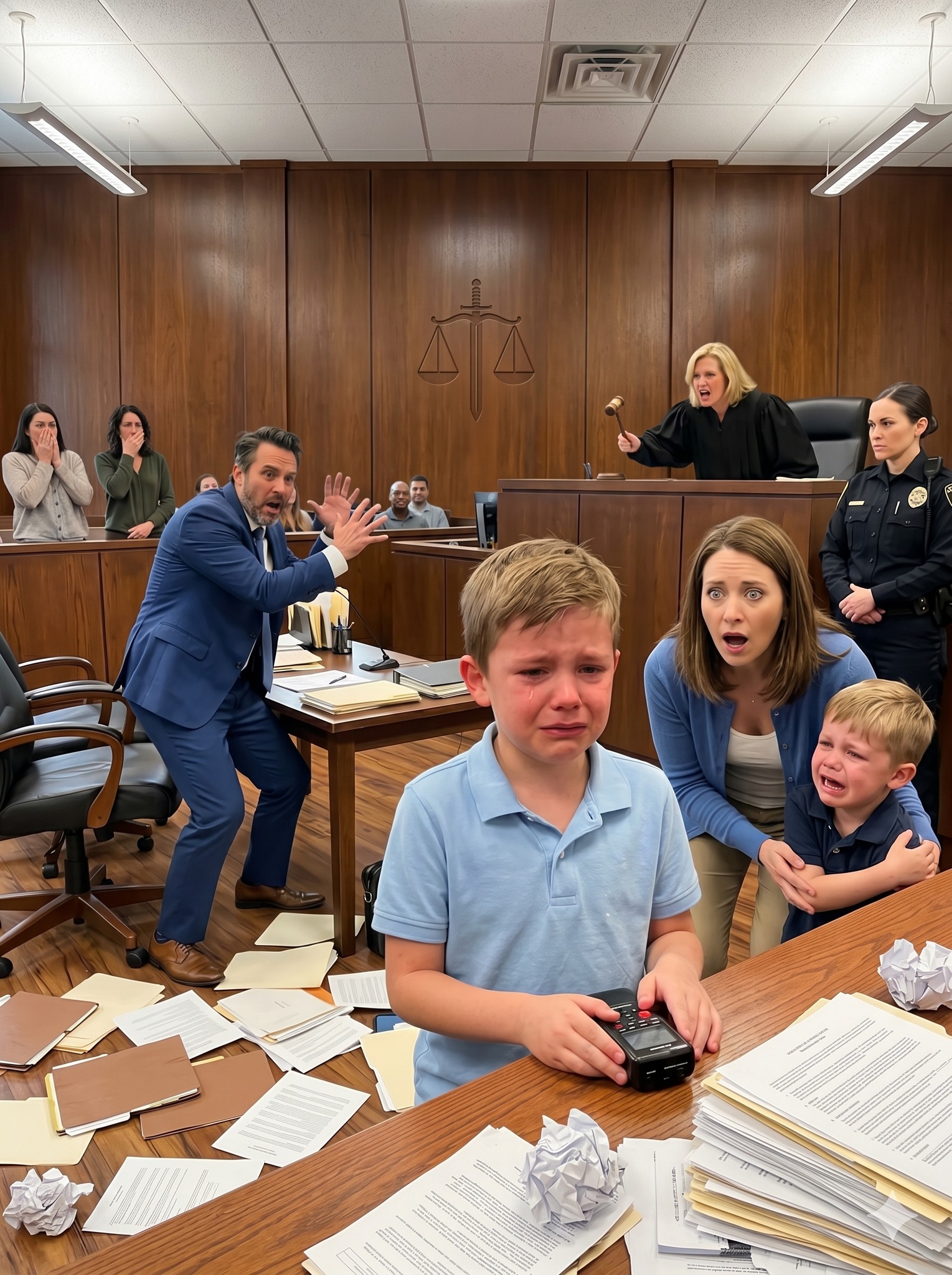
The judge asked Ethan Walker who he wanted to live with, and the boy’s hand went straight to his pocket.
That was the moment the air changed.
Until then, the custody hearing had looked the way Michael Walker wanted it to look. The county family courtroom had polished wood and bright windows and a small American flag beside the judge’s bench. The room smelled like burnt coffee from the hallway machine and floor wax that had not quite dried. Sarah Walker sat at one table in a cream blouse with a loose thread at the cuff. Her ex-husband sat at the other in a tailored navy suit, the kind that made people assume he was telling the truth before he opened his mouth.
Michael had always understood presentation. He understood how to walk into a room like ownership was his natural condition. He understood how to make a threat sound like concern and how to make Sarah look emotional by giving her something unbearable to react to.
For ten years, Sarah had been the invisible half of their family.
She knew the boys’ shoe sizes before they said their toes hurt. She knew Noah needed the hallway light left on after thunderstorms. She knew Ethan pretended not to like peanut butter anymore because Michael had once called it poor kid food in front of company, and Ethan had swallowed the humiliation without complaint in the way that nine-year-olds absorb their father’s cruelties, filing them away as facts about the world. She packed lunches before sunrise and folded laundry after midnight. She took the school calls, the fever calls, the forgotten-project calls, the calls that began with Mrs. Walker, do you have a minute.
Michael took the photographs.
At birthday parties, he stood behind the boys with one hand on each shoulder, looking like a man who belonged at the center of things. At school fundraisers, he wrote a check and let everybody thank him. At restaurants, he smiled at the waiter while Sarah quietly cut the boys’ food and tracked who needed more water and which one was getting overtired and would need to be taken out before the meal was finished.
Money made him visible. Care made Sarah invisible, and visible in their marriage had always been the currency that mattered.
She understood this about their life gradually rather than all at once, the way you understand something you have been living inside for so long it has begun to feel like the shape of reality. There had been a version of Michael she fell in love with, a version that was charming in the specific way of men who direct their full attention at you early in a relationship. He had been interested in her opinions at twenty-six. By thirty, her opinions were a complication to be managed. By thirty-four, she had learned to offer them as questions, which was the form he found most tolerable.
The public humiliation had come in the last two years of the marriage, slow at first and then accelerating in the way of damage once it passes a certain threshold. Weekend trips described as business that turned out not to be business. A young woman’s social media account, visible to mutual acquaintances before someone privately sent Sarah the link, full of hotel breakfasts and mirrored elevators and jewelry counters and the passenger seat of a car Sarah had helped choose. The photographs had the particular quality of documentation, as if being seen was the point rather than a byproduct. Sarah had understood, looking at them, that this had been chosen. Not just the woman, but the visibility. He had wanted her to see.
She did not fight for the house when he filed. She did not ask for the lake weekends or the watches or the club membership or the black SUVs in the garage. She asked for Ethan and Noah.
That was when Michael stopped pretending to be bored with her.
He had never actually wanted primary custody of two small boys. The day-to-day reality of parenting did not interest him in the way that being seen parenting interested him, and those were different things. He had never taken a sick day for a sick child. He had never cancelled a meeting for a school play. He had been present at the highlight moments and invisible at the ordinary ones, which was his preferred distribution in all areas of his life.
The custody fight was not about the boys. It was about what losing them would cost her, and Michael understood cost the way he understood everything that mattered to him: as leverage.
The point was that losing them would hurt her more than losing anything else, and the particular satisfaction Michael found in that calculus was something Sarah had taken years to name for what it was.
By nine-seventeen on the Tuesday of the hearing, his attorney had turned Sarah’s motherhood into a liability with the practiced efficiency of someone who had done this before. She was a small woman in her forties with precise diction and an expensive haircut and the particular kind of confidence that comes from spending years helping wealthy people take things from less wealthy people through entirely legal means.
She had a custody evaluation packet. She had tuition estimates showing what Michael could provide. She had property records. She had printed screenshots of Sarah’s old messages, cropped carefully to make fear look like rage. She spoke to the judge with soft precision.
Mr. Walker can provide stability, education, medical coverage, and continuity.
Sarah watched the judge glance down at the file with the expression of someone reading information for the second or third time rather than encountering it fresh.
Mrs. Walker has not maintained formal employment in ten years. She has no independent income. There are concerns about her emotional regulation around the children.
Sarah felt the words enter her body one at a time.
No independent income. Emotional regulation. Concerns. That was how they did it. They removed the life from the facts and left only the label. Ten years of school pickups became unemployment. Ten years of waiting rooms and sick mornings and the accumulated expertise of a woman who had learned her children’s bodies and minds and fears and preferences with the thoroughness of someone who had no assistant for the work became dependency. Ten years of swallowing insults quietly, of keeping her voice down so the boys would not hear, of locking herself in the bathroom not because she was volatile but because it was the only room with a door that locked and sometimes a closed door was the only available form of safety, became instability.
Service sounds noble until a rich man needs to call it dependency.
Michael lowered his head and pressed two fingers under his eye. She had seen him practice that gesture. He used the same expression when apologizing to investors, when charming teachers who had concerns about one of the boys, when convincing strangers he was the reasonable adult in any given room.
“I wanted to keep this peaceful,” he said. His voice broke neatly at the right syllable. “But Sarah screams. She locks herself in the bathroom. The boys have heard things they should never hear. I am worried about their safety.”
Sarah stood. She did not plan to. Her body moved before her judgment caught up.
“You know why I locked that door,” she said.
The room sharpened. Michael’s lawyer turned toward the judge as if Sarah had handed her a gift.
The gavel hit the bench. Noah flinched.
“Ms. Walker,” the judge said, “one more interruption and I will hold you in contempt. Do you understand?”
Sarah sat. Her mouth filled with the metallic taste of unsaid things.
For one ugly second she imagined standing again and saying everything. The hallway outside the boys’ room. Michael’s voice going low and controlled, the way it went when he wanted to make a point without leaving witnesses, when he understood that a raised voice was traceable and a quiet one was not. His hand braced on the bathroom door while Sarah sat on the closed toilet lid and counted her own breaths and reminded herself that the boys were asleep and that this, like other things, would pass. His voice through the door saying nobody believes women like you when men like me have paperwork.
She did not say any of it.
Mothers in court learn fast that anger is useful only to the person who has already called them unstable.
Michael’s mouth barely moved. But she saw the smile.
Then the judge turned to the witness box.
Ethan and Noah sat side by side. They were both nine, both small enough that their sneakers did not quite reach the floor, but they looked nothing alike in that moment. Noah’s shoulders were folded inward and his hands had disappeared into his sleeves. Ethan sat straight with one palm pressed flat over the front pocket of his khaki pants.
Sarah noticed the gesture and felt something she could not name settle cold inside her chest.
Michael noticed it too. His eyes moved to the pocket and away.
The judge softened his voice.
“Boys, I need you to answer honestly. This is not about pleasing your mother or your father. Who do you want to live with?”
The room held still.
Michael gave the boys a quick wink. It was fast enough that most people missed it.
Sarah did not. Neither did Ethan.
Noah leaned behind his brother. Ethan stepped slightly forward.
He looked at his father first. For a moment Sarah thought he might say what Michael had rehearsed into him. Then Ethan turned to the judge.
“Your Honor,” he said, “before you decide, I need to tell you a secret.”
The judge leaned forward. “What secret?”
“A bad one.”
Sarah stopped breathing.
Michael’s smile disappeared.
Ethan looked at his mother for half a second, and what Sarah saw in his face nearly broke her. Apology. Not for doing something wrong. For knowing something she did not. For having carried it alone.
“My mom doesn’t know it yet,” Ethan said.
Michael rose halfway from his chair. “Ethan.” The word cracked across the room. It was not a father’s warning. It was the particular sound of a man who was accustomed to being obeyed by people smaller than him.
The judge’s eyes cut to him immediately. “Sit down, Mr. Walker.”
Michael sat, but his hand remained on the table edge. His attorney turned toward him, confused for the first time all morning.
Ethan reached into his pocket.
Noah began to cry without sound, which Sarah understood as the crying that came when you had already been doing it privately for long enough that you had trained yourself to remove the noise.
A folder slid off Michael’s attorney’s table and hit the floor. Nobody picked it up.
Ethan pulled out a small black digital recorder. It looked cheap. Plastic. Small enough to disappear in a child’s palm. The kind of device sold at electronics outlets for meeting notes and voice memos, easily forgotten in an office drawer.
Michael went gray.
Sarah had seen him angry. She had seen him smug and bored and dismissive. She had never seen him afraid.
Ethan placed the recorder on the witness rail with both hands. His fingers shook badly enough that the device clicked against the wood. The judge did not touch it immediately. He looked at Ethan in the careful, measured way of someone who understood that rushing a frightened child could make the truth disappear.
“Did someone tell you to bring that here?” he asked.
“No, sir.”
“Where did you get it?”
Ethan looked down at his lap. “Dad had it in his office junk drawer. He uses them sometimes for meetings. I took it back after he told us what to say.”
Michael’s attorney stood. “Your Honor, I object to any recording being admitted without foundation, chain of custody, or proper authentication.”
The judge raised one hand. She stopped.
“We will address admissibility,” he said. “First I am going to determine whether these children are in immediate distress.”
That sentence took what was left of Michael’s color.
Noah pulled his sleeve over his mouth.
Sarah wanted to go to her sons more than she had wanted almost anything in years, but the bailiff’s posture told her not to move. She stayed seated and pressed her nails into her palm.
The judge asked Ethan what was on the recorder.
Ethan looked at his father. Michael mouthed something. Sarah could not read it. Ethan could. His face tightened in the way of a child who has been hearing threats long enough to internalize them even when they are silent.
“He said if we picked Mom, she would lose everything,” Ethan said. “He said we’d get sent away because she couldn’t take care of us. He said if we told anyone, he would make her look crazy.”
The courtroom went cold.
Not quiet. Cold.
The judge turned to Noah. “Is that true?”
Noah nodded so hard his chin trembled. Then he pulled a folded yellow paper from inside his sleeve.
Sarah recognized the color. School office paper. The kind sent home for minor incidents, counselor visits, forms that needed a parent signature and never quite felt minor when you were the parent receiving them.
Noah held the paper out, but his hand could not make the distance between the witness box and the judge. Ethan took it and passed it to the bailiff.
The top line showed a timestamp. Eight-oh-six a.m., Monday. The note documented that Noah had arrived at school shaking and asked to see the counselor because he was scared to go home after Dad practiced court answers in the garage.
Sarah covered her mouth. Not because she was surprised that Michael had coached them. Not because she doubted it. Because her sons had carried it alone. Because in protecting her, they had taken on a weight that belonged to the adults in the room who should have prevented it from ever reaching them.
There are secrets children keep because they are afraid of punishment.
There are secrets children keep because they are trying to protect the parent who should have been protecting them.
The judge read the note twice.
Michael’s attorney stopped looking in command of the room.
“Mr. Walker,” the judge said slowly. “Did you rehearse testimony with your children regarding this custody matter?”
Michael’s mouth opened.
No sound came out.
Then the recorder answered for him.
The judge allowed the device to be handled by the bailiff and placed on the bench. The audio was not clean at the beginning. A scrape, a thump, the muffled sound of a garage door. Then Michael’s voice came through, low and controlled and domestic in its quality, the voice of a man speaking in a space where he believed he was not being observed.
You will tell the judge you want to live with me.
A child’s voice, soft enough not to be immediately identifiable: What if Mom cries?
Michael’s laugh, once, brief. Your mother cries because it works on people who don’t know her. The judge is not stupid. He’ll see what I tell him to see.
Sarah lowered her head.
The recording continued. Michael talked about the house, the schools, the financial reality of Sarah’s situation without him. He talked about these things the way people talk to children when they want the children to feel afraid rather than informed, when the goal is compliance through fear rather than explanation.
Then came the line that made the judge sit back.
If you boys embarrass me in court, I’ll make sure your mother loses you for good. Do you understand?
Noah made a small sound. Not quite a sob. Not quite a breath.
The judge stopped the recorder.
Michael stood. “Your Honor, this is being taken out of context.”
“Sit down.”
“They’re children. They misunderstood.”
“Sit down,” the judge said again, and this time the bailiff took one step forward.
Michael sat.
The judge called a recess. He did not send the boys back to Michael’s side of the room. He ordered them to remain with the court officer. Sarah was allowed to approach them only after the judge gave specific permission.
When she reached Ethan, he did not hug her right away. He looked ashamed. That hurt worse than anything Michael’s lawyer had said all morning.
“I stole it,” Ethan whispered.
Sarah crouched in front of him in the courthouse aisle.
“You told the truth,” she said.
His eyes filled. “Dad said truth doesn’t matter if he has better lawyers.”
Sarah looked past her son at Michael, who was talking fast and low to his attorney, his hands moving too much, the polished calm coming apart in pieces.
“Sometimes,” she said, still watching Michael, “the truth just needs one person brave enough to carry it into the room.”
Ethan collapsed into her arms. Noah followed a second later. The three of them stayed there in the middle of the courthouse aisle while people moved carefully around them, as if the world understood that some moments require being left alone.
The hearing resumed after the judge reviewed the school note, spoke privately with the court officer, and requested the custody evaluation packet be supplemented with the new material. Real courts do not move like movies. They move through process. Through orders and exhibits and clerks stamping papers while someone’s whole life changes on the other side of the counter.
The judge issued temporary orders that afternoon. The boys would remain with Sarah. Michael’s visitation was suspended pending further review. The recording would be preserved as evidence. The school counselor’s note would be added to the file. A custody evaluator would conduct follow-up interviews with the boys. Michael was ordered not to contact them outside approved channels.
Michael objected. His attorney objected more carefully. The judge did not appear moved by either.
When they left the courtroom, Michael tried once to catch Ethan’s eye. Ethan looked at the floor. Noah reached for Sarah’s sleeve, the same blouse with the loose thread that Michael’s attorney had probably looked at and dismissed as evidence of Sarah’s insufficiency.
Outside, the cold air hit Sarah’s face and smelled like wet concrete. Her old SUV sat near the back of the lot with the passenger door that stuck. Noah climbed in first. Ethan stood beside her for a moment.
“Are you mad I didn’t tell you?” he asked.
Sarah looked at her son, nine years old and carrying more strategy than any child should ever need, who had planned and executed something that an adult with full information might not have managed, who had done it alone and without certainty that it would work.
“No,” she said.
He stared at her like he needed more before he could believe it.
So she gave him more.
“I am sorry you thought you had to protect me by yourself.”
That was when he cried like a child, not quietly and not carefully, but with the full force of something that had been held for weeks. Sarah wrapped both arms around him in the parking lot while people walked past. Noah climbed back out and joined them. The three of them stood beside the old SUV until the cold seeped through Sarah’s shoes, and she did not move to end it.
That night she made grilled cheese and tomato soup because it was the meal she knew both boys would eat without negotiation, without one of them making a face at the other over the table, without anyone needing to be convinced. She had learned the architecture of their preferences over nine years of ordinary meals, and she understood that this evening required the least resistance possible.
The kitchen was small. The counters were laminate. The refrigerator hummed too loudly, a complaint she had meant to address for two years and that had remained unaddressed because there was always something more urgent. The boys sat at the table in hoodies and socks while the custody order lay inside Sarah’s purse beside the folded school note and a receipt from the courthouse copier.
Ethan asked if the judge was mad at him. Sarah said no. Noah asked if Dad was going to come take them. Sarah said not tonight.
She did not say never, because never was the wrong kind of promise when the process was still in motion. She had learned not to hand children certainties the legal system had not finished constructing.
But she promised the truth. She promised they would not have to carry evidence in their pockets again.
The weeks that followed were the procedural kind of hard, which is different from the dramatic kind and in some ways harder because there is no single clarifying moment. The dramatic kind happens at a specific hour and then it is over, one way or another. The procedural kind unfolds in increments: a form to fill out on a Tuesday evening, a phone call that needs to be returned before a deadline, a document that needs to be notarized by someone whose office is across town and closes at five. It accumulates over weeks and months and requires a specific kind of endurance that is less visible than courage but not less demanding.
Sarah had experience with that kind of endurance. She had been practicing it for ten years.
Interviews with the custody evaluator. Follow-up calls from attorneys. Motions from Michael’s side answered with help from a legal aid clinic and a family lawyer who agreed to a payment plan after hearing the recording.
The school counselor gave a formal statement. The custody evaluator met with the boys separately. Ethan described the garage. Noah described the wink, and hearing a nine-year-old explain to an adult professional that he had recognized a signal his father used to communicate what answers were expected was the kind of detail that changed how people in that room understood Michael Walker.
Sarah described the bathroom door.
This time she did not shout. She brought dates. She brought texts. She brought the therapist intake form she had been too embarrassed to mention before because she had worried it would be used against her. She brought the boys’ school attendance records, their pediatric appointment confirmations, a calendar showing every pickup and every fever and every night Michael had been working late while she held the structure of daily life together with no particular acknowledgment that this was work or that work required a person.
The second hearing did not feel easy. Nothing about it did. Michael still wore a beautiful suit. He still spoke smoothly. He still offered the recording as misunderstood firm parenting and the school note as a nine-year-old’s anxiety during a difficult divorce.
But the room had heard him.
That changed everything in the specific way that changes everything once the original impression of a person has been replaced by actual evidence of them.
The judge granted Sarah primary physical custody and ordered Michael’s contact to be supervised until further review. He also ordered all co-parenting communication to go through a monitored application. Michael looked insulted by the word monitored in a way that was itself informative.
Sarah looked at Ethan and Noah. They were holding hands beneath the bench. That was the only verdict she cared about in that moment.
Months later, Sarah found the recorder returned in a small evidence envelope through her attorney. It looked smaller than she remembered. Cheap plastic with a scuffed corner and a tiny red light that no longer blinked. She almost discarded it. Then Ethan asked if he could keep it.
She said no at first. The look on his face made her pause.
“Why?” she asked.
He shrugged the particular shrug of someone who has something to say and is deciding whether it is safe to say it.
“So I remember I told the truth.”
Sarah sat beside him at the kitchen table, the same one where grilled cheese had gone cold after the hearing, the same surface where homework and grocery lists and court notices had shared space because life does not pause for legal trauma.
She placed the recorder between them.
“You do not need proof to know who you are,” she said.
He touched the edge of it. “Dad always said proof is what matters.”
Sarah nodded slowly. “Proof matters in court. It doesn’t have to matter at breakfast.”
He almost smiled.
Noah came in then with a cereal bowl and asked if they could go to the park after school. Sarah looked at both of her sons. For the first time in a very long time, the question sounded like what it was: a child asking for a small, ordinary piece of afternoon.
Not strategic. Not scared. Not measured against what anyone else might want or what the answer might cost.
Just a boy asking to go to the park.
Care had made Sarah tired for years. That afternoon it felt different. It felt like driving to the park with snacks in a grocery bag and sitting on a bench in the cold bright air and watching two boys run without checking anyone’s face first to see whether they had permission.
The truth had needed one child brave enough to carry it into the room.
After that, it needed a mother brave enough to build a life around it.
Sarah did.
Not perfectly. Not without difficulty. Not without the continuing process of legal hearings and evaluator reports and co-parenting applications that turned ordinary communication into a documented record.
But with the boys beside her, no longer carrying the family’s hardest secret in a pocket where childhood should have been.
The recorder stayed on Ethan’s bookshelf.
Sarah did not tell him to put it away.
She figured he would know when he no longer needed to see it.
And one morning, without announcement, she noticed it was gone. Not discarded. She found it later in his memory box, wrapped in a piece of paper where he had written in his careful nine-year-old handwriting: the thing I used when I told the truth.
She put it back exactly where she found it.
Some things deserve to stay exactly where a child decided they belonged.