Keira stared at the subject line until the letters blurred together beneath the fluorescent lights and the pounding pulse trapped behind her ribs.
Request to Revoke Candidate Access Pending Family Review.
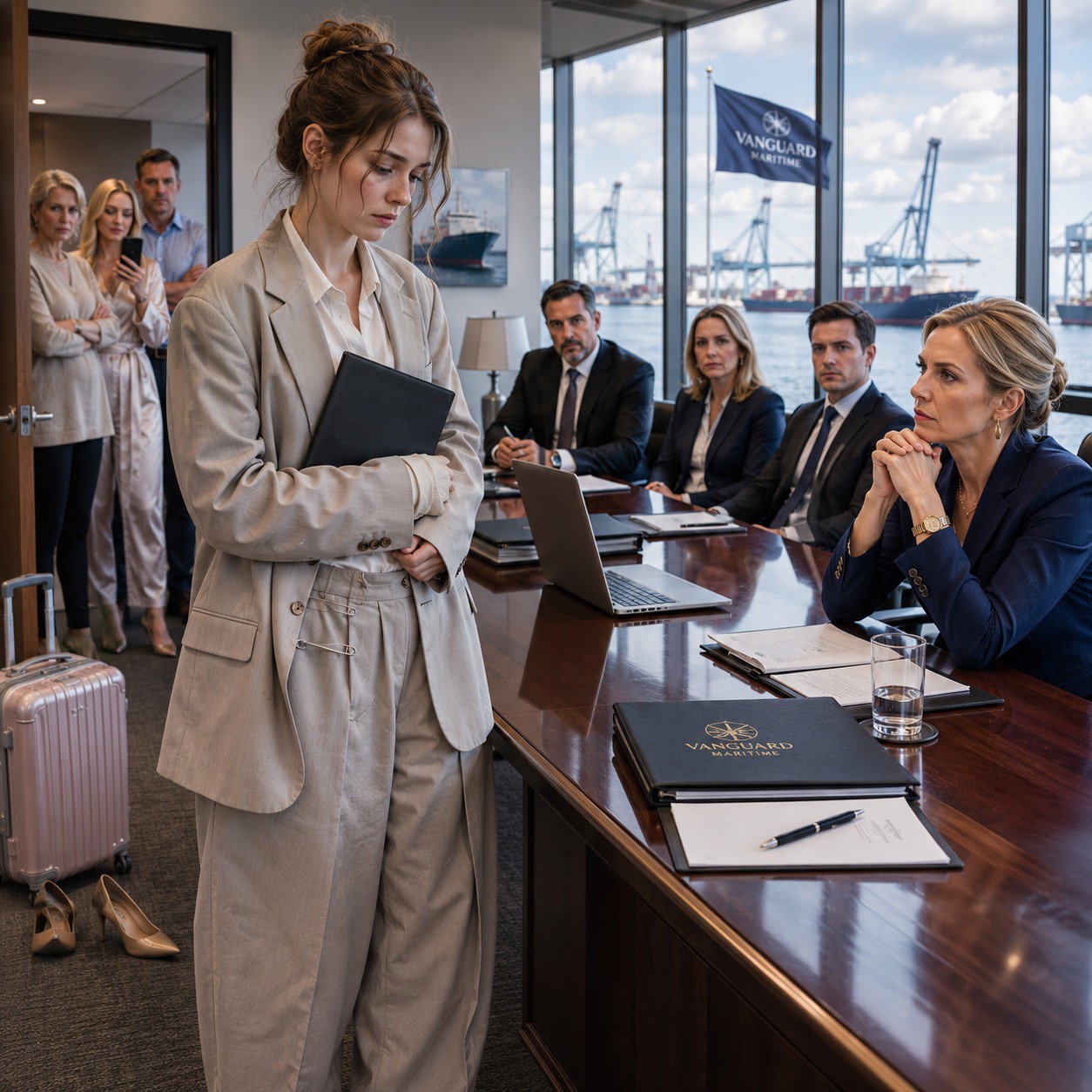
The conference room on the fourteenth floor of Vanguard Maritime headquarters overlooked Charleston Harbor, and through the floor to ceiling windows the gray morning water caught fractured sunlight and threw it back in pieces that moved across the polished mahogany table like something alive. A cargo ship sat motionless near the channel marker, waiting for a pilot, and beyond it the bridge rose in its clean white arc against a sky that could not decide whether to be overcast or clear. The room smelled like leather chairs and fresh coffee and the particular neutrality of corporate spaces that have been designed to contain difficult conversations without absorbing any of their residue.
Keira’s father had sent the email less than two hours earlier. Before she crossed the bridge. Before her mother handed her Vanessa’s old suit and watched her put it on. Before the safety pins.
The timestamp sat there on the screen in front of her, almost polite in its precision, 7:14 a.m., which somehow made the betrayal feel even more deliberate than open cruelty. Her father had been awake early. He had composed this email with care. He had addressed it to Evelyn Cross, CEO of Vanguard Maritime, and copied the legal counsel and the HR director, and he had written it in the measured, clinical language of a man who wanted his interference to look like concern.
Mr. Murphy has a documented pattern of impulsive decision making and emotional instability under pressure. I strongly advise against offering relocation incentives or independent financial authority until family consultation has occurred regarding her long term capability and judgment.
The silence in the room stretched so long that Keira could hear the distant hum of the harbor cranes through the glass. Nobody at the table interrupted her reaction because there was nothing comfortable anyone could say without exposing the ugliness sitting plainly inside those paragraphs. The legal counsel sat with his hands folded. The HR director had slid a glass of water toward Keira without speaking, the small gesture almost unbearable in its unexpected gentleness. The senior engineer had stopped pretending to review paperwork and was looking at her directly for the first time since she had entered the room that morning in a suit two sizes too big, held together with safety pins her mother had pressed into the waistband while telling her she looked fine.
Evelyn Cross leaned back slightly in her chair, fingers resting together beneath her chin, studying Keira with the same measured focus she brought to contract negotiations and board presentations. Evelyn was fifty three years old. She had built Vanguard Maritime from a regional shipping consultancy into a company that designed autonomous navigation systems for commercial vessels. She had done it without family money, without a husband’s connections, without anyone’s permission. She looked at Keira across the table with an expression that was neither pity nor sympathy but something more useful than either.
Your father called twice after sending it, Evelyn said quietly. He wanted confirmation that someone from your family would supervise relocation paperwork personally.
Heat rushed into Keira’s face so suddenly her skin hurt. But underneath the embarrassment, another feeling pushed upward through the shock and shame. Not surprise. That was the worst part. A surprised person still believes something different could have happened. Keira already knew exactly who her father had always chosen to protect. Not her. Not even the family, really. The architecture. The system. The arrangement of rooms and roles and permissions that kept everyone in the Murphy household positioned exactly where he wanted them, with himself at the center and his authority extending outward like the walls of a house that had been built not to shelter its occupants but to contain them.
I did not know he contacted you, Keira said. Her voice sounded thin and distant even to her own ears.
Evelyn nodded once. I believe that.