PART 1 OF 2
Part 1: The Pastel Nightmare
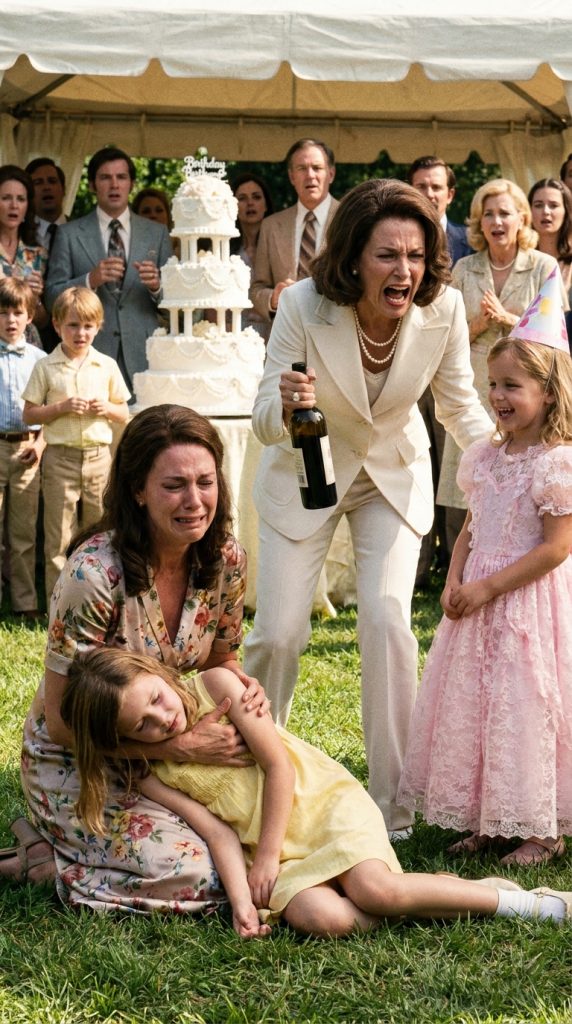
The backyard of my parents’ sprawling suburban Philadelphia home was a sickeningly sweet, carefully curated illusion. It was a sea of pastel pink streamers, a massive, rented bouncy castle shaped like a fairytale fortress, and a towering, three-tier fondant cake that cost more than my first car. A string quartet played softly near the patio. It was an Instagram-perfect setting for my niece Autumn’s seventh birthday party.
But like everything in my family, it was a beautiful facade built over a foundation of absolute, suffocating rot.
I stood near the edge of the manicured lawn, holding my two-year-old daughter, Rosie’s, hand tightly. She was wearing a tiny yellow sundress, her brown curls bouncing as she pointed excitedly at a clown making balloon animals.
Rosie was our miracle. After five years of devastating miscarriages, crippling debt, and grueling rounds of IVF, my husband Derrick and I had finally brought her home. She was the absolute center of our universe. Every breath she took felt like a victory we had fought a war to achieve.
But to my older sister, Natalie, and my parents, Rosie was merely an inconvenience—a lesser child who dared to steal even a fraction of the spotlight from Natalie’s perfect, neurotypical, photogenic offspring.
Natalie was the untouchable Golden Child. She had married Preston, a wealthy corporate lawyer, lived in a house that looked like a magazine spread, and commanded my parents’ adoration with the effortless cruelty of a tyrant. I, on the other hand, was the Scapegoat. I was the disappointing younger sister who married a city paramedic, struggled with infertility, and refused to play the role of the subservient supporting cast member in Natalie’s life story.
I checked my watch. It was 1:30 PM. Derrick was finishing a grueling 24-hour shift at the firehouse and was scheduled to arrive any minute. I just had to survive the tension until he got here.
My mother, Catherine, materialized beside me, a glass of champagne in her hand. Her smile was tight, her eyes hard and evaluating.
“Emma,” Catherine commanded, not bothering with a greeting. “The gift we bought for Natalie—the tennis bracelet—is locked in the trunk of my car in the driveway. The keys are in my purse in the kitchen. Go get it. We’re doing presents in five minutes.”
I looked down at Rosie. She was rubbing her eyes, her thumb drifting toward her mouth. “Mom, Rosie really needs a nap. She’s getting cranky. Can’t Preston go get it?”
Catherine’s face darkened. She physically stepped between me and my daughter, blocking my view of the bouncy castle.
“Don’t be ridiculous,” Catherine snapped, her voice dropping to that familiar, terrifying hiss she used to silence me when I was a child. “Preston is entertaining his firm’s partners. You are doing nothing. We’ve raised children before, Emma. It will take you exactly two minutes. Stop hovering over her like a neurotic. It’s embarrassing.”
“I just don’t want to leave her alone in this crowd,” I hesitated, my stomach knotting with a familiar, deeply ingrained anxiety.
“Natalie is right there,” Catherine pointed to my sister, who was standing near the cake table, sipping Pinot Grigio and laughing with the other mothers. “She’ll watch her. Now go.”
Against every screaming, primal instinct in my body, I let go of Rosie’s hand. I told myself I was overreacting. I told myself it was two minutes. I told myself my sister, a mother of two, wouldn’t let anything happen to a toddler in a fenced-in backyard.
I walked toward the house, navigating through the crowd of laughing children and drinking adults. I went into the kitchen, dug through my mother’s oversized designer purse, found the keys, and walked out the front door to the circular driveway. The trunk was jammed, requiring me to fiddle with the latch for several agonizing minutes before I finally extracted the velvet jewelry box.
The errand took exactly fifteen minutes.
I hurried back through the house, the heavy gift box clutched in my hands. As I stepped onto the back patio, the blinding afternoon sun hit my eyes. I scanned the sea of children for Rosie’s bright yellow sundress.
I checked the bouncy castle. I checked the clown station. I checked the snack tables.
Nothing.
My heart began to hammer a frantic rhythm against my ribs. A cold sweat broke out on the back of my neck.
I pushed through the crowd, my eyes darting frantically. I found Natalie and my mother still standing by the cake table. They were clinking their wine glasses together, laughing at a joke one of Preston’s colleagues had just made.
Rosie was nowhere to be seen.
And the smug, entirely unbothered look on my sister’s face made the blood freeze in my veins.
Part 2: The Blue Lips
I dropped the velvet jewelry box onto the patio stones. It hit the ground with a heavy thud, but neither Natalie nor my mother seemed to notice.
I shoved past a woman in a floral dress and grabbed Natalie by the arm.
“Where is she?” I demanded, my voice cracking, rising above the string quartet. “Where is Rosie?”
Natalie slowly turned her head, looking at my hand on her arm as if it were a diseased insect. She pulled away, rolling her perfectly mascaraed eyes, and took a slow, deliberate sip of her Pinot Grigio.
“Relax, Emma, God,” Natalie sighed, her voice dripping with extreme annoyance. “She was whining. She was crying because she couldn’t go in the bouncy castle with the big kids, and she was totally ruining Autumn’s day. The noise was giving me a migraine.”
“Where. Is. My. Daughter,” I gritted out, the panic bubbling over into pure terror.
“I handled it,” Natalie said dismissively, waving her manicured hand toward the house. “I gave her some Benadryl to knock her out so we could have some peace. She fell asleep in five minutes. I put her in the guest room upstairs.”
I didn’t breathe. I didn’t think. The maternal instinct that had screamed at me fifteen minutes ago exploded into a deafening roar.
You don’t give Benadryl to a two-year-old to make them sleep. You don’t leave them unattended on an adult bed.
I turned and sprinted.
I tore through the patio doors, shoving past guests in the kitchen. I hit the hardwood stairs taking them two, then three at a time. I scrambled down the carpeted hallway of the second floor and slammed both hands into the closed door of the guest room, bursting inside.
The room was dim, the heavy blackout curtains drawn against the afternoon sun.
Rosie lay perfectly still in the dead center of the massive, king-sized duvet.
She wasn’t curled up. She wasn’t sucking her thumb. She was flat on her back, her little arms splayed awkwardly out to the sides.
I lunged onto the bed and grabbed her shoulders. “Rosie? Baby, wake up. Mommy’s here.”
Her head lolled back against the mattress. She was entirely limp, like a ragdoll.
I pulled her up to the light filtering through the crack in the curtains.
My heart stopped.
Her tiny, beautiful lips were tinted a horrifying, unmistakable shade of blue. The skin around her eyes was gray. I pressed my ear to her chest. I heard nothing. I looked at her stomach. It wasn’t rising. It wasn’t falling.
She was not breathing.
An animalistic scream—a sound born of pure, primal agony—tore from the deepest part of my throat. It was a sound I didn’t know a human being could make.
I scooped her limp, heavy body into my arms and threw myself off the bed, laying her flat on the hard wooden floor. I tilted her chin back, pinched her nose, and blew a breath into her tiny mouth. Her chest rose slightly.
I placed two fingers on the center of her sternum and began rapid compressions. One, two, three, four…
“Call 911!” I shrieked, tears blinding me, my voice tearing my vocal cords. “SOMEBODY CALL 911!”
Footsteps thundered up the stairs. My father, Donald, appeared in the doorway, a scotch glass in his hand. His face was twisted not in horror, but in deep irritation.
“Emma, what the hell are you doing?” Donald barked, stepping into the room. “Stop screaming, you’re scaring the guests! People are looking up at the windows! She’s just sleeping, leave her alone!”
“She’s not breathing!” I sobbed, giving Rosie another rescue breath. “Call an ambulance! Dad, please!”
A woman—one of Preston’s coworkers—peered in behind my father. She took one look at Rosie’s blue face, gasped loudly, and immediately pulled her phone from her purse, dialing frantically with shaking hands.
“We need an ambulance!” the woman yelled into her phone, pushing past my father. “A child is unresponsive!”
Suddenly, Natalie pushed her way into the room. Her face was flushed dark red with rage. She wasn’t looking at Rosie. She was looking at me.
“You are ruining my daughter’s party!” Natalie hissed, her eyes wild, fully detached from reality. She stepped toward me, gripping the neck of a heavy, half-empty wine bottle in her right hand. “You always have to make everything about you! Stop faking this!”
“Get away from me!” I screamed, continuing the compressions on my baby’s chest. Come on, Rosie. Please. Please.
“Stop touching her!” Natalie screamed back.
In one swift, psychotic motion, driven by a lifetime of unchecked rage and the absolute certainty that she could do whatever she wanted without consequence, Natalie swung the wine bottle downward in a vicious arc.
The thick glass shattered against the side of my head.
A blinding flash of white-hot pain exploded behind my eyes, like a firework detonating inside my skull. The sound of the glass breaking was deafening, followed immediately by the warm, thick, sickening rush of blood pouring down the side of my face, blinding my left eye, and dripping onto Rosie’s yellow dress.
My vision swam. The room tilted violently. My arms, which had been pumping rhythmically on my daughter’s chest, gave out, collapsing beneath me.