Part 1 of 2
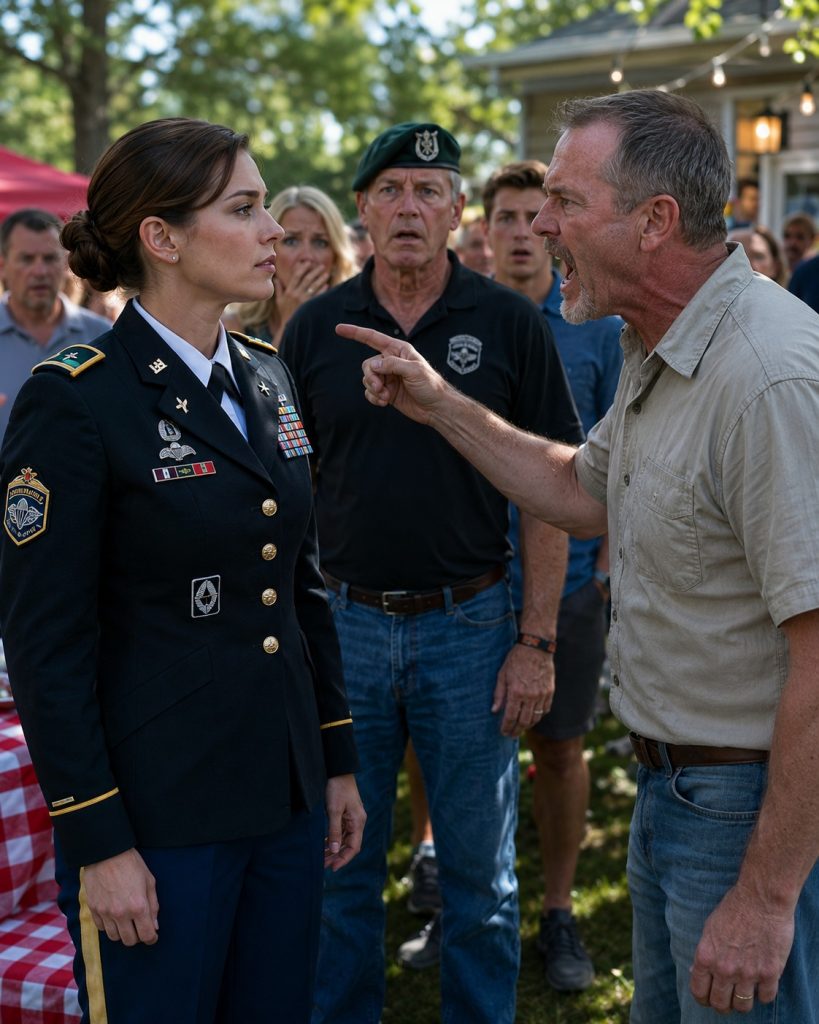
PART 2
The backyard stayed silent after Uncle Grant saluted me.
Not polite silence.
Not awkward silence.
The kind of silence that makes people suddenly aware of every sound around them.
The hiss of the grill.
Wind moving through pine trees.
Ice shifting inside forgotten cups.
My father stood frozen beside the smoker, staring at his older brother like he had spoken another language.
“What the hell is Viper?” he finally asked.
Uncle Grant lowered his salute slowly but didn’t relax.
Neither did I.
Because he had just said a classified callsign out loud in front of civilians.
A callsign buried inside operations most of these people would never even hear rumors about.
And judging by the look on his face…
He realized it too late.
“Grant?” my father snapped again. “What is going on?”
Uncle Grant looked at me carefully.
Waiting.
Giving me the choice.
I could shut it down.
Pretend he was confused.
Walk away.
That’s what protocol demanded.
But after thirty-six years of silence…
Something inside me was tired of shrinking.
So I spoke calmly.
“It’s an old deployment name.”
My father laughed harshly.
“Deployment name? What, like some video game nonsense?”
“Harold,” my mother whispered nervously, “stop.”
But he couldn’t stop.
Not now.
Because men like my father build their identities carefully over decades, and the moment reality threatens them, they attack harder.
“You expect me to believe my daughter is some kind of war hero?” he scoffed loudly. “Grant, tell them the truth. She works a desk job.”
Uncle Grant’s expression darkened.
“No,” he said quietly. “She absolutely does not.”
That got everyone’s attention.
Tyler slowly lowered his beer.
Even my cousins stopped pretending not to listen.
My father folded his arms stubbornly.
“Then explain it.”
Grant hesitated.
I saw the conflict immediately.
The old soldier inside him was fighting two instincts at once.
Protect classified information.
Or defend me.
Finally, he looked directly at my father.
“You know that hostage extraction in Syria eight years ago?”
Dad frowned.
“The diplomats?”
Grant nodded once.
“The operation that got those Americans out alive?”
Dad shrugged.
“Yeah. Saw it on the news.”
Grant pointed at me.
“She planned it.”
The backyard seemed to tilt sideways.
Tyler blinked hard.
My mother covered her mouth.
And my father—
My father laughed.
Actually laughed.
Because denial was easier than accepting the truth.
“That’s ridiculous.”
“It’s classified,” Grant replied. “Or most of it is. But enough got declassified afterward that I can say this much: half the people you spent your life admiring know your daughter’s name.”
I looked away immediately.
Not from shame.
From discomfort.
I hated this part.
The attention.
The mythology people attached to military work.
Most operations weren’t glorious.
They were exhaustion, pressure, impossible choices, and carrying ghosts home quietly.
But my father suddenly looked uncertain.
And uncertainty was new on him.
“You’re serious,” he said slowly.
Grant nodded.
“She’s one of the best strategic officers I’ve ever heard of.”
Dad looked at me again.
Really looked.
Maybe for the first time in years.
But instead of pride, suspicion crept into his face.
“Then why’s everything secret?”
There it was.
The accusation beneath the question.
Liar.
Always liar.
I answered evenly.
“Because some missions involve people still alive.”
He stared hard at me.
Then shook his head.
“No. I don’t buy it.”
Of course he didn’t.
Because if he accepted reality, he’d have to confront what he spent eighteen years saying about me.
Weak.
Emotional.
Soft.
Wrong.
Men like my father would rather destroy reality than admit they misjudged someone.
Especially their own daughter.
—
Dinner became painfully tense after that.
Nobody knew how to act around me anymore.
My cousins suddenly became overly polite.
Tyler avoided eye contact entirely.
My mother hovered nervously with trays of food she barely touched.
And my father drank faster than usual.
I stayed near the edge of the yard beneath the pine trees, trying to disappear into the humid Georgia evening.
Uncle Grant eventually joined me quietly.
“You should’ve corrected me,” he murmured.
“I could’ve.”
His weathered face tightened.
“But you didn’t.”
“No.”
For a moment we stood silently listening to cicadas.
Then he sighed heavily.
“I heard stories about Viper for years before I realized it was you.”
I glanced sideways at him.
That surprised me.
“You didn’t know?”
“Not at first. Different units. Different channels.” He shook his head slowly. “Then two years ago somebody mentioned Colonel Rebecca Hayes during a briefing.”
His eyes moved toward my father across the yard.
“He still has no idea, does he?”
“No.”
Grant rubbed one hand across his jaw.
“He worships soldiers. But only the version he understands.”
That was painfully accurate.
To my father, soldiers looked a certain way.
Sounded a certain way.
Most importantly—
They were men.
Preferably loud ones.
Men who drank beer, fixed trucks, and talked about toughness constantly.
Not women like me.
Quiet women.
Controlled women.
Women who learned endurance instead of performance.
“You know,” Grant said carefully, “your father talks about patriotism nonstop. But he’s never actually understood service.”
I looked down at the grass.
“He understands hierarchy.”
Grant gave a grim smile.
“Yes. That too.”
Before either of us could continue, Tyler approached hesitantly.
My younger brother suddenly looked ten years younger than forty.
“Can we talk?” he asked quietly.
I nodded once.
Grant stepped away immediately.
Tyler shoved both hands into his pockets awkwardly.
“I didn’t know.”
“About what?”
“Any of it.”
His voice sounded genuinely shaken.
I believed him.
Tyler wasn’t cruel the way Dad could be.
Just weak.
Weak in the way people become when favoritism protects them from consequences their entire lives.
“I never asked,” he admitted quietly.
That landed harder than if he’d insulted me.
Because it was true.
Nobody in my family had ever really asked about my life.
Not seriously.
My deployments became “work trips.”
My medals became “certificates.”
My silence became emptiness instead of confidentiality.
And eventually I stopped trying.
Tyler looked miserable.
“I thought you were logistics or administration or something.”
I almost smiled.
“Technically, sometimes I was.”
“Grant said diplomats?”
I stayed silent.
His eyes widened slightly.
“Jesus.”
“Don’t romanticize it,” I replied calmly. “Operations aren’t movies.”
He nodded slowly.
Then surprised me.
“Dad’s scared.”
I frowned.
“Scared?”
“He built his whole identity around being the military guy in the family. The tough one. The authority.”
Tyler glanced toward our father.
“And now he realizes he never understood the actual soldier sitting right in front of him.”
—
By sunset, most of the extended family had started leaving.
The atmosphere remained strange.
People hugged me differently now.
More carefully.
Like I had become someone unfamiliar.
That part always bothered me.
Respect built on secrecy isn’t real understanding.
It’s intimidation.
My aunt Denise squeezed my arm near the driveway.
“You should’ve told us.”
I answered honestly.
“You never wanted to know.”
Her face fell immediately because she knew it was true.
The only person who still refused to soften was my father.
He sat alone beside the grill long after the food was gone, drinking whiskey now instead of beer.
Watching me.
Analyzing me.
As though trying to locate the lie.
Eventually my mother approached quietly.
“Your father wants to talk.”
Every muscle in my body tightened instinctively.
Thirty-six years old.
Colonel in the United States Army.
And still one sentence from my mother could make me feel sixteen again.
I walked across the darkening yard slowly.
Dad didn’t look up when I stopped beside him.
“You embarrassed me,” he muttered.
I blinked.
Of all possible reactions…
That one almost made me laugh.
“You humiliated yourself.”
His jaw tightened.
“Grant made me look stupid.”
“No,” I said calmly. “You did that alone.”
Finally he looked at me.
And underneath the anger…
I saw confusion.
Real confusion.
“How’d this happen?” he asked roughly.
The question sounded almost personal.
Like betrayal.
As though my success violated reality itself.
“I worked,” I answered simply.
“That’s not enough to become…” He gestured vaguely toward my uniform. “That.”
I stared at him for several long seconds.
Then quietly asked the question I had buried most of my life.
“Would it have mattered if I failed?”
His expression shifted slightly.
Just enough.
And suddenly I knew the answer.
No.
Because my father never expected greatness from me in the first place.
Only obedience.
Tyler’s failures were temporary.
Mine were inevitable.
Dad looked away first.
“You were always angry.”
“No,” I replied softly. “I was ignored.”
That hit him harder than yelling would have.
Good.
He swallowed hard before speaking again.
“Grant says people know your name.”
“They know my work.”
“What’s the difference?”
Everything.
But I was too tired to explain.
“You wouldn’t understand.”
That made him furious instantly.
“There you go. Acting superior.”
I almost responded.
Then stopped.
Because suddenly I realized something freeing.
I didn’t actually need him to understand anymore.
For years I thought success would finally force my father to love me correctly.
But people don’t transform just because reality embarrasses them.
Some only dig deeper.
“I have to leave before dawn,” I said quietly.
“Running away again?”
I looked at him calmly.
“No. Returning to work.”
Then I walked away.
And for once in my life…
I didn’t feel guilty.
—
I stayed overnight at my mother’s house because driving back to Fort Liberty that late made no sense.
My childhood bedroom looked smaller than I remembered.
The pale yellow walls.
The narrow bed.
The old track medals still hanging near the closet.
Nothing about the room suggested the life I eventually built.
Maybe that was fitting.
Around midnight, I heard quiet footsteps outside my door.
Then a soft knock.
My mother entered carefully holding two mugs of tea.
She sat beside me without speaking initially.
We stayed quiet for a while.
Then she whispered:
“I’m sorry.”
Simple words.
But twenty years late.
I stared into my tea.
“You knew.”
It wasn’t a question.
She nodded slowly.
“Not specifics. But enough.”
“Enough to stop him.”
Tears filled her eyes instantly.
“You don’t understand your father.”
“No,” I replied evenly. “I understand him perfectly.”
She flinched.
And suddenly I saw something I had missed growing up.
Fear.
My mother wasn’t passive because she agreed with Dad.
She was passive because she had spent decades surviving him.
Not physical violence.
Something quieter.
Control.
Dismissal.
The erosion of confidence over years.
“He was harder after you left,” she admitted softly.
That surprised me.
“How?”
“He thought the Army turned you against him.”
I laughed once bitterly.
“No. He did that himself.”
She looked exhausted.
Older than I remembered.
“You know he talks about you constantly?”
I frowned.
“What?”
“He tells people his daughter’s an officer.”
I stared at her in disbelief.
“He’s proud,” she whispered.
“No. He’s possessive.”
Her eyes widened slightly because she knew I was right.
There’s a difference.
One loves who you are.
The other loves claiming ownership over your accomplishments.
My mother hesitated before asking quietly:
“Are you really in danger all the time?”
I smiled faintly.
“No more than anyone else in my field.”
“That’s not comforting.”
“It isn’t supposed to be.”
She looked down at her tea.
Then finally asked the question buried beneath everything else.
“Are you happy?”
That one caught me off guard.
Because nobody in my family had ever asked before.
Not once.
Not truly.
I considered the answer carefully.
“Yes,” I said eventually.
And surprisingly…
I meant it.
Not perfectly happy.
Not movie happy.
But purposeful.
Useful.
Respected.
Things I never felt in this house.
My mother smiled sadly.
“I’m glad one of us escaped.”
—
At 0430 the next morning, I woke to pounding on the front door.
Instantly alert.
Years of training kicked in before consciousness fully arrived.
I was out of bed and halfway across the room before realizing where I was.
Another hard knock echoed downstairs.
Voices followed.
Male.
Urgent.
I reached automatically toward where my sidearm normally would’ve been before remembering regulations prevented carrying while drinking earlier.
My stomach tightened.
Wrong.
Something felt wrong.
I moved downstairs quietly.
My father had already opened the door.
Two men in dark suits stood outside beneath the porch light.
Federal.
No question.
One held credentials.
The other scanned the house perimeter automatically.
Both looked serious.
Dad glanced toward me immediately.
“They’re here for you.”
The older agent stepped forward.
“Colonel Hayes?”
“Yes.”
“We need a private conversation immediately.”
Every instinct sharpened.
“What happened?”
The agents exchanged a quick look.
Then the older one spoke carefully.
“There’s been a breach.”
Cold slid through my chest.
“What kind of breach?”
“We can discuss details during transport.”
My father looked confused.
“Transport?”
The younger agent finally spoke.
“Ma’am, your name was mentioned publicly yesterday in connection with classified operational identifiers.”
I understood instantly.
Viper.
Uncle Grant.
Damn it.
“The exposure has triggered internal review protocols,” the older agent continued. “And possibly something else.”
“What else?”
Another pause.
Then:
“Three hours ago, someone accessed archived files connected to Operation Viper.”
The world narrowed sharply.
Operation Viper wasn’t just classified.
It was buried.
Compartmentalized.
Locked behind levels most officers never touched.
Nobody accidentally accessed those files.
“Who?” I asked quietly.
“We don’t know yet.”
That answer terrified me more than certainty would have.
Because uncertainty meant active threat assessment.
The younger agent handed me a secure phone.
“Your commanding officer requested direct contact immediately.”
I took it.
A familiar voice answered after one ring.
“Rebecca.”
General Morrison.
Which meant this was serious.
Very serious.
“Sir.”
“Where are you exactly?”
“Savannah. My parents’ house.”
“Stay with the agents. Do not separate.”
My pulse accelerated.
“Sir, what’s happening?”
Silence.
Then:
“We believe someone may have used yesterday’s exposure to identify you.”
The room seemed colder suddenly.
Behind me, my father looked increasingly uneasy.
“Identify me for what?”
Another pause.
Then the General answered quietly.
“Retaliation.”
—
The drive to Hunter Army Airfield happened before sunrise.
Nobody spoke much.
The agents remained hyper-alert the entire trip.
Watching mirrors.
Monitoring comms.
Checking intersections.
I recognized the posture instantly.
Protective detail behavior.
Which meant the threat level was real.
My secure phone buzzed halfway there.
A message from Uncle Grant.
I’m sorry.
Before I could respond, another message appeared.
You weren’t supposed to become visible.
Visible.
Interesting choice of word.
Not exposed.
Not embarrassed.
Visible.
As if visibility itself was dangerous.
Maybe it was.
At the airfield, military police escorted us directly inside a secure operations building.
No greetings.
No delays.
Everything moved fast.
Too fast.
General Morrison appeared waiting near a conference room.
Tall.
Gray-haired.
Calm in the way powerful men become during crises.
“Colonel.”
I saluted automatically.
He returned it sharply.
Then dismissed the agents.
The second the door closed, his expression hardened.
“Tell me exactly what was said yesterday.”
I explained everything carefully.
The cookout.
My father.
Grant recognizing the patch.
The callsign.
Morrison listened silently.
When I finished, he exhaled slowly.
“Damn it, Grant.”
“What’s this really about?”
The General studied me carefully.
Then slid a classified file across the table.
Red stripe.
Restricted compartment.
My stomach tightened immediately.
I opened it slowly.
And froze.
Because staring back at me was a photograph.
Not recent.
Old.
Maybe twenty years old.
A younger Uncle Grant standing beside three soldiers I didn’t recognize.
Except one face.
My father.
I looked up sharply.
“Why is my father in a black operations file?”
General Morrison’s expression turned grim.
“Because your father lied to you too.”
My heartbeat stopped.
“What?”
Morrison folded his hands carefully.
“Your father was never just a mechanic.”
I stared at him.
“No.”
“He served briefly attached to an intelligence support unit during the late 1980s.”
“That’s impossible. He would’ve told everyone.”
“No,” Morrison said quietly. “He wouldn’t.”
He slid another document toward me.
This one contained one sentence highlighted in red.
SUBJECT REMOVED FOLLOWING INTERNAL COMPROMISE INVESTIGATION.
I read it twice.
Then looked up slowly.
“What compromise?”
Morrison’s jaw tightened.
“We believe your father was connected to an operation failure that got two agents killed.”
The room went silent.
“No,” I whispered.
“The investigation disappeared politically. Most records buried.”
I looked again at the photo.
My father looked young.
Confident.
Standing beside Uncle Grant.
Beside men who were probably dead now.
“Why are you telling me this?”
The General held my gaze steadily.
“Because Operation Viper wasn’t random.”
A chill crawled slowly up my spine.
“What does that mean?”
Morrison hesitated.
Then finally answered.
“The mission that made your reputation…”
He tapped the file lightly.
“…was connected to the same network your father failed to stop thirty years ago.”
I stopped breathing.
Somewhere deep in the building, alarms suddenly began blaring.
The General stood instantly.
An officer burst through the door seconds later.
“Sir—we have unauthorized access inside the west corridor.”
Morrison turned toward me sharply.
Then said six words that changed everything.
“They found you faster than expected.”