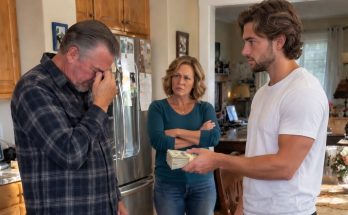
PART 2 — The Quiet Widow’s Ranch
The doorbell rang again.
Not loud.
Not dramatic.
Just one clean chime cutting through my little living room while the gold pen hovered over a signature line Brooke had been praying I wouldn’t read.
Her polished smile cracked at the corner.
Paul, the man with the navy suit and black briefcase, looked up first. His eyes flicked to the door, then to Brooke, then to the papers spread across my coffee table like white bones.
“Were you expecting someone?” Brooke asked.
Her voice was still sweet.
But sweetness has a sound when it is forced.
Thin.
Tight.
A little too high.
I set the gold pen down with the care of a woman placing a scalpel back in its tray.
“Yes,” I said. “I was.”
Brooke’s fingers tightened around the edge of her cream leather handbag.
“Mom, we really should finish this first,” she said. “Paul has another appointment.”
Paul swallowed.
He did not look like a man with another appointment.
He looked like a man beginning to understand he had walked into the wrong house with the wrong briefcase on the wrong afternoon.
I rose slowly from my chair.
At sixty-nine, you learn the power of not rushing. People who think they own the room expect panic. They expect tears. They expect the elderly to tremble, forget, apologize, and make space for younger voices.
I gave them none of that.
I walked to the door while Brooke watched me as if the rug beneath her had begun moving.
When I opened it, rain was misting lightly over the porch rails. Seattle rain—not a storm, just that endless gray breath that turns everything silver.
Standing beneath the porch light were three people.
Margaret Ellis, my attorney, wore a charcoal coat and carried a slim leather folder against her chest.
Beside her stood Detective Evelyn Shaw from the financial crimes unit, a calm woman in her forties with dark hair pinned at the nape of her neck and eyes that missed very little.
And behind them, holding his hat in both hands, stood Frank Calder.
Frank had been my late husband’s ranch manager for twenty-six years.
His face was browned by wind and sun, his shoulders still broad beneath a canvas jacket, his boots carrying traces of eastern Washington dirt onto my Seattle porch.
The ranch had come to my doorstep.
Brooke saw them over my shoulder.
For one second, she didn’t recognize what she was looking at.
Then Margaret smiled.
Not kindly.
Professionally.
“Suzanne,” she said, “we came as soon as you called.”
Brooke stood so quickly her handbag slipped off her wrist and hit the carpet.
“Called?” she said.
I stepped aside.
“Please come in.”
Margaret entered first, then Detective Shaw, then Frank. The room changed as they crossed the threshold. Not because they raised their voices. Not because they made threats. But because truth has a weight. When enough of it walks into a room, lies suddenly need somewhere to hide.
Brooke’s eyes darted to Matthew’s wedding photo on the mantel, then back to Margaret.
“Who are these people?” she asked.
“My attorney,” I said. “A detective. And an old friend of my husband’s.”
Paul’s face drained.
Detective Shaw glanced at the coffee table.
“Are those the documents you mentioned, Mrs. Harlan?”
Mrs. Harlan.
Not Mom.
Not Miss Suzanne.
Not sweet little old lady.
My legal name, spoken clearly in my own house.
“Yes,” I said. “They are.”
Brooke let out a brittle laugh.
“This is ridiculous. We’re just helping her with estate planning.”
Margaret removed her gloves one finger at a time.
“That is interesting,” she said. “Because Mrs. Harlan already completed her estate planning three days ago.”
Brooke froze.
Paul’s eyes snapped toward Brooke.
Three days ago.
Those words landed harder than a shout.
Brooke recovered first. Women like Brooke often do. Not because they are strong, but because they are used to performing under pressure.
“Well,” she said, folding her arms, “that’s wonderful. Matthew will be relieved. We’ve been very worried about her.”
Detective Shaw looked at her.
“Worried in what way?”
Brooke gave her a smooth, sorrowful smile.
“She’s been confused. Forgetful. Emotional. Since the wedding, especially. Grief comes back at strange times, you know. She’s been alone for so long.”
I looked at my daughter-in-law and almost admired the speed of it.
There it was.
The first knife.
Not in my chest.
In my mind.
Confused.
Forgetful.
Emotional.
Those words are gentle only to people who don’t understand how they are used against old women.
Margaret opened her folder.
“Mrs. Harlan passed a full cognitive evaluation last week,” she said. “Administered independently. She also met with me twice, alone, with no family present, and demonstrated complete understanding of her assets, beneficiaries, and legal rights.”
Brooke blinked.
Frank looked down at the floor, jaw hard.
Paul shifted toward the briefcase.
Detective Shaw noticed.
“Sir,” she said, “please keep your hands visible.”
Paul stopped.
His lips parted. “I’m only the notary.”
“Then you won’t mind staying,” Detective Shaw said.
Brooke’s face hardened. “You can’t detain us in a private home.”
“No,” Detective Shaw said. “But I can observe. And I can ask questions. You’re free to leave after we identify everyone present and review whether an elderly homeowner was brought legal documents under false pretenses.”
Brooke stared at her.
Then at me.
For the first time since I had met her, I saw something real behind her eyes.
Not grief.
Not guilt.
Calculation.
She was measuring the room and finding no soft corner left.
Margaret walked to the coffee table and looked down at the papers without touching them.
“Paul,” she said pleasantly, “would you care to explain why a notary brought a durable power of attorney, a quitclaim deed, and what appears to be a trust amendment for my client to sign without her attorney present?”
Paul’s mouth opened, closed, opened again.
“I didn’t prepare them.”
“Who did?”
He glanced at Brooke.
Brooke smiled sharply.
“Matthew did,” she said.
My heart flinched.
Not because I believed her.
Because some part of me still wanted not to.
Even after the wedding.
Even after the phone calls.
Even after every careful little push wrapped in concern.
A mother’s heart is the last room to admit the house is burning.
I looked at the papers.
“Matthew prepared these?”
Brooke lifted her chin.
“He asked me to help. He’s your only child, Suzanne. He has every right to be involved.”
Margaret looked up.
“No, he does not.”
The room went silent.
Margaret’s voice stayed calm, but steel sat beneath every word.
“An adult child has no automatic right to manage a parent’s property. Marriage does not transfer authority. Concern does not create legal power. And showing up with a notary to pressure a competent widow into signing away control of her assets is not estate planning.”
Brooke’s cheeks colored.
“You’re twisting this.”
“No,” Margaret said. “The documents are doing that by themselves.”
She lifted the top page with a gloved hand and read.
“Durable Power of Attorney. Agent: Brooke Eleanor Harlan.”
I heard Frank breathe in.
Brooke’s maiden name had not been Harlan. She had taken Matthew’s name seven days ago.
Seven days.
And already she had written herself into my life as if she had been there through the winters, the hospital stays, the funeral, the lonely mornings when grief sat across from me at breakfast.
Margaret continued.
“Alternate agent: Matthew Robert Harlan. Effective immediately upon signing. Broad authority over banking, real estate, investment accounts, personal property, medical decisions, and residential placement.”
Residential placement.
There it was.
A quiet phrase that could move a woman from her own home into a facility chosen by people who found her inconvenient.
Brooke stepped forward.
“It’s standard language.”
Margaret looked at her.
“It is predatory language when brought to a woman’s home under the claim that she is signing ‘a few documents for the house.’”
Paul whispered, “I didn’t know.”
Detective Shaw turned toward him.
“What exactly were you told she was signing?”
Paul wiped his palms on his trousers.
Brooke snapped, “Paul.”
He looked at her, frightened now.
Detective Shaw said nothing.
That was enough.
Paul broke.
“She said Mrs. Harlan understood everything and just needed notarization. She said her mother-in-law was embarrassed about aging and would resist if there were too many explanations. She told me not to overwhelm her.”
Brooke’s eyes went flat.
“You misunderstood.”
“I have the texts,” Paul said.
The words seemed to suck the air from the room.
Brooke turned on him. “You’re a notary, not a lawyer. Don’t pretend you know what any of this means.”
“I know what you told me,” Paul said, voice shaking. “You said she was sitting on property she didn’t need and Matthew deserved security.”
Frank took one step forward.
“What property?” he asked.
Brooke’s mouth shut.
That was the moment she realized her second mistake.
She had come for my Seattle house.
But she had already sniffed around the ranch.
And now a man who had spent half his life protecting that land stood ten feet away, hearing her speak of it like loose change.
Margaret turned another page.
“Quitclaim deed. Transfer of the Seattle residence from Suzanne Marie Harlan, widow, to Matthew Robert Harlan and Brooke Eleanor Harlan, husband and wife, as community property.”
Brooke inhaled sharply.
Frank’s hands tightened around his hat.
I felt strangely calm.
Maybe because part of me had mourned this already.
Not the house.
Not even the money.
Matthew.
I had mourned my son in small pieces over the years, though I never admitted it. Each time he forgot a birthday but remembered a loan. Each time he called only when something needed fixing. Each time he let Brooke speak for him, then claimed he was just keeping peace.
Mothers are told love must be endless.
No one warns us that endless love can become a hallway where people keep tracking mud.
Detective Shaw looked at me.
“Mrs. Harlan, did you ask your daughter-in-law to bring these documents?”
“No.”
“Did you ask this man to come notarize anything today?”
“No.”
“Did anyone explain that signing these documents would give your daughter-in-law immediate authority over your finances, home, medical decisions, and living arrangements?”
“No.”
Brooke threw her hands up.
“This is absurd. She knew. We talked about simplifying things.”
I turned toward her.
“You told me assisted living would be safer.”
“Because it would be.”
“You told me the house was too much for me.”
“It is.”
“You told me Matthew needed stability.”
“He does.”
“And you told me a family should not keep assets scattered when younger people could make better use of them.”
Brooke’s expression hardened.
“Well, isn’t that true?”
There it was.
The polished mask slipped just enough for everyone to see the mouth beneath it.
Margaret closed the folder.
“Mrs. Harlan, may I ask why you did not mention the ranch to Brooke or Matthew?”
Brooke went still.
I looked at her.
Then at the wedding photo on the mantel.
Matthew smiling.
Brooke glowing.
Me standing at the edge of the frame like a woman waiting for permission to exist.
“I didn’t mention it,” I said, “because I wanted to know who they were when they thought I had nothing.”
No one spoke.
The rain tapped gently against the windows.
Brooke’s lips parted.
“The ranch,” she said carefully. “What ranch?”
Frank’s laugh came out low and bitter.
“Now she asks.”
I looked at my daughter-in-law.
“My husband inherited nearly five hundred acres in Adams County. Cattle land. Water rights. Three rental houses. A main ranch house. Equipment. Grazing leases. Mineral options that may or may not ever matter. It passed fully to me after he died.”
Brooke’s face changed so quickly it was almost ugly.
Shock first.
Then hunger.
Then anger at herself for showing hunger.
“You never told Matthew?”
“No.”
“That’s his father’s land.”
“That is my husband’s land,” I said. “And now it is mine.”
Brooke stared at me as if I had slapped her.
“Matthew had a right to know.”
“Matthew had many chances to be kind before he knew.”
For once, she had no answer.
Then headlights swept across the front window.
A car door opened outside.
My chest tightened before I saw him.
A moment later, Matthew stepped onto the porch without knocking.
He had a key.
Of course he had a key.
He used it before I could reach the door.
He stepped inside in a gray pullover and jeans, hair damp from rain, irritation already on his face.
“Brooke, what’s taking so—”
He stopped.
His gaze moved across the room.
Me.
Brooke.
Paul.
Margaret.
Detective Shaw.
Frank.
The papers.
His whole expression collapsed into confusion.
“What is this?”
Brooke rushed to him.
“Matthew, your mother called the police on us.”
I watched my son’s face twist with practiced disbelief.
“Mom, seriously?”
One word.
Mom.
How easily he found it when he needed to shame me.
Detective Shaw lifted a hand.
“No one called police on you, Mr. Harlan. I am here regarding a potential financial exploitation complaint.”
Matthew looked at me as though I had betrayed him.
“You filed a complaint?”
“I asked for help.”
His jaw tightened.
“Against your own son?”
That hurt.
I will not pretend it didn’t.
Even prepared women bleed.
But this time I did not reach for the wound. I let him see the damage.
“No,” I said. “I protected myself from whoever was willing to take my home.”
Matthew looked down at the papers.
Then at Brooke.
“What papers?”
Brooke’s face flickered.
Just once.
Small enough that another woman might have missed it.
But I had spent decades reading a sick husband’s pain before he said a word. I had known when bills were overdue by the sound of an envelope hitting the table. I had raised a boy through moods, lies, shame, hunger, pride.
I saw it.
Matthew had not known everything.
Not all of it.
Brooke touched his arm.
“The documents we discussed.”
He frowned. “We discussed power of attorney in case Mom needed help.”
Margaret said, “And the quitclaim deed?”
Matthew’s eyes sharpened.
“The what?”
Brooke’s hand slipped from his sleeve.
Paul looked like he wanted to disappear into the carpet.
Margaret lifted the page.
“This deed transfers your mother’s Seattle home to you and your wife.”
Matthew stared at it.
Then at Brooke.
“Why is that in there?”
Brooke’s mouth opened.
Closed.
Opened again.
“Because it’s cleaner that way,” she said finally. “You said the house was too much for her. You said she should move somewhere safer.”
“I didn’t say take her house.”
Brooke’s eyes flashed.
“You said we needed to plan.”
“Planning isn’t this.”
The first crack between them opened so quietly that only the women in the room heard it.
Brooke saw him stepping away from her and panicked.
“Matthew, don’t let them do this. Your mother is manipulating you. She hid a ranch from you.”
Matthew turned slowly.
“A ranch?”
There it was again.
The test.
I had expected anger.
I had expected confusion.
I had even expected greed.
But when Matthew looked at me, what I saw first was hurt. Raw, boyish hurt, the kind that took me back to scraped knees and broken school projects.
“You had Dad’s ranch and didn’t tell me?”
“Yes.”
“Why?”
“Because I needed to know whether you still loved me when you thought all I had was this little house.”
He looked away.
That answer struck harder than accusation.
Brooke seized the moment.
“Do you hear her? She tested us. She lied.”
I looked at Brooke.
“No. I waited.”
Brooke laughed coldly.
“You waited for what?”
“For you to show me whether I was family or an obstacle.”
Matthew whispered, “Mom.”
But it was not the same Mom as before.
This one had a crack in it.
A memory.
Maybe shame.
Maybe something beginning.
I did not move toward him.
For the first time in his adult life, I let him cross the distance himself or not at all.
Margaret laid the documents back down.
“Mr. Harlan, did you instruct your wife to prepare documents transferring your mother’s home?”
“No.”
“Did you instruct her to name herself primary agent under your mother’s power of attorney?”
Matthew’s face turned pale.
“Primary?”
Brooke’s eyes narrowed at Margaret.
Matthew looked at the paper again.
“Why are you first?”
Brooke’s voice sharpened.
“Because I know paperwork. You get emotional with her.”
“I’m her son.”
“And you let her guilt you.”
The words came too fast.
Too honest.
Matthew stared at her.
“She’s my mother.”
Brooke’s laugh was small and cruel.
“She’s a woman sitting on assets she hid from you while we’re drowning in wedding debt.”
There it was.
The room changed again.
Wedding debt.
Margaret’s eyes lifted.
Detective Shaw wrote something down.
Matthew looked at Brooke like he had never seen her before.
“What wedding debt?”
Brooke’s face went still.
“Don’t.”
“What wedding debt?”
She glanced at me, then at Margaret, then at Paul.
“This is not the place.”
Matthew took a step back.
“How much?”
Brooke’s silence answered before she did.
I thought of the $70,000 dress, the champagne tower, the imported flowers, the string quartet, the five-tier cake I had not been allowed to bake because homemade love was apparently beneath them.
Brooke folded her arms.
“It was an investment in our future.”
Matthew’s mouth fell open.
“How much, Brooke?”
“Two hundred and eighteen thousand.”
Frank muttered something under his breath that sounded like a prayer and a curse at the same time.
Matthew staggered back half a step.
“What?”
Brooke’s voice turned sharp.
“Don’t act innocent. You wanted the wedding too.”
“I wanted a wedding. I didn’t want debt bigger than a mortgage.”
“You wanted to impress my family.”
“No,” he said. “You wanted to impress yours.”
The rain kept falling.
Paul suddenly spoke.
“She told me there was pressure from creditors.”
Brooke turned slowly.
Paul looked terrified but kept going.
“She said if the house transfer went through quickly, there would be breathing room. She said the son agreed, but the old woman might get sentimental.”
Old woman.
Matthew flinched as if the insult had hit him physically.
Brooke whispered, “Paul, shut up.”
Detective Shaw looked at Paul.
“Do you have documentation of these communications?”
“Yes,” he said. “Texts. Emails. The document drafts were sent from her account.”
Brooke’s face emptied.
All the color.
All the polish.
Gone.
For the first time, she looked young.
Not innocent.
Just young enough to have believed cruelty was strategy.
Margaret turned to me.
“Suzanne, would you like to continue this conversation privately, or would you prefer to make your position clear now?”
My hands were cold.
But steady.
“I’ll make it clear now.”
I looked at Matthew first.
Not Brooke.
Not Paul.
My son.
“The Seattle house stays mine. The ranch stays mine. My medical decisions stay mine. My bank accounts stay mine. My body, my home, my land, my future—mine.”
Matthew closed his eyes.
I turned to Brooke.
“You will not contact my banks. You will not speak to my doctors. You will not enter my home without permission. You will return the spare key. Today.”
Brooke’s jaw flexed.
“And if I don’t?”
Detective Shaw answered.
“Then you will be creating a much simpler case for us.”
Brooke looked at Matthew.
“Are you just going to stand there?”
He did not answer.
She stepped closer to him.
“Your mother hid millions from you.”
Millions.
That word hung in the room like smoke.
I had not said millions.
Neither had Margaret.
Brooke had done the math with her imagination and found enough money to mourn.
Matthew looked at me.
“Is it worth that much?”
I could have lied.
I didn’t.
“Maybe. Maybe not. Land is complicated.”
Brooke laughed.
“Oh, please.”
I held Matthew’s gaze.
“But that is what you ask about first?”
His face crumpled.
“Mom, I—”
“No,” I said softly. “I need you to hear yourself.”
He looked down.
And there it was.
The silence every parent fears.
The moment a child sees the mirror and cannot blame the glass.
Brooke grabbed her handbag.
“This is insane. I’m not staying here to be ambushed.”
Margaret stepped aside.
“No one is forcing you to stay.”
Brooke turned to Paul.
“Get your things.”
Paul did not move.
“I’ll cooperate,” he said quietly.
Brooke stared at him.
“You pathetic little man.”
Detective Shaw’s eyes hardened.
“Mrs. Harlan, I suggest you stop speaking.”
Brooke’s head snapped toward her.
“I am Mrs. Harlan.”
I looked at her hand, at the enormous diamond Matthew had gone into debt to put there.
“No,” I said. “You are Brooke.”
Just Brooke.
For some reason, that wounded her more than anything else.
She reached into her handbag, pulled out the spare key to my house, and threw it onto the coffee table. It struck the power of attorney papers and slid across the signature line where my name had been waiting.
Then she looked at Matthew.
“Are you coming?”
Matthew stood motionless.
Brooke’s eyes widened.
“Matthew.”
He looked at her.
“What else did you do?”
The question was quiet.
But it broke something.
Brooke’s face flushed dark red.
“I did everything because you are too weak to do anything yourself.”
Matthew recoiled.
She kept going because people like Brooke always think one more cut will make the other person surrender.
“You cried for three days because your mother didn’t offer more money for the wedding. You complained that she never helped enough. You said your father would’ve left you something if he’d loved you properly.”
The words hit me one by one.
Matthew turned white.
“Stop.”
“No. Let’s tell the truth since everyone is so obsessed with truth.” Brooke pointed at me. “Your son resented you long before I came along. He told me you made him feel poor. He told me you were clingy. He told me he was tired of being your emotional support animal after his father died.”
The room blurred.
Just for a second.
I gripped the back of the chair.
Frank said my name softly.
“Suzanne.”
I lifted one hand to tell him I was still standing.
Matthew’s mouth trembled.
“Mom, I said those things when I was angry.”
I looked at him.
“That does not mean you didn’t say them.”
Brooke smiled as if she had won something.
But she hadn’t.
She had only burned down the room she was standing in.
Matthew turned toward her slowly.
“You used that.”
Brooke’s smile faded.
“You took every ugly thing I said in private and turned it into a plan to take her house.”
“I tried to build us a life.”
“With my mother’s property?”
“With family assets.”
“They weren’t ours.”
“They should have been.”
There.
The ugliest truth of all.
Not hidden in legal language.
Not softened by concern.
Just entitlement standing naked in my living room.
Brooke looked at me with open contempt.
“You lived small your whole life. What were you going to do with a ranch? Sit on it until you died? Let weeds inherit it?”
Frank’s voice cut through the room.
“That land fed families before you learned to sign your name in cursive.”
Brooke scoffed.
“And I’m sure everyone out there is very sentimental while the property taxes come due.”
Frank stepped closer, face dark with controlled anger.
“Mrs. Harlan sent checks from grocery money to keep that ranch alive when her husband’s brother tried to sell it. She worked nights and mailed feed payments when your husband was still in middle school. You don’t know the first thing about what she built.”
Matthew turned to me.
“You paid for it?”
I could not look at him.
“Your father’s family was fighting. Your uncle wanted to sell. Your father was sick even then. We had to keep things quiet.”
“Why didn’t you tell me?”
“You were fourteen.”
“After that.”
“You were busy resenting the size of our kitchen.”
That landed.
He flinched.
I hated saying it.
But some truths are not cruel.
They are overdue.
Margaret placed a hand lightly on the folder.
“Suzanne, we should preserve the documents as evidence.”
Detective Shaw nodded.
“Paul, I’ll need you to provide the communications voluntarily. If not, we’ll proceed formally.”
Paul nodded quickly.
“I’ll provide them.”
Brooke laughed once.
A wild, humorless sound.
“You can’t prove coercion. She didn’t sign.”
Detective Shaw looked at her.
“Attempted exploitation does not require success.”
Brooke’s confidence flickered.
Margaret added, “And civil remedies have a lower threshold than criminal charges. If you contacted financial institutions, doctors, care facilities, or creditors while representing yourself as Mrs. Harlan’s authorized agent, that creates additional exposure.”
Brooke went very still.
Matthew noticed.
“Brooke.”
She didn’t look at him.
“What did you do?”
“Nothing that matters.”
“What did you do?”
She snapped.
“I called one senior community. One. To ask about availability.”
My knees nearly weakened.
Assisted living would be safer.
Professionals could handle everything.
She had already chosen a place to put me.
Matthew whispered, “Without asking her?”
“She would never agree.”
“Because she doesn’t need it!”
“She’s old, Matthew!”
The word cracked through the room.
Old.
Not mother.
Not widow.
Not woman.
Old.
Brooke’s eyes were wet now, but not with sorrow.
With fury.
“She is old, and you are her only child, and everything will come to you anyway. Why is everyone pretending I’m evil for speeding up the inevitable?”
No one moved.
Not even Detective Shaw.
Because sometimes evil does not arrive dressed as a monster.
Sometimes it arrives in a cream coat, carrying forms, speaking in soft tones about safety, efficiency, and family.
I walked to the coffee table.
I picked up the unsigned power of attorney.
Then I tore it in half.
Brooke made a strangled sound.
I tore it again.
And again.
Not because tearing it had legal meaning.
Margaret had already made sure of that.
I tore it because my hands needed to teach my heart something.
The sound filled the room.
Paper giving way.
A trap losing shape.
When I finished, I let the pieces fall onto the coffee table like dirty snow.
Then I picked up the quitclaim deed.
Brooke lunged forward.
“You can’t destroy—”
Detective Shaw stepped between us.
“Careful.”
Brooke stopped inches from her.
I looked at Margaret.
“Do you need the original?”
Margaret’s mouth twitched.
“I made scans when you sent me photographs this morning.”
I tore the deed too.
Slowly.
Right through Matthew’s name.
Then Brooke’s.
Matthew watched without speaking.
Maybe he was mourning a house he had never owned.
Maybe he was finally seeing how close he had come to helping steal it.
When I finished, I sat down.
For the first time that afternoon, I felt my age.
Not weakness.
Weight.
There is a difference.
Brooke looked at Matthew one last time.
“If you stay here, don’t come home.”
He stared at her.
“I don’t know where home is right now.”
She absorbed that like a slap.
Then she turned and walked to the door.
At the threshold, she paused.
Her hand rested on the knob.
“You’ll regret this,” she said.
I looked at her.
“I already regretted being kind to you. Everything after this is recovery.”
Her face twisted.
Then she left.
The door closed behind her with a soft click.
Not a slam.
A click.
It sounded like a lock finding its place.
For a moment, nobody spoke.
Then Matthew sank into the nearest chair and put his face in his hands.
He did not cry loudly.
He did not make a performance of it.
He just folded.
And I stood across from him with every instinct in my body screaming to comfort my child.
But motherhood is not the same as surrender.
So I stayed where I was.
Margaret gathered the remaining documents.
Detective Shaw stepped into the kitchen with Paul to take his statement.
Frank stood by the mantel, looking at the wedding photo with an expression I could not read.
Matthew finally lifted his head.
“Mom.”
I waited.
“I’m sorry.”
The words were small.
Too small for the room.
Too small for the wedding.
Too small for fifth-row humiliation.
Too small for Miss Suzanne.
Too small for every call where he repeated Brooke’s lines and called it concern.
I looked at him.
“I believe you are sorry right now.”
His eyes filled.
“But that is not the same as change.”
He nodded once, like he deserved that.
“I didn’t know about the deed.”
“I saw that.”
“I did talk about power of attorney. I thought… I thought it was normal. Brooke said couples should handle aging parents before things become emergencies. She said waiting too long makes families suffer.”
“She used pieces of truth.”
His mouth tightened.
“I let her.”
“Yes.”
He closed his eyes.
“I was angry you didn’t give more for the wedding.”
“I gave five thousand dollars.”
“I know.”
“That was two months of my living expenses.”
His face crumpled again.
“I know.”
“No,” I said gently. “You know now. There is a difference.”
He looked at the floor.
I remembered him at six years old, sitting at the kitchen table with a broken crayon, crying because he could not draw a horse the way his father did. I remembered taking his small hand and saying, Lines get better when you practice.
I wondered when I had stopped making him practice gratitude.
Maybe when grief softened me.
Maybe when guilt made me overgive.
Maybe when being needed felt close enough to being loved.
Matthew wiped his face.
“Is the ranch really Dad’s?”
“It was his family’s. Now it belongs to the trust.”
“What trust?”
“My trust.”
He nodded slowly.
“Am I in it?”
There it was.
A terrible question.
But this time, at least, he had the shame to look sick after asking.
I sat across from him.
“You were.”
He swallowed.
“Were?”
“Yes.”
He bowed his head.
I watched the word enter him.
Were.
A small word.
A locked gate.
“I changed it after the wedding,” I said.
He looked up sharply.
Not angry.
Afraid.
“To what?”
“The ranch will be protected. Frank will remain manager. The working acreage cannot be sold for twenty years unless a board approves it. Profits will support the ranch operations first, then scholarships for rural students studying agriculture, veterinary science, nursing, and elder law.”
Frank turned away from the mantel.
His eyes were wet.
I continued.
“The main house will be mine as long as I live. After that, it becomes a retreat for widows and caregivers who need rest. The smaller houses will remain rentals for local workers at below-market rates.”
Matthew stared at me.
I had expected anger.
Instead, he looked stunned.
“You’re giving it away?”
“No,” I said. “I’m giving it purpose.”
Frank pressed his hat against his chest.
“Tom would’ve liked that,” he said roughly.
My husband’s name, spoken in that room, changed the air.
Tom.
For years, I had avoided saying it too often because grief made his name feel like touching a bruise.
But now it sounded like a hand on my shoulder.
Matthew whispered, “What about me?”
I looked at him for a long time.
“I left you something.”
His face lifted.
“Not land. Not control. Not money you can borrow against.”
He nodded slowly, shame returning.
“I left you your father’s letters.”
His eyes widened.
“What letters?”
“He wrote them during the last year. Birthday letters. Advice. Stories about the ranch. Things he wanted you to know when you were ready to hear them.”
Matthew’s mouth trembled.
“You never gave them to me.”
“You weren’t ready.”
He started to argue.
Then stopped.
Because both of us knew.
A year ago, he would have skimmed them.
Two years ago, he would have put them in a drawer.
Last week, Brooke might have read them aloud in a mocking voice and called them sentimental leverage.
Today, maybe they could wound him cleanly enough to heal.
Margaret returned from the kitchen doorway.
“Suzanne, Detective Shaw has what she needs for now. Paul is cooperating. I recommend changing locks immediately and freezing any accounts Brooke may have attempted to contact.”
“Already scheduled,” I said.
Matthew looked at me.
“You changed the locks?”
“Tomorrow morning.”
His face fell.
I did not apologize.
He nodded.
“Good.”
That surprised me.
He looked older suddenly. Not mature, exactly. Just stripped of the boyish belief that consequences were always negotiable if he sounded wounded enough.
“I’ll leave my key,” he said.
He took it from his key ring with shaking hands and placed it beside Brooke’s.
Two keys.
Two small silver shapes on my coffee table.
For thirty years, I thought giving a child a key meant love.
That afternoon, taking it back did.
Detective Shaw and Paul emerged from the kitchen. Paul looked hollow.
“Mrs. Harlan,” he said, “I’m sorry.”
I studied him.
He was not blameless.
But he had chosen fear over loyalty when truth entered the room, and sometimes that is the first decent thing a weak person does.
“Be better at your job,” I said.
He nodded.
“I will.”
Detective Shaw gave Margaret a card and turned to me.
“We’ll follow up. Do not communicate with Brooke except through counsel. Save everything she sends.”
“I will.”
She looked at Matthew.
“And you should consider doing the same.”
Matthew flinched but nodded.
After they left, the house felt strangely large.
Margaret stayed a few minutes longer, reviewing practical steps. Locks. Bank alerts. A no-trespass notice if needed. Notification to care facilities that no one had authority to act for me. A letter to Brooke instructing her not to contact me directly.
Legal language built a fence around my life.
I was grateful for every post.
When Margaret finally left, Frank lingered at the doorway.
“I can stay nearby tonight,” he said.
“You drove four hours.”
“I’ve driven longer for less important things.”
I smiled for the first time that day.
“Thank you. But I’ll be all right.”
He looked at Matthew, then back at me.
“You coming out to the ranch soon?”
I glanced at my son.
“Yes,” I said. “Tomorrow.”
Matthew looked startled.
“Tomorrow?”
“I was planning to go next week. But I think I need to be somewhere that remembers me correctly.”
Frank nodded.
“I’ll make sure the house is warm.”
After he left, Matthew and I were alone.
The rain had thinned to mist. The living room smelled of coffee gone cold and paper torn open.
Matthew stood awkwardly near the door.
“I should go.”
“Yes.”
He winced.
Not because I was cruel.
Because I was clear.
He reached for his coat, then stopped.
“Mom, did Dad hate me?”
The question broke through me.
Not because of Brooke.
Not because of the ranch.
Because beneath all my son’s selfishness, arrogance, neglect, and resentment, there was still a boy afraid his father had measured him and found him wanting.
“No,” I said.
His shoulders shook once.
“Your father loved you more quietly than you needed. And you became angry because he didn’t love you loudly enough.”
Matthew pressed his fist against his mouth.
“But he did love you,” I continued. “He left letters because speaking became hard. Not because loving you was.”
Matthew nodded, crying now.
“I don’t know how to fix this.”
“You start by not asking me to make it easier.”
He looked at me through tears.
“That’s fair.”
“Then you get honest. With yourself. With your debts. With your marriage. With the things you said when you thought I would never hear them.”
“I’m ashamed.”
“Good,” I said softly. “Shame is useful if it becomes a door and not a room.”
He breathed out shakily.
“I don’t want your money.”
I looked at him.
“Today, I believe you want not to want it.”
He closed his eyes.
“That’s also fair.”
“Matthew.”
He opened them.
“I love you. But you cannot come back into my life by walking over the same rug you wiped your feet on before.”
“I know.”
“No. You don’t. But maybe you will.”
He stood there, waiting.
For a hug.
For forgiveness.
For a mother to make the ending gentle.
I wanted to.
God help me, I wanted to.
Instead, I walked to the mantel and took down the wedding photo.
I removed it from the frame, folded it once, and placed it in the drawer.
Matthew watched.
“That’s what this is?” he asked.
“No,” I said. “That was one day. This is years.”
He nodded.
Then he left.
I locked the door behind my son for the first time in his life.
And I did not die from it.
That night, I packed a suitcase.
Not much.
Warm sweaters. Work jeans. My husband’s old flannel shirt. The folder Margaret had prepared. A framed photo of Tom standing beside a chestnut horse with dust on his boots and laughter in his eyes.
At dawn, I drove east.
Seattle disappeared behind me in layers of gray. The city thinned into highways, then open land, then long stretches of sky that seemed to remember more than people did.
The farther I drove, the easier I breathed.
By the time I crossed the mountains, sunlight had broken through.
Eastern Washington opened wide and golden.
Dry grass.
Fences.
Low hills.
The kind of silence that does not feel empty.
It felt like a hand unclenching.
The ranch gate stood at the end of a gravel road, iron letters arched across the top.
HARLAN CREEK.
I stopped the car before driving through.
For a moment, I could not move.
Tom had brought me here when we were twenty-three. I had worn white sandals and a yellow dress completely wrong for dust. His mother had hugged me with flour on her hands. His father had said city girls don’t last long out here, and Tom had smiled and said, This one will.
I had lasted.
In ways none of them had seen.
Frank was waiting by the main house when I pulled in. So was his wife, Marlene, small and sturdy with silver braids and an apron dusted in flour.
She did not ask questions.
She just wrapped me in her arms.
That nearly undid me.
Not the police.
Not Brooke.
Not the papers.
Kindness.
Real kindness is dangerous when you have gone too long without it.
Marlene held me harder.
“You’re home,” she said.
I closed my eyes.
Home.
Not because I owned it.
Because nobody there needed me small.
The ranch house smelled of cedar, coffee, and old sunlight. Frank had lit the fireplace. Marlene had made stew. Someone had placed fresh sheets on the bed in the downstairs room because they remembered my knees did not like stairs.
That first evening, I sat on the porch wrapped in Tom’s flannel and watched cattle move like dark punctuation across the pasture.
My phone buzzed eleven times.
Brooke.
Then Matthew.
Then an unknown number.
Then Brooke again.
I did not answer.
Margaret had told me not to.
At 8:17 p.m., a text from Matthew appeared.
Mom, I found a hotel. Brooke is furious. I don’t know what happens next. I’m sorry. I know that doesn’t fix anything. I just wanted you to know I didn’t go back with her.
I stared at the message a long time.
Then I typed one sentence.
Get legal advice. Get financial advice. Get honest.
I sent it.
Not I love you.
Not It’s okay.
Not Come here.
Love without boundaries had brought us to that living room.
Love with boundaries would have to carry us out.
The next morning, Frank drove me across the property.
Five hundred acres sounds grand until you see the work stitched into every mile of it.
Fence lines needing repair.
A barn roof patched twice too many times.
Cattle trails.
Irrigation ditches.
A wind-bent cottonwood Tom had refused to cut down because he said stubborn things deserved respect.
We stopped by the creek.
Water moved over stones with a sound so clean it made my throat tighten.
“Tom used to come here when he was worried,” Frank said.
“I know.”
“He talked about you.”
I looked at him.
Frank leaned against the truck.
“Said you were the only reason the place survived. Said folks thought he was the rancher because he wore boots, but you were the spine because you could stretch five dollars until it screamed.”
A laugh burst out of me unexpectedly.
Then tears followed.
Frank looked away, giving me privacy without leaving.
“He wanted Matthew to understand,” he said.
“Matthew wanted things easier than they were.”
“Most sons do until life teaches them.”
I watched the creek.
“I’m tired of being life’s lesson.”
Frank nodded.
“Then don’t be. Be the owner.”
The word felt strange.
Owner.
I had been wife.
Mother.
Widow.
Helper.
Emergency contact.
Cook.
Driver.
Bank.
Apology.
But owner?
That took practice.
Over the next three weeks, I practiced.
I met with ranch accountants. I learned which leases were fair and which had been allowed to drift because Tom’s illness had made confrontation exhausting. I signed repair approvals. I sat through water-rights explanations until my head hurt. I listened more than I spoke.
And every time someone tried to soften a hard truth because I was an older woman, I made them explain it twice.
Not because I was confused.
Because I had paid too much for clarity to accept fog.
News from Seattle arrived in pieces.
Margaret filed formal notices.
Brooke hired an attorney.
Paul surrendered the texts.
The senior living facility confirmed Brooke had represented herself as “family coordinator” and asked about memory-care availability for a woman who “might resist transition.” My doctor’s office found a voicemail from Brooke requesting “capacity documentation.” A bank branch had record of her asking what documents were needed for an adult child and spouse to help “manage an elderly parent’s accounts.”
None of it alone was a thunderclap.
Together, it was weather.
A pattern.
A storm with Brooke’s name on it.
Matthew called once a week.
I did not always answer.
When I did, I kept the conversations short.
He told me he had met with a debt counselor.
He told me Brooke had opened three credit lines he hadn’t fully understood.
He told me the wedding planner was demanding payment.
He told me Brooke said I had destroyed their marriage.
I told him Brooke did not need my help to do that.
He was quiet after that.
Then he said, “I know.”
In the fourth week, he asked about the letters again.
I told him I would bring them when I was ready.
Not when he wanted.
When I was ready.
That difference became the foundation of my new life.
By late spring, the ranch had begun changing.
Not dramatically.
Real recovery rarely looks dramatic from the outside.
A repaired gate.
A signed lease.
A scholarship fund account opened in Tom’s name.
A long table in the ranch house cleared of old bills and covered instead with plans.
Marlene brought over a young woman named Cassie who worked part-time at the feed store and wanted to study veterinary medicine but couldn’t afford tuition. Frank introduced me to two brothers renting one of the smaller houses who were afraid their rent would double under “new ownership.” I told them it would not.
Word spread slowly.
The widow was here.
The widow knew what she owned.
The widow asked questions.
The widow remembered names.
One afternoon, as I was reviewing fence repair estimates, a black SUV appeared at the gate.
Frank saw it first.
He stepped onto the porch, eyes narrowing.
I knew before the driver’s door opened.
Brooke.
She had traded her cream coat for a fitted black dress and sunglasses too large for the dusty road. Even out here, she dressed as if cameras might emerge from the wheat fields.
Matthew was not with her.
That mattered.
Frank looked at me.
“Want me to handle it?”
“No,” I said. “But stay.”
Brooke walked up the porch steps slowly, her heels deeply unsuited for gravel.
She removed her sunglasses.
For once, she looked tired.
Not humbled.
Just tired.
There is a difference.
“Suzanne,” she said.
“Brooke.”
Her eyes flicked to Frank.
“Can we speak privately?”
“No.”
Her mouth tightened.
“I’m still your daughter-in-law.”
“Legally, for the moment.”
That hit.
She looked away, then forced a laugh.
“So Matthew told you.”
“He told me he filed for separation.”
Her eyes flashed.
“Of course he did. Running back to Mommy after you poisoned him against me.”
I looked at her without speaking.
Brooke hated silence.
She always had.
She filled it.
“You think you won because you have land and lawyers. But Matthew is miserable. He’s living in a cheap apartment near SeaTac, driving himself crazy over bills, blaming me for everything when all I did was try to fix the mess.”
“The mess you made.”
“The mess he wanted!” she snapped. “He wanted the wedding. He wanted the image. He wanted people to think he had finally become someone.”
“That part may be true.”
Brooke blinked, thrown by my agreement.
I continued.
“But you saw that wound and pressed your thumb into it until money came out.”
Her nostrils flared.
“You don’t know me.”
“I know enough.”
“No, you know the version of me everyone loves to hate. Greedy Brooke. Cold Brooke. The daughter-in-law who wanted the house.” She laughed bitterly. “Do you know what my family is like? Do you know what happens when you grow up around people who measure love by what you can display? I learned early. Security is never given. You take it before someone takes it from you.”
For a moment, I saw the girl beneath the woman.
Not enough to excuse her.
Enough to understand the machinery.
“I’m sorry you learned that,” I said.
Her face flickered.
Then hardened.
“Don’t pity me.”
“I don’t.”
“Good.”
“I pity the people you hurt trying to avoid becoming powerless.”
She looked at me sharply.
“That’s very poetic.”
“It’s very expensive.”
Brooke glanced past me into the house.
“So this is it? You become some saint of the countryside? Scholarships and widows and cheap rent? Everyone claps?”
“No one claps much out here. Too much work.”
Her mouth twitched despite herself.
Then she remembered why she had come.
“I need you to drop the complaint.”
“No.”
The answer came so quickly she recoiled.
“Suzanne—”
“No.”
“You don’t understand what this could do to me.”
“I understand exactly. That is why you are here.”
Her eyes reddened.
“If this goes forward, I could lose my job.”
“You should have thought of that before trying to take mine.”
“Your job?”
“My life.”
She looked down.
For the first time, Brooke had no immediate answer.
The wind moved across the porch.
Frank stood by the rail, silent as a fence post and twice as useful.
Brooke took a breath.
“I never would have put you somewhere dangerous.”
“You had no right to put me anywhere.”
“I was desperate.”
“So was I, many times. I sold jewelry. I skipped meals. I borrowed against nothing but hope. I never stole from my husband’s mother.”
Her face crumpled—not fully, not beautifully, but enough.
“I didn’t think of it as stealing.”
“That is because you thought I was already gone.”
Brooke stared at me.
That was the sentence that found her.
Not the legal threats.
Not the detective.
Not Matthew leaving.
That.
You thought I was already gone.
Her lips parted.
Then closed.
A tear slipped down her cheek. She wiped it angrily, as if emotion had betrayed her.
“I can’t fix this, can I?”
“No.”
She laughed softly.
“Then why am I even apologizing?”
“You haven’t apologized.”
Her jaw tightened.
A long silence stretched between us.
Then she said, very quietly, “I’m sorry.”
The words were not polished.
They were not enough.
But for once, they were not aimed at a camera.
I nodded once.
“I hear you.”
“That’s it?”
“That’s more than you gave me at the wedding.”
She flinched.
Good.
Some pain is instruction.
Brooke put her sunglasses back on with unsteady hands.
“Matthew loved you, you know. Even when he acted like he didn’t.”
“I know.”
“He hated feeling poor.”
“I know.”
“He hated that your grief took up space.”
That one struck deeper.
I kept my face still.
Brooke seemed to regret saying it, but not enough to take it back.
I nodded.
“Then he will have to learn grief is not a debt a mother owes her child.”
Brooke looked away.
“I suppose you want me gone.”
“Yes.”
She turned toward the steps.
At the bottom, she paused.
“For what it’s worth,” she said, “your pie at that first dinner was better than our wedding cake.”
Then she walked back to the SUV.
I did not smile until she was gone.
Frank exhaled.
“Well.”
“Well,” I said.
“You dropping the complaint?”
“No.”
“Good.”
“But I hope she becomes better than this.”
Frank looked at the dust settling behind her tires.
“That’s generous.”
“No,” I said. “That’s distance.”
By summer, the legal process moved forward.
Brooke was not dragged away in handcuffs. Life is rarely that theatrical when people wear expensive clothes and use paperwork instead of crowbars.
But consequences came.
Her employer placed her on leave after learning she had used company resources to prepare personal legal documents. The notary commission opened an inquiry into Paul, though his cooperation spared him the worst. Brooke’s attorney negotiated. Margaret stood firm.
In the end, Brooke accepted a civil settlement.
She admitted in writing that I had never authorized her to act on my behalf.
She agreed to no direct contact.
She paid part of my legal fees.
She signed a statement withdrawing any claim, present or future, of authority over my home, medical decisions, finances, or ranch interests.
The criminal matter did not become the courtroom spectacle Brooke feared.
But the written record remained.
That mattered more to me.
A public punishment would have fed the story for strangers.
A permanent record protected my life.
Matthew’s divorce took longer.
Marriage, like property, has paperwork that outlives love.
He moved into a small apartment and sold the car he couldn’t afford. He took a second job doing weekend inventory for a hardware supplier. The first time he told me that, I nearly said, Good, work will help you.
I didn’t.
I had said enough.
In July, he asked to visit the ranch.
I said no.
He accepted it.
In August, he asked again.
I said not yet.
He accepted that too.
In September, he stopped asking and sent a photo instead.
A small kitchen table.
A stack of bills.
One of Tom’s letters unopened beside a cup of coffee.
He had driven to the ranch mailbox, left a note with Frank, and asked if I would allow him one letter.
Frank had called me first.
I had said yes.
The letter was one Tom had written for Matthew’s thirty-fifth birthday.
I knew it almost by heart.
Son, if you are reading this, I am either gone or too stubborn to admit I’m close to it. I won’t tell you to be strong. Men have been ruining themselves with that phrase for centuries. Be honest instead. Strength without honesty is just pride wearing boots.
Matthew texted me three days after receiving it.
I read Dad’s letter. I didn’t deserve it. Thank you for letting me have it.
I typed back:
Deserving is not the point of a father’s love. What you do after receiving it is.
He did not respond for a while.
Then:
I’m trying.
I believed him.
Not fully.
Not foolishly.
But enough to leave the door inside me unlocked, even if the house remained secured.
Autumn came to Harlan Creek in gold and rust.
The scholarship fund awarded its first grant to Cassie from the feed store. She cried in my kitchen and hugged me so hard my ribs hurt. The two brothers in the rental house fixed the porch steps themselves and refused to charge me for labor. Marlene organized a Saturday supper for widows from three counties, though she called it “a casual dinner” because people come more easily to food than to healing.
Eight women sat at my long table that night.
A retired teacher whose husband had died after forty-seven years.
A nurse who had cared for her mother until dementia swallowed both their lives.
A young widow with two children and an insurance claim still tangled in paperwork.
A woman who had lost not a husband but a sister, and said grief did not care about categories.
We ate pot roast, potatoes, apple pie, and too much bread.
No one asked anyone to be inspirational.
That was what made it holy.
After dinner, we sat on the porch under a sky crowded with stars.
The young widow asked me, “How did you know when to stop being nice?”
I thought about that.
Then I said, “I didn’t stop being nice. I stopped being available for harm.”
She nodded slowly.
The retired teacher raised her glass of iced tea.
“To that.”
We all drank.
In October, Matthew came to the ranch.
Not as a son returning home.
As a man requesting permission.
He arrived in an old blue pickup he had borrowed from a friend, wearing jeans, work boots too new to be convincing, and a nervousness I had not seen in him since childhood.
Frank met him at the gate.
I watched from the porch.
They spoke for several minutes. Frank did not smile. Matthew listened. Then Frank pointed toward the barn.
Matthew nodded and went there first.
That was our agreement.
If he wanted to come, he would work before we talked.
Not because labor erased harm.
Because humility needs somewhere to put its hands.
For six hours, Matthew helped repair fencing.
He blistered both palms.
He tore his sleeve.
He got sunburned on the back of his neck.
He did not complain.
At supper, Marlene served stew and cornbread. Matthew thanked her twice. He did not check his phone. He did not ask about the value of the land. He did not mention inheritance.
After the meal, we sat on the porch.
The same porch where Brooke had asked me to drop the complaint.
This time, the air was cool and smelled of hay.
Matthew held a mug of coffee in both hands.
“I read all the letters you sent,” he said.
“I know.”
“Dad was funnier than I remembered.”
“He was funnier before pain.”
Matthew looked out toward the dark pasture.
“I think I made him smaller in my mind after he died. You too. It was easier to be angry if I turned you both into people who had failed me.”
I said nothing.
He continued.
“I was embarrassed growing up. Other kids had new shoes, vacations, bigger houses. I didn’t understand where the money went.”
“The ranch. Medical bills. Your school. Food. Life.”
“I know now.”
The wind moved softly.
He swallowed.
“I told Brooke things I should have told a therapist.”
That surprised a laugh out of me.
Matthew smiled faintly.
Then his eyes filled.
“I let her disrespect you because part of me liked having someone else say the selfish things I was ashamed of feeling.”
That was honest.
Ugly.
But honest.
I looked at him.
“Thank you for telling the truth.”
He nodded, crying silently.
“I don’t expect the trust changed back.”
“It won’t be.”
“I know.”
“And you should know something else.”
He looked at me.
“I did not disinherit you to punish you. I changed the trust because I no longer believed giving you control would bless you. I believed it would destroy what your father protected and make you worse.”
He lowered his head.
“You were right.”
“I left you a path, Matthew. Not a payout.”
He looked up.
“What path?”
“If you remain sober with your finances, complete counseling, finalize the divorce without cruelty, and rebuild your life honestly for three years, you may apply to serve on the ranch foundation board. Not as owner. Not as heir. As a steward.”
His face changed.
Careful hope.
The kind that knows it has no right to demand more.
“You’d allow that?”
“I would consider it. The board would decide.”
He smiled through tears.
“Board. Right. Not you.”
“Not only me. That is the point.”
He nodded slowly.
“Good.”
We sat together while the first stars sharpened overhead.
Then he said, “Mom?”
“Yes.”
“Can I apologize for the wedding?”
“You can.”
He set down his mug.
“I am sorry I let them put you in the fifth row. I am sorry I let Brooke call you Miss Suzanne. I am sorry I didn’t dance with you. I am sorry I looked past you when you said goodbye. I am sorry I treated your love like something embarrassing because it didn’t come wrapped in money.”
My throat tightened.
He continued.
“I am sorry I forgot Dad was poor too, and proud too, and tired too. I am sorry I became the kind of son who made you protect yourself from me.”
There it was.
The apology big enough to enter the room.
Not big enough to erase everything.
But big enough to stand on.
I turned toward him.
“I accept your apology.”
He closed his eyes.
Relief moved through him so visibly that for a moment, he was six again.
Then I added, “And trust will take time.”
He nodded.
“I know.”
This time, I believed he did.
Before bed, I gave him the rest of Tom’s letters.
Not all.
Enough.
A bundle tied with twine, his name written in Tom’s shaky hand.
Matthew held them like they were breakable.
“They’re not money,” I said.
He looked at me.
“No,” he said. “They’re more dangerous.”
I smiled.
“Good.”
He slept in one of the smaller houses that night.
Not in the main house.
Boundaries are not walls when they have gates.
They are how you know where to knock.
Winter arrived early that year.
Snow covered the upper pastures and turned the fences into black lines across white fields. The ranch work slowed but did not stop. Nothing honest ever fully stops.
Brooke disappeared from my life except through legal envelopes.
Her divorce from Matthew finalized in January.
She kept her clothes, her debts, and her maiden name.
Matthew kept his father’s letters, a used truck, and the beginning of humility.
The settlement barred Brooke from contacting me, but one final letter arrived through her attorney.
Margaret asked if I wanted to read it.
I said yes.
It was handwritten.
Not long.
Suzanne,
I know this letter changes nothing. I know I am not entitled to forgiveness. I am writing because part of the settlement requires accountability, but I want at least one sentence to be voluntary.
I saw you as an obstacle because I was terrified of becoming powerless. That does not excuse what I did. I lied. I manipulated Matthew. I tried to take control of things that were not mine. I humiliated you when I should have respected you.
I am sorry.
Brooke
I read it twice.
Then I folded it and placed it in a file.
Not in my heart.
In a file.
That was where it belonged.
By spring, the first Harlan Creek Widow and Caregiver Retreat opened with six guests.
No sign announced tragedy.
No one wore name tags with their losses printed beneath them.
They came tired.
They left less alone.
One woman slept twelve hours the first night and cried at breakfast because no one had needed her at 3 a.m. Another walked to the creek and said she had forgotten water could make noise without asking anything of her. A third sat in Tom’s old chair and told us she had not been touched kindly in two years.
Marlene cooked.
Frank pretended not to cry.
I learned that healing a place does not require grand speeches.
Sometimes it is fresh sheets.
A repaired porch step.
A pot of coffee.
A door that locks from the inside.
In May, almost one year after Matthew’s wedding, we held the first foundation supper in the barn.
The same barn Tom had wanted to restore but never had time to finish.
Now string lights hung from the rafters. Long tables ran down the center. Ranch families, scholarship students, widows, workers, neighbors, lawyers, and old friends filled the space with the low hum of people fed and safe.
At the front, beside a table covered with framed photographs of Tom, Margaret handed me the final foundation documents.
“All recorded,” she said. “Everything is official.”
I looked down at my signature.
Suzanne Marie Harlan.
Not shaky.
Not cornered.
Not hidden beneath someone else’s plan.
Mine.
Frank tapped a spoon against a glass.
The barn quieted.
I stood.
For a moment, I saw the wedding reception again.
Brooke clapping me down.
Guests laughing.
Matthew looking past me.
My words disappearing before they had a chance to live.
This time, no one clapped early.
No one reached for my arm.
No one called me Miss Suzanne like an insult wrapped in lace.
They waited.
And I spoke.
“My husband, Tom, believed land was not something we own so much as something we answer to. I used to think that was just ranch talk. Then I learned people can inherit houses, money, names, even grief—and still waste all of it if they never learn responsibility.”
Matthew sat near the back.
Not beside me.
Not at the head table.
By choice.
He listened with wet eyes.
I continued.
“For a long time, I thought being a good mother meant giving until nothing was left to protect. I was wrong. Love without truth becomes a door without a lock. And a door without a lock does not make a home. It makes an invitation for harm.”
Marlene wiped her eyes.
Margaret smiled faintly.
Frank stared hard at the floor.
“This ranch will not be sold to satisfy greed. It will not be carved up by impatience. It will not become a prize for those who mistake inheritance for love. From this day forward, Harlan Creek will support working families, students, widows, caregivers, and anyone who needs a place to remember that being tired does not mean being finished.”
The room stayed silent.
The good kind.
The kind that holds words instead of swallowing them.
I looked at Matthew.
“And to my son, who is here tonight not as an heir, but as a man learning to repair what he helped break—I want to say this. You are not owed what your father built. Neither am I. We are both responsible for what love placed in our hands.”
Matthew lowered his head.
A tear fell onto his clasped fingers.
I took a breath.
“Tom once told me I was stronger than I thought and had more than I realized. He was right. But strength is not loud. Sometimes strength is a widow putting down a pen. Sometimes it is a mother taking back a key. Sometimes it is a family learning that the most valuable land is not the land beneath your feet, but the ground inside you that no one is allowed to steal.”
For one heartbeat, the barn was completely still.
Then Frank stood.
Marlene stood beside him.
Then Cassie.
Then the workers.
Then the widows.
Then Margaret.
Finally, Matthew stood too.
The applause came slowly at first.
Then fully.
Not sharp.
Not quick.
Not final.
It did not erase the wedding.
It answered it.
After supper, Matthew found me outside near the fence.
The sky was deep blue, the last light fading behind the hills.
He stood beside me without speaking for a while.
Then he said, “I didn’t clap too early this time.”
I laughed softly.
“No. You didn’t.”
He smiled.
It was sad.
But real.
“I signed the divorce papers,” he said.
“I know.”
“I’m still in counseling.”
“I know.”
“I got promoted at the warehouse.”
“I didn’t know that.”
His smile widened a little.
“Assistant logistics manager. Not glamorous.”
“Honest work rarely needs glamour.”
He nodded.
Then he reached into his jacket pocket and took out something small.
My breath caught.
It was the gold pen.
The one Brooke had handed me that day.
The one I had lowered toward the signature line before the doorbell rang.
“I found it in my boxes,” he said. “I think Brooke threw it in with some papers. I almost tossed it.”
He held it out.
“I thought you should have it.”
I stared at the pen.
Such a small thing.
A weapon that had failed.
A memory that no longer frightened me.
I took it.
The metal was cold against my palm.
“What will you do with it?” Matthew asked.
I looked toward the barn, where laughter spilled out into the night.
“I think,” I said, “I’ll use it to sign scholarship checks.”
Matthew laughed.
Then cried.
Then laughed again.
And this time, I did hug him.
Not because everything was fixed.
Because something honest had survived.
His arms went around me carefully, as if he finally understood I was not fragile, but I was not to be handled carelessly either.
“I love you, Mom,” he whispered.
“I love you too,” I said.
And for the first time in years, those words did not feel like payment.
They felt like weather after drought.
Clean.
Quiet.
Enough.
One year later, Harlan Creek awarded twelve scholarships, housed four families, hosted thirty-one widows and caregivers, and turned a profit large enough to repair the north barn roof without touching the reserve fund.
Matthew completed his first year of counseling.
He paid down half his debt.
He visited once a month, always calling first, always working before supper, always leaving his key ring in his pocket because he no longer had a key to my door.
He did not ask for one.
That was how I knew he was changing.
On the anniversary of the day Brooke came with the notary, I returned to Seattle alone.
The house looked smaller than I remembered.
Not sadder.
Just smaller.
The new locks shone on the front door.
Inside, everything was quiet. The good china sat in the cabinet. The mantel held a different photograph now—Tom at the ranch, smiling under a wide sky.
I made coffee.
I sat in the same chair.
For a while, I looked at the place where the papers had been spread.
I could almost see Brooke leaning forward.
Paul opening the briefcase.
Matthew stepping in from the rain.
My hand holding the pen.
The doorbell ringing.
People think a life changes when something enormous happens.
A death.
A wedding.
An inheritance.
A betrayal.
But sometimes a life changes in the space between lowering a pen and deciding not to sign.
I opened my purse and took out the gold pen Matthew had returned.
Then I pulled a blank card from the drawer.
On the front, I wrote Matthew’s name.
Inside, I wrote only three sentences.
Your father believed repair was sacred work.
So do I.
Keep going.
I sealed it.
Then I drove back east before sunset.
Back through the mountains.
Back toward the dry grass and long fences.
Back to the ranch that had waited quietly while everyone underestimated the woman who owned it.
When I reached the gate, Frank had left the porch light on.
The iron letters overhead caught the last of the day.
HARLAN CREEK.
I stopped beneath them and looked across the land—at the main house glowing warm, the barns standing strong, the creek moving through the pasture like a silver thread stitched through old cloth.
For most of my life, I thought silence meant swallowing pain.
I know better now.
Silence can be strategy.
Silence can be shelter.
Silence can be the space where a woman gathers every stolen piece of herself and builds a gate no greed can open.
I drove through.
And this time, I did not feel like a widow guarding what was left.
I felt like a woman arriving at what had always been hers.