Part 1 of 2
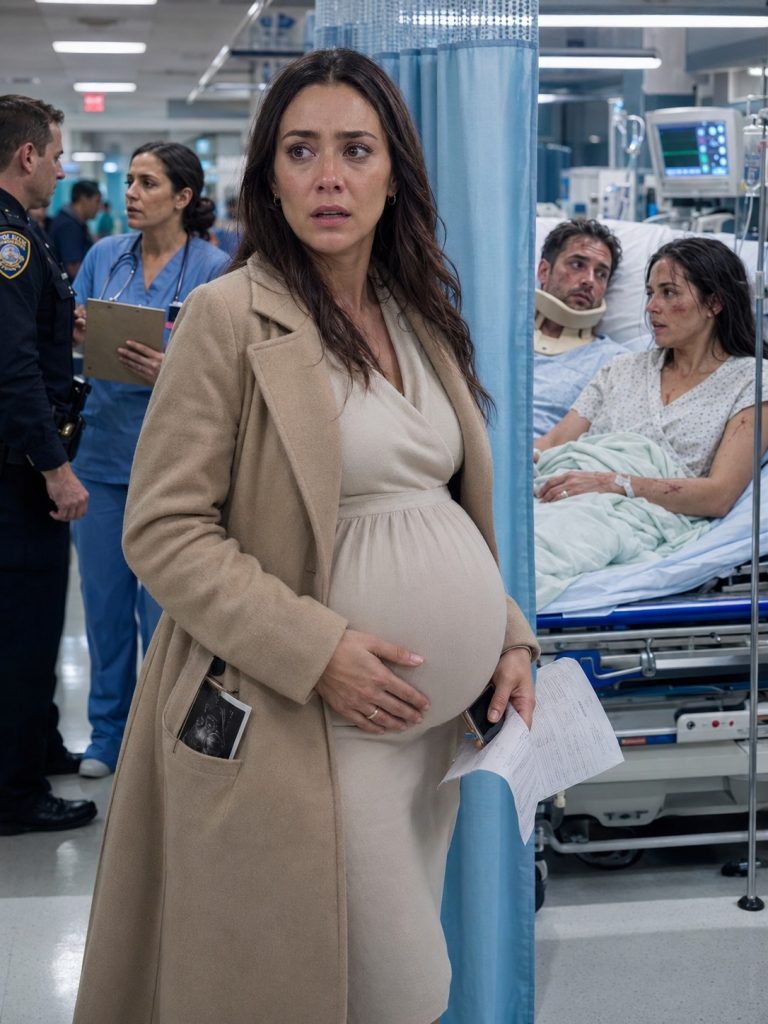
The police called while I was whispering to the baby inside me.
They said my husband had been found unconscious in a hotel bathroom.
Then they said he had not been alone.
At thirty-three weeks pregnant, a woman learns the exact weight of fear. It sits low in the body, beneath the ribs, behind the navel, wrapped around the child she has not yet held. That Friday night, I was sitting alone on the edge of our bed in South Boston, one hand resting on my stomach, the other holding a half-folded onesie against my thigh. The room smelled faintly of clean cotton, cocoa butter, and the lavender detergent I had started buying after the doctor told me strong scents might make my nausea worse. Outside the windows, the city was dark and wet, the kind of Boston night where headlights smear across pavement and harbor wind gets into every crack of an old house.
I was talking to my son.
Not in a sentimental way, though maybe all mothers become sentimental in private. I was telling him ordinary things because ordinary things had begun to feel like promises. I told him his crib was ready. I told him the blue blanket on the rocking chair had been knitted by a nurse who worked with my mother years ago. I told him I had finally stopped being afraid to wash his tiny clothes, even though part of me still believed that preparing too much might tempt fate.
“Stay with me,” I whispered, rubbing slow circles over the place where his heel pressed against my side. “Just a little longer.”
The phone rang.
The sound tore through the room so sharply that my whole body jerked. The onesie slipped from my lap. My first thought was the doctor. My second was my husband, Gabriel, though he had texted earlier saying he had a late client dinner near the Financial District and not to wait up. The screen said Boston Police Department.
My mouth went dry before I answered.
“Mrs. Peterson?”
The voice was male, steady, professional, too calm for anything good.
“Yes.”
“This is Officer Daniel Reaves with Boston Police. We’re calling from Massachusetts General Hospital. Your husband, Gabriel Peterson, has been brought in for emergency care following an incident at the Liberty Hotel.”
For a second, the room tilted.
“What happened?”
“There was a fall in a hotel bathroom. He is conscious intermittently. Medical staff are evaluating him.”
I tried to stand, but my knees did not cooperate. I grabbed the nightstand.
“Is he okay?”
A pause. Small. Careful.
“Mrs. Peterson, he was not alone.”
Every sound in the bedroom sharpened: the hum of the ceiling vent, the soft tick of the wall clock, my own breathing turning shallow and fast.
“What does that mean?”
“The responding officers found him with a woman. She was also transported for treatment.”
My hand went to my stomach.
The baby shifted once, a slow internal roll, as if even he had sensed the air change.
“Who?” I asked.
“I don’t have permission to release full details over the phone until you arrive, but you are listed as next of kin. You should come as soon as you safely can.”
Safely.
I was eight months pregnant, barefoot in a bedroom full of folded baby clothes, hearing that my husband had been found unconscious in a hotel bathroom with another woman, and the officer was telling me to come safely.
I do not remember putting on my coat. I remember one shoe being difficult because my ankle had swollen that week and the heel would not slide in. I remember grabbing my keys from the dresser and seeing Gabriel’s cufflinks beside them, the silver ones I had given him for our fifth anniversary. I remember my reflection in the hallway mirror: pale face, loose hair, black leggings, gray maternity sweater pulled tight over my stomach, eyes wide with a terror I recognized too well.
Hospital terror.
I had lived inside it twice before.
The first time, I lost a baby at nine weeks. The second, at fourteen. Both losses had taken place under fluorescent lights, with paper bracelets around my wrist, nurses speaking gently, doctors moving with that careful efficiency that tells you something has already happened and everyone is waiting for your heart to catch up.
Gabriel had missed most of both.
Not because he did not care, I had told myself then. Because his job demanded him. Because stock brokerage was brutal. Because clients needed him. Because somebody had to keep earning. Because grief, for men like Gabriel, looked more like late meetings and unopened whiskey than hospital chairs and hand-holding.
I forgave what I did not want to name.
That is how a marriage begins lying to itself.
The drive to Mass General should have taken fifteen minutes. It felt like an hour. Rain spit against the windshield in thin, nervous lines. The streets were slick and nearly empty, the city reduced to traffic lights, gas stations, dark restaurant windows, and the occasional bright blur of someone running under an umbrella. I kept one hand on the steering wheel and the other on my stomach, murmuring, “We’re okay. We’re okay. We’re okay,” though I did not know who I was trying to convince.
At a red light near Cambridge Street, a thought flashed through me so quickly I tried to push it away.
Jennifer.
Earlier that night, before the call, I had opened TikTok to distract myself from the ache in my lower back. The first video on my feed had been Jennifer Ramirez, my best friend of thirteen years, standing in front of a hotel window overlooking Boston Harbor. She wore satin pajamas, dark hair loose over one shoulder, face bright with the effortless confidence that made strangers trust her through screens.
Quick layover in Beantown before NYFW, she had captioned it, with two little heart emojis.
Jennifer lived in Detroit. She was an influencer, a lifestyle creator, the sort of woman who could turn a latte, a suitcase, and a hotel robe into content about healing, friendship, and feminine power. She had flown to Boston after both of my miscarriages. She had slept beside me in a hospital chair, held my hand so tightly her nails left crescent marks in my skin, cried when I cried, and promised, “Next time, you’ll keep the baby. I’ll be here. I swear.”
I had almost texted her after seeing the video.
Want to go baby shopping tomorrow?
Then fear stopped me. I was still superstitious about joy.
At the hospital parking garage, I nearly hit the curb turning in. My hands were shaking so hard I had to sit in the car for three full breaths before opening the door. The elevator smelled like wet wool, old coffee, and metal. When the doors opened into the emergency entrance, the smell of antiseptic hit me like a hand over my mouth.
My body remembered before I did.
I stopped just inside the sliding doors.
Monitors beeped somewhere behind a wall. A child cried in short, exhausted bursts. Nurses moved quickly in blue scrubs, shoes squeaking against polished floor. A man in a Red Sox hoodie held a bloodied towel to his forehead. A woman whispered into her phone near a vending machine.
Everything was normal.
Everything was unbearable.
At the desk, I gave Gabriel’s name.
“My husband,” I said. “Gabriel Peterson. The police called.”
The nurse looked at her screen, then at my stomach, then back at the screen. Her face changed almost imperceptibly. Professional sympathy is a terrible thing to witness when you already know the news is not clean.
“Please confirm some information for me.”
She handed me a clipboard.
There were two names printed near the top of the intake sheet.
Patient One: Gabriel Peterson. Boston, Massachusetts.
Patient Two: Jennifer Ramirez. Detroit, Michigan.
My vision narrowed until the letters seemed to float above the page.
Jennifer.
Not a colleague.
Not a stranger.
Not some woman I could hate simply because I had never loved her.
Jennifer.
My best friend. My bridesmaid. My emergency contact for years when Gabriel traveled. The woman who knew exactly how my voice sounded after loss. The woman who once put her palm on my flat, empty stomach and said, “Your body didn’t fail you. Don’t ever believe that.”
The clipboard bent under my fingers.
“Ma’am,” the nurse said softly. “You’re pregnant. Please breathe.”
I tried.
The air burned.
A police officer approached, the same calm voice from the phone now attached to a tired-looking man in his forties with rain on the shoulders of his uniform.
“Mrs. Peterson?”
I nodded.
“I’m sorry. I need to clarify a few things. Hotel staff reported a disturbance in room 2418 at the Liberty Hotel. Security heard glass break and forced entry after no one responded. Your husband was found on the bathroom floor. Ms. Ramirez was beside him. Both were unclothed. There was water on the tile, broken glass, and blood from a scalp laceration. Medical staff believe your husband slipped and struck his head.”
Unclothed.
The word did not enter me all at once.
It kept entering.
Layer by layer.