THE WOMAN THEY THOUGHT THEY HAD ERASED
The divorce papers lay across the silk comforter like a verdict.
Vivian Hayes stood beside the bed in the master suite of the Chicago penthouse, her bare feet cold against the polished marble floor, her hands resting at her sides because she did not trust them not to shake. The city glittered beyond the floor-to-ceiling windows, all silver lights and dark water, a skyline that had once made her feel lucky. Tonight, it looked like a wall of witnesses.
Beatrice Hayes stood near the foot of the bed with one hand on her pearl necklace and the other resting on the top page of the legal packet. She had not raised her voice yet. She did not need to. Her calm was sharper than shouting.
“Sign them, Vivian,” Beatrice said. “This performance has gone on long enough.”
Preston stood in the doorway.
Not beside his wife.
Not in front of his mother.
In the doorway, where cowards stand when they want to pretend they are not choosing a side.
His arms were crossed over his tailored shirt, his face unreadable, his eyes fixed on the wall behind Vivian’s shoulder. Three years earlier, those eyes had softened every time she entered a room. He had told her she made him feel real. He had told her the Hayes name meant nothing without love inside it. He had promised her that his mother would come around, that class did not matter, that old money people were just regular people with better table settings.
Now he would not even look at her.
Vivian looked down at the documents. The first page carried the name of the Hayes family law firm, embossed in dark blue at the top. Below that, the language was clean and formal. It did not say abandoned. It did not say replaced. It did not say that a woman who had given up her job, her apartment, her friends, and her independence had been summoned into her own bedroom and presented with the end of her marriage like a scheduling correction.
It simply said dissolution.
She almost laughed.
A marriage could be dissolved the way sugar disappeared in tea, as if the sweetness had never been there at all.
“I need time to read it,” she said.
Beatrice’s smile thinned. “You had three years to understand you never belonged here.”
Preston’s jaw moved.
Vivian saw it.
For half a second, she thought he might speak. She thought perhaps somewhere inside the expensive clothes and the polished silence, the man she had loved was still alive enough to say, Mother, stop.
But Preston only shifted his weight.
The room grew colder.
Beatrice picked up a gold pen from the nightstand and placed it on top of the papers. “The terms are generous.”
Vivian lifted her eyes. “Generous?”
“You leave with what you brought.”
“I brought myself.”
“And that was more than enough trouble,” Beatrice replied.
The words did not land like a slap. They landed like confirmation.
For three years, Vivian had collected these little confirmations and tucked them away in the private place where women store the things they are told not to overreact to. The glance Beatrice gave her when Vivian used the wrong dessert fork at her first holiday dinner. The way Hayes family friends asked what she had done before Preston, their voices slightly softer on before. The country club lunches where Beatrice introduced her as “Preston’s wife” and never by name. The charity events where Tiffany Sterling laughed too brightly at Preston’s jokes and Beatrice watched with approving eyes.
Tiffany.
The thought made Vivian’s throat tighten.
She had been circling for months.
Perfect hair. Perfect family. Perfect pedigree. A Sterling daughter, born into the kind of fortune that Beatrice considered respectable because it had enough generations behind it to hide the sharp edges. Tiffany knew how to stand at Preston’s elbow without looking eager. She knew when to touch his sleeve. She knew how to say Vivian’s name with sweetness that made it sound temporary.
Vivian looked at Preston.
“Is Tiffany part of this?”
His face finally moved.
Not with guilt.
With irritation.
“Don’t make this uglier than it needs to be.”
The room seemed to tilt slightly.
So there it was.
Not denial.
Not shock.
Not even the courtesy of pretending.
Beatrice made a small sound of satisfaction, as if a deal had finally reached the practical stage. “Tiffany arrives tomorrow. Her father is in town for the merger discussions. Preston needs to think about his future.”
“I was his future,” Vivian said.
“No,” Beatrice replied. “You were a detour.”
The silence after that sentence was the kind that changes a person.
Vivian felt it move through her slowly. It did not make her collapse. It did not make her scream. It did something worse.
It made her clear.
For three years, she had tried to be easy to love in a house that had no intention of loving her. She had learned the names of Beatrice’s friends. She had hosted dinners for men who discussed markets over steak while their wives compared auction catalogs. She had stood beside Preston after the failed Chicago distribution deal, holding his hand under the table while people whispered that he had overreached. She had smiled when Beatrice corrected her pronunciation of a French designer in front of six guests. She had told herself that endurance was proof of devotion.
And now devotion had been filed into a packet with blue tabs and signature lines.
“Preston,” Vivian said.
He looked tired. Not heartbroken. Tired, as if her pain were another meeting running long.
“Please don’t drag this out,” he said.
The sentence was so small.
So ordinary.
So final.
Vivian picked up the pen.
Beatrice’s eyes brightened.
“Good girl,” she said.
Vivian paused, the pen hovering above the page.
Something about those two words opened a door in her mind. Behind it stood a younger version of herself, not Vivian Hayes, not the carefully dressed wife in silk, but Sienna Blackwood, eighteen years old, standing in the marble foyer of her grandfather’s estate in Virginia and telling Marcus Blackwood she wanted a life that did not come with guards, boardrooms, or inheritance lawyers.
She had wanted to be normal.
She had wanted to know what it felt like to be chosen without a trust fund attached.
So she had walked away from the Blackwood name. She had taken her mother’s middle name and her father’s old surname from before the family consolidation. Vivian Carter. A waitress in Indiana. A girl with no story worth investigating. A woman who paid rent, clipped coupons, and learned how to be invisible.
Preston had met that woman.
He had loved that woman, or something close enough to love to fool them both.
Then he had brought her home to Beatrice, and the Hayes family had mistaken invisibility for worthlessness.
Vivian signed the first page.
Then the second.
Then the third.
Each signature was neat. Controlled. Mechanical.
Vivian Marie Hayes.
A name she had worn like a promise and now released like a coat that had never fit.
Beatrice gathered the papers the second the final signature dried, smoothing them with both hands. “There. That wasn’t so hard.”
Vivian set the pen down. “No. It wasn’t.”
For some reason, the answer made Beatrice narrow her eyes.
Preston shifted again.
Perhaps he heard it too.
Not defeat.
Distance.
“You have until morning,” Beatrice said. “One suitcase. Personal items only. Everything purchased during the marriage stays with the penthouse.”
“Of course.”
“And do not contact Preston.”
Vivian looked at him.
He still had not moved from the doorway.
“I won’t.”
That, finally, made him look at her.
Just for a moment.
A flicker crossed his face, too late to name. Regret, maybe. Or panic. Or the uncomfortable recognition that a person who stops begging becomes harder to control.
Beatrice turned toward the door. “Try to leave quietly. Dignity is the last thing you have left.”
Vivian did not answer.
Preston lingered after his mother left, one hand on the doorframe.
“Vivian,” he began.
She folded her arms, not defensively, but to keep herself from reaching for the part of him that no longer existed.
“What?”
“I didn’t want it to happen like this.”
She studied him.
His expensive watch. His careful hair. The man who had once stayed awake all night with her when she had the flu, bringing tea and pretending not to worry. The man who had kissed her in a diner parking lot during a rainstorm and said, “I don’t care where you come from.” The man who now let his mother hand her divorce papers in the bedroom they had shared.
“No,” Vivian said. “You wanted the result without having to watch the process.”
His mouth tightened.
“That’s not fair.”
“Neither was this.”
He looked toward the hallway, where Beatrice’s heels had already faded. “You’ll be okay.”
That almost made her smile.
Not because it was kind.
Because he had no idea what he was saying.
“Yes,” she said. “I will.”
He left without another word.
The door clicked shut behind him.
Vivian stood alone in the master suite, surrounded by cream walls, custom furniture, and a view she had once believed meant she had arrived. The room was beautiful in the way hotel suites are beautiful: perfect, expensive, and empty of anything that loves you back.
She opened the bottom drawer of her nightstand.
Beneath a stack of silk sleep masks Beatrice had once called “more appropriate than cotton,” Vivian found the old phone. It was scratched at the corners, heavier than she remembered, still carrying a number only a handful of people knew. She had kept it charged out of habit, or fear, or hope. She was not sure which.
She sat on the edge of the bed and unlocked it.
The contact list was nearly frozen in time.
Thomas.
Mrs. Chen.
Aunt Lydia.
Grandfather.
Her thumb hovered over Marcus Blackwood’s name.
Pride stopped her.
Three years of silence stood between them. Three years since she had walked away from the Virginia estate, leaving behind a grandfather who had loved her fiercely and warned her just as fiercely. Marcus had not begged her to stay. Blackwoods did not beg. He had simply said, “If you leave as Vivian Carter, remember that you can always come home as Sienna Blackwood. But do not expect the world to be gentle while you are learning the difference.”
She had thought he was being dramatic.
Now she was sitting on a bed she no longer had the right to sleep in, holding a phone like a lifeline.
She set it down.
Not yet.
She packed instead.
Not the designer luggage Preston had bought because Beatrice said her old duffel was embarrassing. Vivian pulled that old duffel from the back of the closet and laid it open on the floor. Into it went her jeans, her cotton dresses, her worn sweaters, the flat shoes she had stopped wearing because Beatrice said they made her look “practical.” She left behind the gowns. The jewelry. The silk blouses. The handbags with names that had never belonged to her.
Three years fit into one bag when you removed the costume.
Her phone lit up twice while she packed.
Unknown numbers.
Short messages.
Heard about the split. Hope you find your footing.
So sorry, darling. These things happen when people marry too quickly.
Thinking of you. Beatrice must be relieved.
Vivian turned the screen face down.
The Hayes family was already managing the story. Of course they were. By breakfast, Chicago society would have its version. Preston, patient and trapped. Beatrice, protective and wise. Vivian, the unsuitable wife who had finally been persuaded to leave before she did more damage.
Let them have the first version.
Versions could be corrected.
At midnight, there was a soft knock.
Vivian opened the door expecting a staff member.
Richard Hayes stood outside.
Preston’s father looked older than he had at dinner the week before. His tie was loosened, and his expression carried the tiredness of a man who had watched a storm cross his own house and decided not to close the windows.
“May I come in?” he asked.
Vivian stepped aside.
Richard entered but did not sit. He stood near the window and looked out at the city.
“I’m sorry,” he said.
She did not respond.
He nodded, as if that was fair.
“My wife can be rigid.”
“Your wife can be cruel.”
A breath passed through him. “Yes.”
That one word made Vivian look at him.
Not because it changed anything.
Because in three years, no one in that family had ever admitted the truth so plainly.
Richard reached into the inside pocket of his jacket and removed a cream envelope. He held it out.
“This is from my personal account. Fifty thousand dollars.”
Vivian stared at it. “I don’t want Hayes money.”
“It isn’t Hayes money. It’s mine.” He placed it on the dresser when she would not take it. “Call it an apology from a man who should have spoken more often.”
“Why didn’t you?”
He looked at her then, and there was real shame in his eyes.
“Because silence is easier when you have spent a lifetime practicing it.”
That answer was too honest to hate.
Vivian looked at the envelope, then at him.
“Preston is your son.”
“Yes.”
“And you let him become this.”
Richard flinched, but he did not deny it. “Yes.”
Another silence.
Then he said, “You were good for him. Better than he deserved. I thought he might become braver because of you.”
“He didn’t.”
“No.” Richard’s mouth tightened. “He didn’t.”
At the door, he paused and looked back.
“Vivian, whatever name you use after this, I hope you use one that belongs fully to you.”
After he left, she placed the envelope in her duffel.
Not because she forgave him.
Because starting over required money, and pride was a poor substitute for rent.
She did not sleep.
At five in the morning, she showered in the marble bathroom for the last time, dressed in jeans and a navy sweater, braided her hair, and looked in the mirror.
Without makeup, without diamonds, without the Hayes name arranged around her like borrowed architecture, her face looked younger and older at once.
Familiar.
She picked up the duffel and walked through the penthouse.
Past the living room where she had served wine to people who called her charming because they could not call her equal. Past the dining table where Beatrice had once corrected the flowers after Vivian arranged them. Past Preston’s office, where he had promised her, only a month earlier, that the Sterling conversations were purely professional.
The front door opened before she touched the handle.
Beatrice stood there fully dressed, pearls at her throat, hair immaculate.
“Leaving early?”
Vivian adjusted the strap of her bag. “Yes.”
“Good. It will be easier for everyone.”
“For you, maybe.”
Beatrice’s smile sharpened. “Careful, dear. You are walking out with exactly what you earned.”
Vivian met her eyes.
For the first time, she saw Beatrice clearly. Not as a force of nature. Not as a woman with the power to approve or reject her. Just as a frightened gatekeeper standing in front of a house built on appearances, terrified that anyone not born inside it might learn the locks were decorative.
“You should enjoy this morning,” Vivian said quietly.
Beatrice’s expression flickered.
“Excuse me?”
“You worked hard for it.”
Then Vivian walked past her.
In the lobby, Carlos the doorman stood when he saw her.
His eyes went to the duffel.
Then to her face.
“Mrs. Hayes,” he said softly.
“It’s just Vivian now.”
He opened the glass door for her. “Miss Vivian, then.”
The morning air hit hard. Chicago in early spring had a way of pretending winter was gone while keeping one hand on your throat. Vivian stood on the sidewalk with her bag at her feet, the penthouse tower rising behind her like a life she had dreamed and woken from.
She took out the old phone.
This time, she did not let pride speak.
She called.
It rang once.
Twice.
A voice answered, rough with sleep and authority.
“This had better matter.”
Vivian closed her eyes.
“Grandfather.”
Silence.
Then the entire world changed with one word.
“Sienna.”
Her knees nearly gave.
“I’m in Chicago,” she said, and her voice broke despite every effort to hold it. “Outside the Hayes building. I made a mistake. You were right. I’m sorry. I know I don’t deserve—”
“Stop.”
The command was firm, but not cold.
She stopped.
“Give me the address,” Marcus Blackwood said.
She gave it.
“Do not move. Thomas will be there in twenty minutes.”
“Grandfather, I—”
“We will talk when you are home.”
The line ended.
Vivian stood with the phone in her hand and finally cried.
Not for Preston.
Not for Beatrice.
For the sound of her real name in the mouth of someone who had never stopped waiting for her to reclaim it.
Carlos stepped outside and offered a folded handkerchief without a word.
She took it.
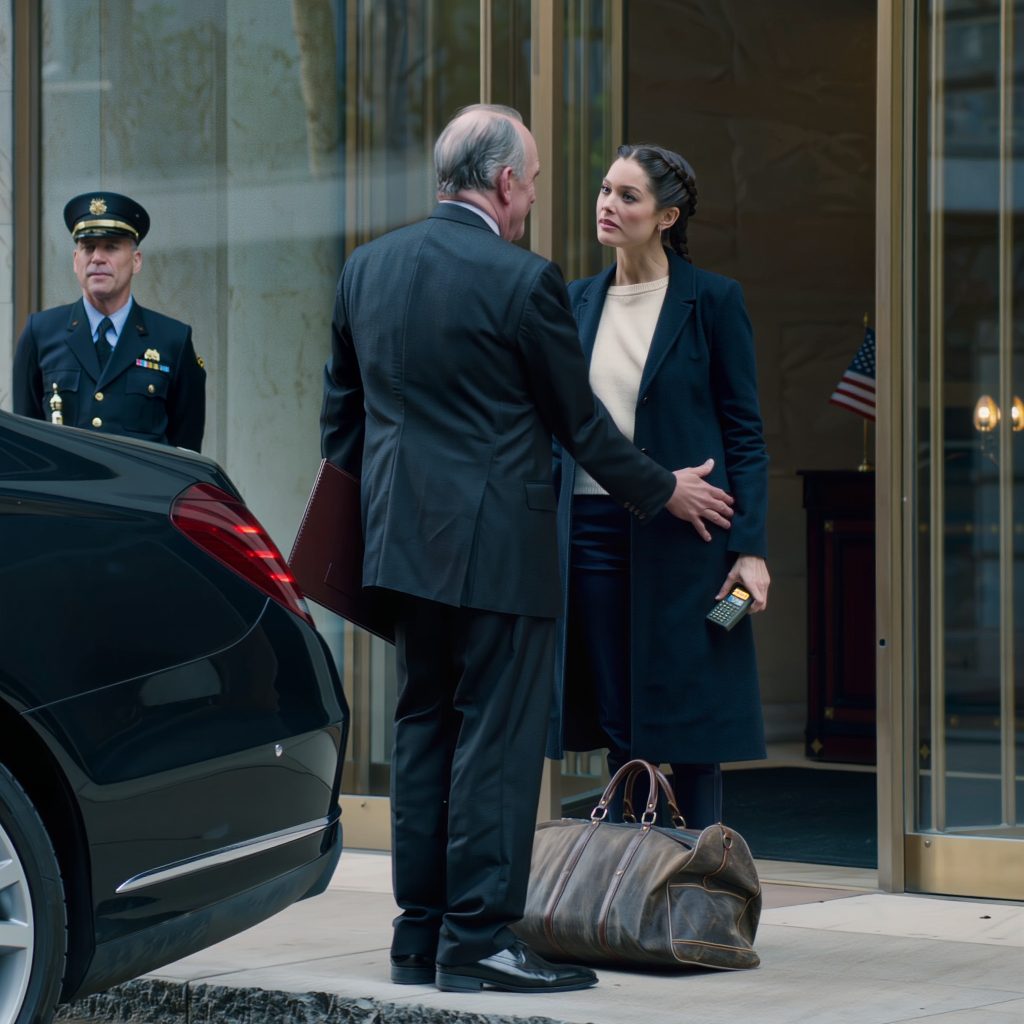
Twenty minutes later, a black Mercedes pulled to the curb. The driver stepped out in a dark suit, silver hair neat, posture impeccable.
“Miss Blackwood?”
The name passed through Vivian like warm water over ice.
“Yes.”
“I’m Thomas. Mr. Blackwood sent me.”
He took her duffel as if it were fine luggage and opened the rear door. The car smelled of leather and cedar, understated and calm in a way the Hayes family never managed. Their wealth always needed an audience. Blackwood wealth never did.
As the Mercedes pulled away, Vivian looked back once.
The Hayes tower vanished around the corner.
Thomas glanced at her in the mirror. “We’ll be at the airport shortly.”
“The airport?”
“Yes, Miss Blackwood. Mr. Blackwood is waiting on the jet.”
She stared at the passing city.
The jet.
The family jet she had refused to use because she had wanted to prove she could live without all of it. The jet whispered about at charity functions by people who had never guessed that Vivian Hayes, the quiet wife Beatrice dismissed as ordinary, had once walked barefoot through its cabin as a child, eating strawberries while her grandfather reviewed acquisition reports.
“Is he angry?” she asked.
Thomas’s eyes softened in the mirror. “Mr. Blackwood has been waiting three years for this phone call. No, miss. He is not angry.”
The private terminal was nearly empty when they arrived. Dawn had barely touched the sky. The Gulfstream waited under floodlights, white and silver, its stairs lowered.
Sienna stopped at the bottom step.
For three years, she had been Vivian.
Vivian Carter. Vivian Hayes.
A woman trying to escape inheritance, trying to be loved without history, trying to make ordinary feel like freedom.
Now the name she had buried was waiting at the top of the stairs.
Inside, Marcus Blackwood sat in a cream leather chair with a tablet in his lap and reading glasses low on his nose. At seventy-eight, he looked exactly as she remembered: silver hair, sharp eyes, and the kind of presence that made rooms adjust around him.
He looked up.
For one suspended moment, neither moved.
Then he set the tablet aside.
“Sienna.”
She crossed the cabin and broke.
Marcus stood and opened his arms, and she stepped into them like a child returning from a storm. He held her while she cried into his jacket, one hand steady on the back of her head.
“You’re home,” he said. “That is the only thing that matters first.”
“I wasted three years.”
“You learned for three years.”
“I was so stupid.”
“You were young. Those are not the same.”
She pulled back, wiping her face with both hands. “I signed the divorce papers.”
“Good.”
She blinked. “Good?”
“If you signed them as Vivian Hayes, then Vivian Hayes leaves with nothing.”
His eyes sharpened.
“Sienna Blackwood still owns everything that was always hers.”
She sat slowly.
Marcus picked up his tablet and swiped once, turning the screen toward her. Legal documents filled the display. Holdings. Trust structures. Share certificates. Names of companies layered under other companies.
“I don’t understand.”
“You never told the Hayes family who you were.”
“No.”
“Did Preston ever ask?”
She opened her mouth.
Closed it.
No. He had not.
Preston knew her parents had died when she was young. He knew she had been raised by her grandfather. But he had never asked Marcus’s last name. Never asked why she refused to talk about Virginia. Never asked how a waitress knew enough about financial statements to follow his business conversations better than his own analysts.
He had liked her mystery because he assumed mystery meant lack.
Marcus nodded, as if reading the answer on her face.
“Beatrice investigated Vivian Carter. She found a waitress with modest savings, a rented apartment, and no visible family wealth. She concluded you were nobody.”
Sienna let out a small, bitter sound. “That sounds like her.”
“She did not investigate well enough.”
He tapped the tablet again.
A document enlarged.
Sterling Group.
Forty percent voting control.
Sienna stared.
“Tiffany’s family?”
“Yes.”
Her heartbeat shifted.
“Why do you own Sterling Group?”
“I don’t anymore,” Marcus said. “You do.”
The cabin seemed to go silent except for the hum of the engines preparing for departure.
“Grandfather.”
“I began acquiring Sterling shares years ago through layered entities. The company was undervalued, poorly defended, and strategically useful. I intended to transfer control to you when you were ready.”
“I’m not ready.”
“Ready is a luxury people use to avoid duty.”
She stared at the screen.
Sterling Group was the company Preston had been chasing for two years. Its distribution network would solve Hayes Industries’ liquidity and expansion problems in one move. Preston had talked about it constantly. The merger. The future. The deal that would prove he was not just Richard Hayes’s son but a force of his own.
Tiffany Sterling had not just been a romantic replacement.
She had been access.
Sienna looked up.
“Preston wants the merger.”
“Yes.”
“And Tiffany is part of that arrangement.”
“Yes.”
“And the majority approval now belongs to me.”
Marcus smiled, but there was no warmth in it.
“Now you are understanding.”
The jet began to move.
Chicago slid slowly past the window.
Sienna wrapped both hands around the cup of tea a flight attendant had placed beside her. The heat steadied her fingers.
“When do they announce it?” she asked.
“The Starlight Charity Gala. Three weeks from tonight. Five hundred guests. Business leaders, donors, press, the usual performance of generosity and ambition.”
“Preston will announce the merger there?”
“With Tiffany beside him.”
Sienna closed her eyes.
She saw Beatrice’s face in the penthouse. The satisfaction. The certainty. The way she had said Tiffany wants to redecorate, as if Vivian had been furniture removed before delivery.
“What do you want me to do?”
Marcus leaned back.
“I want you to decide who controls your story.”
For the next six hours, as the jet crossed the sky toward Virginia, Marcus told her everything.
He told her about the Sterling share structure, about shell entities and voting rights, about the Hayes family’s debt exposure. He explained that Hayes Industries had borrowed against future expectations of the Sterling merger, quietly and aggressively, using projected revenue as collateral. Without the deal, lenders would start asking harder questions. Partners would hesitate. Investors would whisper. The Hayes name, polished for generations, would no longer be enough.
“And if I vote no?” Sienna asked.
“The merger fails.”
“And Hayes Industries?”
“Faces a serious financial reckoning.”
She looked down at her hands.
Hours earlier, those hands had signed away a life. Now they held the power to change the future of the people who erased her.
“I don’t want to be like them,” she said.
“You won’t be.”
“How do you know?”
“Because you are asking that question.”
Marcus studied her for a moment.
“Sienna, power does not make people cruel. It reveals whether they were cruel when they were powerless.”
The sentence stayed with her long after the jet landed.
The Blackwood estate in Virginia appeared at the end of a long private drive lined with oaks. The house rose white and brick against rolling green, its columns bright in the morning sun. Sienna had spent her childhood running through those halls, hiding in the library, riding horses badly but bravely, listening outside Marcus’s study while men twice her age learned that underestimating a Blackwood was expensive.
Staff waited on the front steps.
Mrs. Chen, the head housekeeper, covered her mouth when Sienna stepped from the car.
Then she hurried down and wrapped Sienna in a hug that smelled of lavender soap and home.
“Miss Sienna,” she whispered. “You came back.”
Sienna held on harder than she meant to. “I’m sorry I stayed away so long.”
Mrs. Chen pulled back and touched her cheek. “Then don’t do it again.”
For three days, Sienna slept, ate, and remembered how to breathe.
Then the house became a command center.
Stylists arrived with gowns. Lawyers arrived with folders. Corporate advisors arrived with laptops and guarded expressions. Marcus’s communications team began quietly reintroducing Sienna Blackwood into the world she had abandoned. A mention to the right columnist. A confirmed attendance here. A whispered return there. By the time the Starlight Gala approached, Chicago’s elite knew that Marcus Blackwood’s granddaughter would be attending.
What they did not know was that Vivian Hayes and Sienna Blackwood were the same woman.
One week before the gala, Marcus called Sienna into his study.
A copy of the Hayes-Sterling merger agreement sat on the desk.
“Read it,” he said. “Tell me where it breaks.”
Sienna sat across from him and opened the folder.
At first, the legal language felt dense. Then memory returned. Columbia Business School. Late-night case studies. Acquisition models. Negotiation simulations. She had buried that version of herself beneath apron strings and country club smiles, but knowledge does not die from disuse. It waits.
She turned a page.
Then another.
After an hour, she tapped section twelve.
“Hayes Industries is exposed here.”
Marcus’s eyes brightened.
“Explain.”
“They’ve tied short-term financing to projected post-merger cash flow. If the merger stalls or fails, the loan conditions shift. Some of this debt could become immediately reviewable.”
“Good.”
Sienna kept reading.
“And Preston has framed this publicly as inevitable. If it collapses at the gala, he loses more than the deal. He loses confidence.”
“Excellent.”
She looked up.
“Did you already know this?”
“Yes.”
“Then why make me find it?”
“Because you needed to remember you could.”
That night, Sienna tried on the emerald gown.
It was simple from a distance. Deep green silk, clean lines, open neckline, no glitter, no excess. But when she moved, the fabric caught light like still water. Around her throat, Marcus placed her grandmother’s diamond necklace.
“Eleanor wore this when she took control of her first board,” he said.
Sienna touched the stones. “Was she afraid?”
“Terrified.”
“She told you that?”
“No. I knew her.”
He stood behind her in the mirror.
“Fear is not the problem, Sienna. Forgetting who you are is the problem.”
On the night of the gala, Chicago glowed under a cold, clear sky.
The event was held at the Four Seasons, in a ballroom filled with white flowers, gold light, and the low strategic laughter of people who gave generously in public and negotiated aggressively in private. The red carpet at the entrance was lined with photographers. Women in couture stepped from black cars. Men adjusted cuff links and looked over shoulders for people more important than themselves.
Sienna arrived at 7:15 on Marcus’s arm.
The cameras reacted first.
Then the room.
Conversation did not stop all at once. It died in rings. People near the entrance noticed Marcus Blackwood and straightened. Then they noticed the woman beside him. Then whispers began moving ahead of them like wind through dry leaves.
“That’s his granddaughter.”
“Sienna Blackwood?”
“I thought she lived abroad.”
“Isn’t she the one who disappeared years ago?”
Sienna kept her eyes forward.
Her heart pounded, but her face remained calm.
At the Blackwood table near the stage, Marcus introduced her to a tech CEO, a hospital trustee, a retired judge, and a philanthropist whose family fortune was old enough to have forgotten its first scandal. Sienna smiled, answered politely, and held a glass of champagne she did not drink.
She felt Preston before she saw him.
A stare can have weight.
She turned slowly.
He stood ten feet away in a tuxedo, Tiffany Sterling at his side.
Preston looked as if he had forgotten how to breathe.
Tiffany’s smile was fixed, but her eyes moved quickly from the emerald dress to Marcus, to the diamonds, to the table placement, to the way people were watching Sienna with curiosity rather than pity.
“Sienna?” Preston said.
Hearing him say the name nearly made her flinch.
She did not allow it.
“Hello, Preston.”
His eyes searched her face. “What are you doing here?”
“Attending a charity gala.”
“With Marcus Blackwood.”
“My grandfather.”
The word landed.
Preston looked from her to Marcus and back again. The realization moved across his face in stages: confusion, disbelief, calculation, fear.
Tiffany recovered faster.
“I didn’t realize Vivian had such interesting family connections,” she said lightly.
“It’s Sienna,” Sienna replied. “Vivian was a name I used when I wanted privacy.”
Preston stepped closer. “We need to talk.”
“No, we don’t.”
“Sienna, please.”
“No.”
The word was quiet, but it held.
For three years, she had explained. Softened. Made room. Now she offered him one syllable and watched him discover he could not move it.
His voice lowered. “I made mistakes.”
“Yes.”
“My mother pushed things too far.”
“Your mother did what you allowed.”
Tiffany’s fingers tightened around Preston’s arm. “Darling, we should sit. The announcement is soon.”
Sienna looked at Preston.
“Congratulations.”
He stared at her. “You know?”
“I know enough.”
A flicker of panic touched his face.
Marcus rose smoothly from his chair. “Preston, was it? I believe the program is about to begin. You wouldn’t want to keep the room waiting.”
It was dismissal, wrapped in courtesy.
Preston felt it.
So did everyone close enough to hear.
Tiffany led him away, but his eyes kept returning to Sienna as if he could solve her by looking harder.
When the lights dimmed, the ballroom settled into elegant silence. Speeches began. Donations were praised. Hospital wings were named. Applause rose and fell.
Then the master of ceremonies smiled toward the front.
“And now, we have a special announcement from two families who represent the next chapter of Chicago business leadership. Please welcome Preston Hayes and Tiffany Sterling.”
Applause filled the ballroom.
Preston and Tiffany walked onto the stage hand in hand.
Beatrice sat at the Hayes table like a queen awaiting tribute. Richard looked tired beside her. Tiffany’s father stood near the front, already smiling for the future.
Preston took the microphone.
“Thank you. Tonight, Tiffany and I are honored to share not only a personal joy, but a business milestone. Hayes Industries and Sterling Group have reached an agreement to merge operations, combining Sterling’s distribution network with Hayes manufacturing capacity to build something truly extraordinary.”
The applause swelled.
Sienna felt Marcus shift beside her.
He stood.
“Point of order.”
The words cut cleanly through the room.
The applause faded in confusion.
Preston’s smile froze.
Marcus buttoned his jacket calmly. “You are announcing a merger that does not have majority shareholder approval.”
Tiffany leaned toward the microphone. “Mr. Blackwood, the board approved the agreement.”
“Conditionally,” Marcus said. “Pending approval from the voting majority.”
Tiffany’s father stood. “Marcus, what is this?”
“A correction.”
The ballroom was fully silent now.
Marcus’s voice never rose.
“The Sterling family controls thirty-five percent. The remaining voting interest is not as scattered as you believed. Over the past several years, Blackwood-controlled entities have acquired forty percent of Sterling Group.”
Tiffany’s face went white.
Preston’s hand slipped from hers.
Marcus turned slightly.
“Those shares were transferred yesterday to my granddaughter, Sienna Blackwood. She is the voting majority. And she does not approve this merger.”
A sound moved through the room. Not a gasp. Something larger. Five hundred people realizing they were present for a social event that had just become a business earthquake.
Sienna stood.
Every eye turned.
She walked to the stage slowly. Her heels clicked against the polished floor, each step measured, each breath controlled. Preston stood motionless as she approached, the microphone loose in his hand.
She took it from him.
He let her.
For the first time in their marriage and after it, Preston Hayes had nothing to say.
Sienna faced the room.
“For those who knew me as Vivian Hayes,” she said, her voice steady, “yes. I am that woman. Preston’s former wife. The one many of you were told married above her station. The one Beatrice Hayes described as unsuitable, opportunistic, and easy to remove.”
Beatrice rose halfway from her chair.
Sienna looked directly at her.
“Sit down, Beatrice.”
The room inhaled.
Beatrice sat.
Sienna turned back to the crowd.
“Three weeks ago, I signed divorce papers and left the Hayes penthouse with one bag. The Hayes family believed I had nothing. They were wrong. What I did not have was any remaining reason to protect their assumptions.”
She turned toward Preston.
“You ended our marriage because you thought I was replaceable. You stood silent while your mother arranged my exit. You prepared to stand beside Tiffany tonight and announce a merger that would secure your future. But the company you need does not answer to you. It answers to me.”
Preston’s face had gone pale.
“Sienna,” he whispered.
She continued.
“Sterling Group will not merge with Hayes Industries. Not under current leadership. Not under the terms presented. Not as long as I hold the deciding vote.”
The words struck the room like a gavel.
Tiffany stepped back from Preston.
Her father turned on her with a look of disbelief.
Beatrice gripped the edge of her table.
Richard closed his eyes.
Sienna set the microphone down on the podium.
Then she walked off the stage.
Marcus met her at the bottom, offered his arm, and together they left the ballroom while the room behind them broke into controlled chaos.
Outside, the air was cold and clean.
In the car, Marcus asked, “How do you feel?”
Sienna looked out at Chicago passing in gold and black.
She thought she would feel triumphant.
She did, but not only that.
There was grief too. Not for Preston. For the woman who had once needed him to choose her. For Vivian, who had tried so hard to be accepted in rooms that were too small for her real name.
“I feel free,” she said.
Marcus nodded. “Good. Freedom is the beginning. Not the end.”
Her phone began buzzing before the car reached the airport.
Preston called fourteen times.
Richard sent one message.
Please. Think of the employees. Name your terms.
That stopped her.
Three thousand people worked for Hayes Industries. Mechanics. Engineers. Assistants. Warehouse staff. Account managers. People who had nothing to do with Beatrice’s cruelty or Preston’s weakness. People with mortgages, children, prescriptions, car payments, parents in care homes.
Marcus watched her read the message.
“He is trying to move the burden onto you.”
“The employees are real.”
“Yes.”
“And if Hayes collapses, they pay.”
Marcus said nothing.
Sienna looked at him. “There has to be a third option.”
At the airport, before boarding, she turned to Marcus.
“What if Blackwood buys Hayes Industries?”
He studied her.
“After you refused the merger?”
“Not as a merger. As a rescue acquisition. We assume debt, restructure, remove the Hayes family from control, and keep the employees wherever possible.”
Marcus’s eyes sharpened with interest.
“You would save the company and take it from them.”
“I would save the workers. The company is just the container.”
He almost smiled.
“That is more merciful than I would be.”
“I know.”
“And perhaps more effective.”
Thirty-six hours later, Preston accepted the offer.
One dollar.
Complete transfer of operational control.
Blackwood Holdings would assume Hayes Industries’ debt, keep the name for continuity, remove all Hayes family members from leadership, and rebuild the company under new governance. Employees would receive retention protections during restructuring. Senior executives would undergo review. Beatrice would be barred from company involvement entirely.
Preston called Sienna at dawn.
She answered in Marcus’s study with the call on speaker.
“I’ll sign,” he said.
His voice sounded hollow.
“Good,” Sienna replied.
“You’re leaving the name?”
“Yes.”
“Why?”
“Because the workers did not fail. You did.”
Silence.
Then, quietly, “I’m sorry.”
For the first time, she believed he meant it.
For the first time, it did not matter.
“I accept your apology,” she said. “But I do not return to places that taught me how to leave.”
She ended the call.
The acquisition made national business news by lunch.
Blackwood Holdings Acquires Hayes Industries in Emergency Rescue Deal.
Hayes Family Steps Down.
Sienna Blackwood Named Acting Chair.
Three days later, Sienna walked into Hayes Industries headquarters.
The same receptionist who had once glanced through Vivian Hayes as if she were part of the décor now stood so quickly her chair rolled back.
“Miss Blackwood,” she said. “Welcome.”
Sienna nodded.
The lobby was filled with employees. Some clapped cautiously. Some watched with distrust. Some looked relieved. All of them looked tired.
Margaret Kading, Marcus’s former chief operating officer and the woman he had brought out of retirement to help Sienna, stood beside her in a navy suit and sensible shoes.
“Ready?” Margaret asked.
“No.”
“Good. Ready people get careless.”
In the executive conference room, department heads waited around a long table. The chair Preston used to occupy sat empty at one end.
Sienna took it.
No one spoke.
She opened a folder and placed one page in front of her.
Not a speech.
A plan.
“Hayes Industries survived this week,” she began. “That does not mean it is healthy. It means it has been given a chance. I am not here to preserve anyone’s comfort. I am here to preserve the parts of this company that deserve a future.”
A senior vice president named Carson leaned back. “With respect, Miss Blackwood, you have never run a manufacturing company.”
Sienna looked at him.
“With respect, Carson, neither did Preston. That is why I’m sitting here.”
The room went still.
Margaret’s mouth twitched.
Sienna continued. “Every department will be reviewed. Promotions will be based on performance, not proximity to the Hayes family. Redundant leadership roles will be eliminated. Vendor contracts will be renegotiated. Compensation bands will be audited. If you have been underpaid, we will correct it. If you have been overpaid for poor work, we will correct that too.”
A woman from human resources raised her hand slowly.
“What about layoffs?”
“There will be some. I will not insult you by pretending otherwise. But anyone affected will receive severance, benefits continuation, and placement support. I will not ask people to pay alone for leadership mistakes they did not make.”
That shifted the air.
Not trust.
Not yet.
But attention.
Over the next month, Sienna worked eighteen-hour days.
She removed Preston’s office door and left it off.
People thought it was symbolic.
It was also practical.
Employees came in with ideas, complaints, warnings, and documents. A warehouse supervisor brought proof of a supplier overcharging for years. A junior analyst showed her a routing inefficiency that saved two million dollars in projected costs. A payroll manager quietly explained which employees were one emergency away from leaving because wages had not kept up with the market.
Sienna listened.
She did not always agree.
But she listened.
The first layoffs were painful. She sat through them herself, refusing to hide behind HR. Some people were angry. Some cried. Some shook her hand. Every meeting left a mark.
Leadership, she learned, was not the thrill of giving orders.
It was the weight of signing decisions that changed kitchens, rent payments, college plans, and medical appointments for people whose names you might never forget.
Two months later, Hayes Industries stabilized.
Three months later, it posted its first profitable quarter in five years.
Six months later, business magazines began calling Sienna Blackwood “the turnaround heir,” which made Marcus laugh so hard he nearly spilled his coffee.
Preston sent flowers after the quarterly announcement.
White roses.
No note.
Sienna had them delivered to the employee lounge.
Beatrice attempted to challenge parts of the acquisition through social pressure first, then legal letters. The legal challenge went nowhere. The social pressure went even less far. Chicago had watched her misjudge Vivian Hayes in public. People who once feared her opinion now found it inconvenient to answer her calls.
Richard requested one meeting.
Sienna granted it.
He came to her office thinner than before, carrying no lawyers and no demands. He stood in front of the desk that had once belonged to his son and looked around at the open space, the missing door, the employees passing freely outside.
“You made it better,” he said.
“We’re making it better.”
He nodded.
“I wish I had done that when I had the chance.”
“So do I.”
There was no cruelty in her answer.
Only truth.
Richard placed a small envelope on her desk.
Inside was a handwritten note.
Thank you for saving what we failed to protect.
No check.
No apology money.
Just words.
This time, she kept it.
A year after the night of the divorce papers, Sienna returned to the Blackwood estate for a spring gala her grandfather hosted for scholarship students. The house was full of music, flowers, and young people in formal clothes trying not to look impressed by the chandeliers.
Late in the evening, she stepped onto the terrace alone.
The Virginia air was soft. Fireflies blinked over the lawn. Somewhere inside, Marcus was telling a group of donors a story Sienna knew was only eighty percent true.
Her phone buzzed.
A news alert.
Hayes Industries Announces Expansion of Employee Training Initiative Under Blackwood Leadership.
Sienna read the headline twice.
Then she locked the screen.
Behind her, Marcus joined her on the terrace.
“Thinking about Chicago?”
“A little.”
“Preston?”
“No.”
That was the truth.
Preston had become a chapter heading in a book she no longer opened. Important, yes. Painful, yes. But not central.
She thought instead of the woman standing in the penthouse with divorce papers on the bed, believing she had been erased.
She wished she could reach back and touch that woman’s shoulder.
Tell her the signature line was not an ending.
Tell her the suitcase was not proof she had nothing.
Tell her the phone call at dawn would bring her back to a name no one could take.
Marcus leaned beside her on the railing.
“You know,” he said, “your grandmother would have liked this version of you.”
Sienna smiled. “The version who votes down mergers in public?”
“Especially that version.”
They stood quietly.
The estate lights glowed behind them.
For the first time in years, Sienna felt no desire to run from the Blackwood name or hide inside someone else’s idea of normal. She understood now that power was not the enemy of love, and independence was not the opposite of belonging.
The wrong people had made her feel small because smallness made her easier to manage.
But she had never been small.
She had only been waiting to remember.
That night, before going inside, Sienna looked up at the dark sky and thought about the divorce papers scattered across the silk comforter, the cold Chicago sidewalk, the old phone in her hand, the emerald dress, the microphone, the board documents, the stunned silence in the ballroom.
Every piece had led here.
Not to revenge.
Not even to victory.
To ownership.
Of her name.
Her future.
Her voice.
Her life.
And somewhere far away, perhaps Beatrice Hayes was still telling anyone who would listen that Vivian had tricked them all.
Sienna hoped she did.
It was comforting, in a way, to know that Beatrice still did not understand.
Vivian had not tricked anyone.
Vivian had simply left.
Sienna Blackwood had come back.