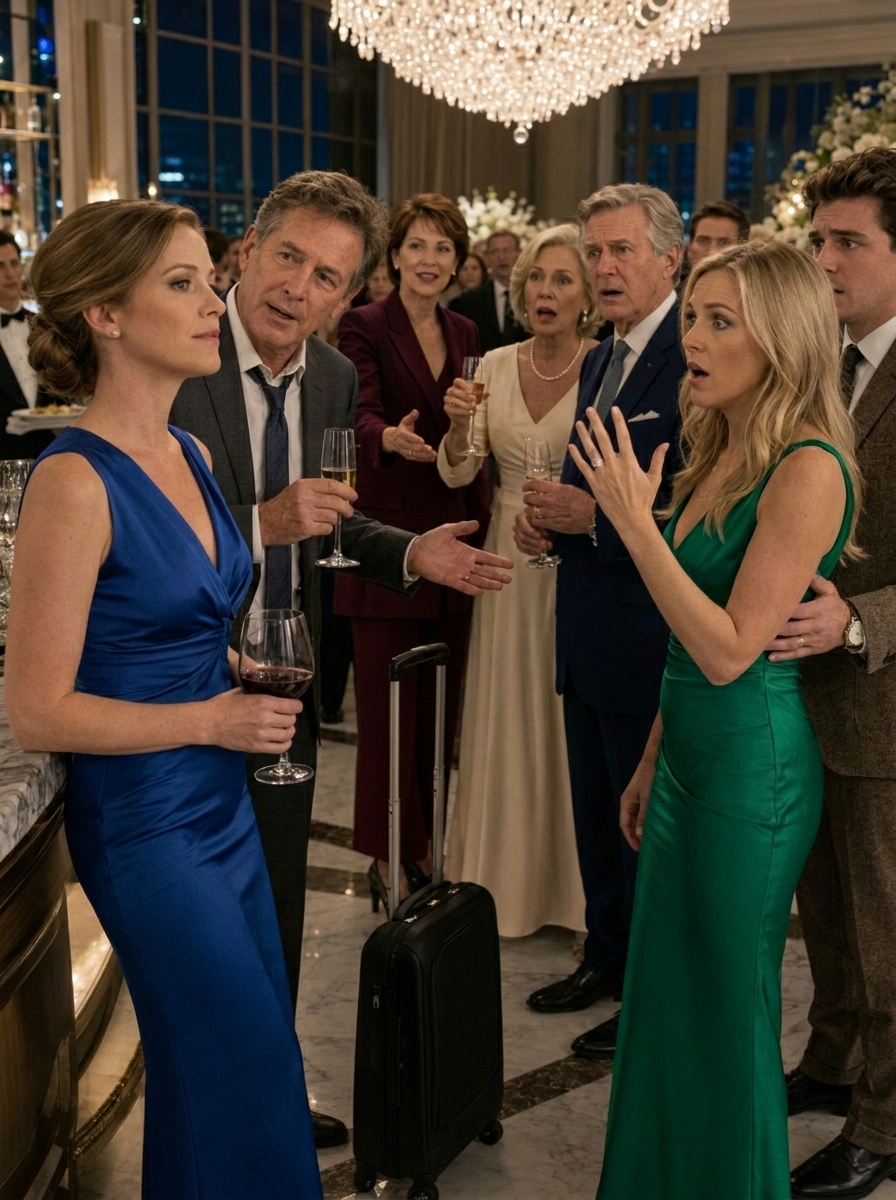
The engagement party at the Riverside Ballroom had been choreographed down to the last sparkling detail.
Crystal chandeliers floated overhead, scattering light over two hundred impeccably dressed guests. A string quartet played unobtrusively in the corner, weaving familiar classical melodies through the low hum of conversation and clinking glassware. Waiters glided like ghosts in black and white, replenishing champagne flutes before they were even half empty.
And right in the center of it all, under the largest chandelier and the undivided attention of most of the room, stood my sister, Brooke.
She held her left hand out at just the right angle, fingers slightly splayed, wrist relaxed, the movement casual enough to seem unpracticed but deliberate enough that the diamond on her finger caught every possible shard of light. The two-carat stone flashed and winked as she laughed, as she covered her mouth in mock embarrassment, as she touched her fiancé’s arm exactly when she recounted the part of the story where he “got down on one knee and totally surprised” her.
I had heard that story fifteen times in the last hour. I knew precisely when the collective “awww” would ripple through the circle of watching guests, when my mother would dab at an entirely imaginary tear, when my father would puff with a fresh wave of paternal pride.
I also knew that not one person in that semicircle would remember to ask me how I was doing.
I leaned against the bar, my glass of pinot noir cradled in my hand, and watched the scene unfold like a play I’d already seen in previews, dress rehearsal, and opening night. Somewhere between the dessert course and the speeches, I’d become part of the scenery—decorative, unobtrusive, useful only when someone needed an extra set of hands to carry gifts or a neutral person to take a group photo.
“Refill, ma’am?” the bartender asked politely.
I glanced at my glass. I’d been nursing the same one for most of the night, letting it warm slowly in my hand.
“I’m good, thanks,” I said.
He nodded and moved down the bar. I turned slightly, putting Brooke back in my line of sight.
She radiated joy, and to be fair, she had every reason to. The ring really was beautiful. Her fiancé, Michael, ticked all of my parents’ boxes: stable job in corporate finance, expensive watch that wasn’t too flashy, a smile that suggested he was “good with people,” and a willingness to laugh at my father’s jokes. The way my mother looked at him—bright, hopeful, almost reverent—made it clear that he had already been mentally grafted into the family tree as the future patriarch of the next generation.
I didn’t begrudge Brooke her happiness. I honestly didn’t. What I did begrudge—quietly, under layers of practiced composure—was the way her happiness had automatically become the central planet in our family’s solar system. Every conversation orbited around her, around them, around their future house, their potential children, their wedding registry.