“They’ve identified one of the entities,” she said. “It leads to a registered consultant. No license. No business activity beyond what we’ve already seen.”
“Has she responded?” I asked.
“Yes,” Dana said. “With counsel.”
I let that settle.
“What does that mean for us?”
“It means this moves forward without us needing to accelerate it,” she replied. “Which is exactly where we want it.”
That night, Daniel came home later than usual. He did not turn on the overhead lights. He moved through the house with a kind of controlled quiet, as if volume itself might change the shape of things. I was at the dining table. The laptop was open, but I was not working anymore. The timeline had reached the point where adding more detail did not change its structure. It only confirmed it.
He stood across from me for a moment before speaking.
“They’re overreaching,” he said.
I looked up.
“In what way?”
“They’re asking for things that don’t exist,” he said. “Formal agreements. Contracts. That’s not how this worked.”
“How did it work?” I asked.
He hesitated.
“Informally,” he said. “I handled things directly. It was more efficient.”
Efficient. The word returned, but it no longer carried the same weight.
“They’ll understand that,” he added.
I did not answer because I knew they would not. Systems are not designed to interpret intention. They verify structure.
He watched me for a moment longer, then exhaled, slower this time.
“You could help clarify this,” he said. “You know how these things work.”
There it was. Not accusation. Not yet. A shift.
“I’ve already provided what I have,” I said.
“That’s not what I mean,” he replied. “You could explain the context. That your mother trusted me. That this wasn’t what they think.”
I held his gaze.
“They’re not asking what I think,” I said. “They’re asking what can be shown.”
The distinction landed. He looked away first.
The next call came from Clare. Her voice was quieter than usual.
“Mom, can I ask you something?”
“Of course.”
She hesitated.
“Dad said the bank is questioning things because you didn’t keep track of them.”
I leaned back slightly in my chair.
“That’s one way to describe it,” I said.
“What’s the other?” she asked.
“That the records are being reviewed,” I replied. “And the review is based on what’s there, not who describes it.”
There was a pause.
“I remember something,” she said. “From last year.”
“What do you remember?”
“Dad asked me to drop off papers at Grandma’s house,” she said. “He said they were routine, but she looked confused, like she didn’t know what she was signing.”
I reached for a pen and wrote the date she gave me. It aligned.
“You don’t have to decide what it means,” I said. “Just remember it clearly.”
“I don’t want to get this wrong,” she said.
“You don’t have to be right,” I replied. “You just have to be honest.”
After we hung up, I added the entry to the timeline. Not as proof. As context.
A few days later, adult protective services contacted Daniel directly. I was not present for that conversation, but I saw its effect. He stopped using the word routine. He started using the word misunderstanding.
“They’re twisting this,” he said one evening, pacing slowly across the living room. “They don’t see the full picture.”
“What is the full picture?” I asked.
“That I was helping,” he said. “That everything I did was for your mother. For us.”
I believed that he believed that. That was the part that made it complicated.
Daniel did not see himself as someone who had taken something. He saw himself as someone who had stepped in where others had hesitated. Control, in his mind, had always been a form of responsibility. But responsibility, when it goes unexamined, can shift into something else without announcing it.
The review continued, not quickly, but steadily. Requests became more specific. Intermediary records were reviewed. Transfers were traced beyond their initial destination. Each layer added clarity, not confusion.
Then, without announcement, it crossed into the next phase.
Formal charges. Not dramatic. No one came to the door. No one raised a voice. The process unfolded through counsel, through filings, through documents that carried more weight than any conversation. Daniel did not deny them immediately. He negotiated. Offers were presented, declined, adjusted.
Time passed. The house changed, not in structure, but in presence. Andrew visited more often, but he asked different questions now, less about what was happening, more about what had happened. Clare stopped repeating Daniel’s explanations. She listened more. Neither of them chose sides. They did not need to. The pattern had already done that for them.
Back in the courtroom, when Dana laid out the timeline and the judge listened without interruption, I understood that we had reached the point where nothing more needed to be added. The structure was complete. Everything after that would be resolution. And resolution, once it begins, does not require momentum. It requires acceptance.
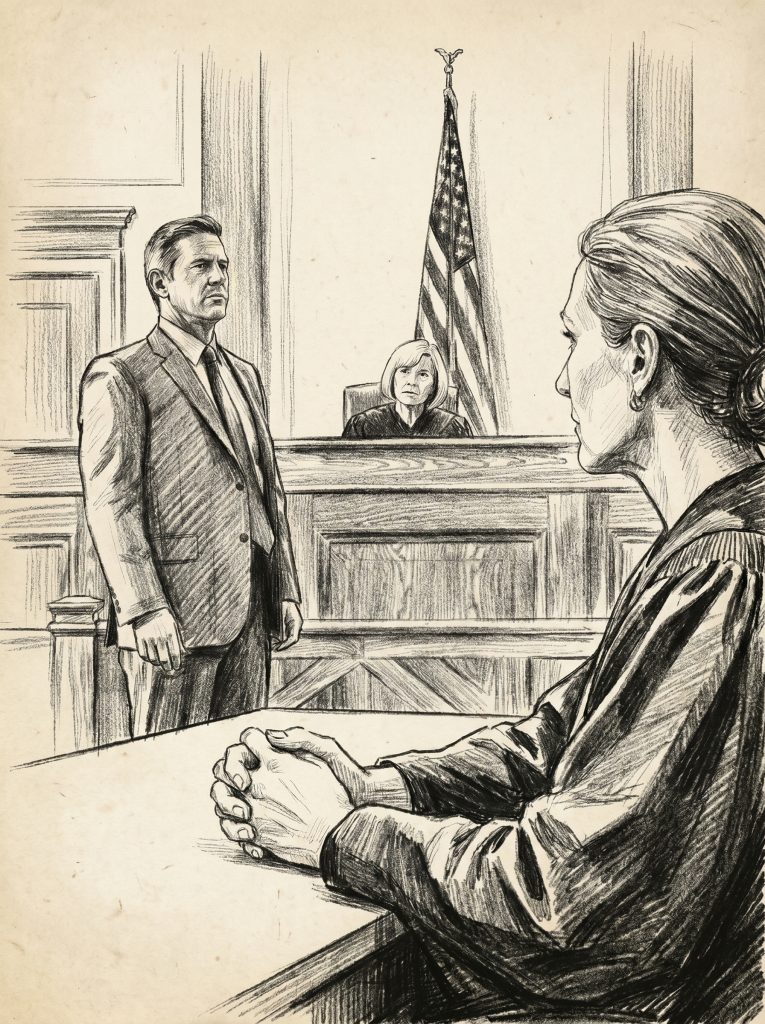
Courtrooms rarely deliver the moment people expect. There was no sudden shift in tone when Dana began laying out the timeline. No visible reaction from the judge that signaled something had turned. The room remained exactly as it had been: quiet, evenly lit, procedural.
But attention moved.
Dana did not rush. She did not try to explain everything at once. She selected a small portion of the timeline and placed it where it could be seen without interpretation.
“Your Honor,” she said, “we’re not presenting the full record today, only a segment sufficient to demonstrate consistency.”
The word hung there briefly. Consistency. Not as an argument. As a description.
The monitor beside the bench displayed a series of entries: dates, transaction labels, amounts. Nothing dramatic. Nothing that would draw attention on its own. But arranged together, they no longer looked incidental.
“These transactions,” Dana continued, “occurred over a ten-month period. Each aligns with documented access to Mrs. Hail’s accounts under the authority granted by the power of attorney.”
Steven Vale stood.
“Objection, Your Honor. This is beyond the scope of the petition.”
“Overruled,” Judge Holloway said, her voice steady. “The relevance is clear. Continue.”
Dana inclined her head slightly and went on.
“The descriptions attached to these transfers—consulting, administrative—do not correspond to verifiable services. Requests for documentation have been issued by multiple institutions. Those requests remain unresolved.”
Daniel did not move immediately, but I saw the change. Not in his posture. In the way he held still. Before, his stillness had been controlled. Now it required effort.
Dana advanced one step.
“We also have medical records indicating that on the dates surrounding the execution of the power of attorney and subsequent transfers, Mrs. Hail was experiencing periods of reduced clarity. Not incapacity, but vulnerability.”
She paused long enough for the distinction to settle.
Judge Holloway leaned forward slightly.
“Was independent counsel present during the execution of this document?” she asked.
“No, Your Honor,” Dana said.
The judge made a brief note. Daniel’s attorney shifted beside him, whispering something that did not carry. Dana did not press. She let the structure stand.
Then she turned slightly toward me.
“Mrs. Price, can you briefly describe your professional background?”
I stood.
“I worked in forensic accounting and financial compliance,” I said. “Primarily identifying irregular transaction patterns.”
“For how long?” the judge asked.
“Fourteen years full-time, and intermittently since.”
“Have you provided testimony in similar matters?”
“Yes.”
Judge Holloway nodded once, then looked at Steven Vale.
“Counselor, was this background considered when assessing Mrs. Price’s capacity?”
Steven hesitated.
“We were aware she had not been employed recently,” he said.
“That’s not what I asked,” the judge replied.
Silence followed. Not heavy. Just precise.
Daniel spoke then.
“She doesn’t do that anymore,” he said. “That’s the point.”
Judge Holloway raised her hand slightly.
“Mr. Price, you’ll have an opportunity to respond. Sit down.”
He did, but something had shifted. It was not visible to everyone, only to those who knew where to look.
Dana returned to the table.
“Your Honor,” she said, “this petition asks the court to grant emergency authority based on the assumption that Mrs. Price cannot recognize financial risk. What we are showing is that the concern is not her inability, but the existence of transactions that are now under independent review.”
She did not say fraud. She did not need to.
Judge Holloway’s expression did not change, but her attention narrowed.
“Are these reviews active?” she asked.
“Yes, Your Honor,” Dana replied. “By financial institutions and adult protective services.”
Another pause. This one longer.
Daniel exhaled slower than before.
Judge Holloway folded her hands.
“Mr. Price,” she said, turning to him, “you have petitioned this court for emergency authority over your wife’s finances.”
“Yes, Your Honor.”
“Based on what I have heard, that request appears to rely on assumptions that are not supported by the information presented today.”
Daniel opened his mouth, then closed it.
“I am denying the petition,” she said, “with prejudice.”
The words were delivered evenly, but they carried.
Steven Vale lowered his gaze. Daniel did not look at him. He looked at me. For the first time that morning, there was no certainty in his expression. Not anger. Not even fear. Recognition.
Judge Holloway was not finished.
“Given the nature of the transactions described and the indication of ongoing review, I am referring this matter for further evaluation.”
A referral, not a conclusion, but enough.
The gavel came down once.
“Court is adjourned.”
The room shifted back into motion. Papers gathered. Chairs moved. The clerk resumed typing. I remained seated for a moment, not because I needed time, but because I understood what had just happened.
Daniel had not lost in a dramatic way. Nothing had been proven in that room beyond what was necessary. But the foundation of his argument, what he had built everything on, had been removed. And without it, nothing else held.
Dana leaned slightly toward me.
“This part is done,” she said quietly.
I nodded, because I knew she was right. The outcome had already moved beyond the room.
The courthouse doors closed behind us with a sound that felt final, but was not. Outside, the air was sharp with early spring, the kind that wakes you up without asking permission. Dana walked beside me toward the parking lot, her pace steady, her tone unchanged.
“The petition’s denied,” she said. “But this continues.”
“I know,” I replied.
Relief did not arrive the way people expect. There was no release, no visible shift in the body. What I felt was quieter than that. Something had been set down, but the structure around it was still moving.
Within days, the reviews expanded. Not loudly. Not dramatically. The emails changed first. The language became more precise. Requests that had been general turned specific. Documentation. Verification. Clarification tied to exact dates, exact transfers.
Daniel stopped calling it routine. He called it a misunderstanding.
“They’re reading too much into this,” he said one evening, standing in the doorway of the kitchen. “This is getting out of hand.”
I was at the table. The laptop closed. By now, the timeline did not need to grow anymore.
“They’re following the records,” I said.
He stepped further into the room.
“You could stop this,” he said. “You know how these things work. You could explain the context.”
“What context?” I asked.
“That your mother trusted me,” he said. “That I was helping.”
I held his gaze.
“They’re not asking what you meant,” I said. “They’re asking what can be shown.”
He looked away first.
The next call came from Andrew. His voice carried less certainty this time.
“Mom, I’ve been thinking about what you said.”
“What part?”
“About paying attention to what stays consistent.”
I waited.
“I looked at some of the statements Dad left out,” he said. “They don’t match what he told me.”
“No,” I said. “They wouldn’t.”
There was a pause.
“I didn’t want to believe that,” he admitted.
“You don’t have to decide everything at once,” I said. “Just don’t ignore what you see.”
He exhaled.
“Okay.”
Clare came by the next afternoon. She did not sit right away. She stood near the table, looking at the same place I had spent weeks working.
“I told them what I remembered,” she said.
“About your grandmother?”
She nodded.
“I didn’t say what it meant,” she added. “Just what I saw.”
“That’s enough,” I said.
She sat then, slower than usual.
“Why didn’t you say anything earlier?” she asked.
I thought about that.
“Because I didn’t need to,” I said. “Not yet.”
She looked at me, trying to understand that answer. I did not explain it further.
The process moved forward without us. The intermediary was questioned. Records were requested. Transfers traced beyond their initial destination. Each step added detail, but it did not change the structure that had already been established.
Then, quietly, it crossed into the next phase.
Formal charges.
Daniel did not deny them immediately. He negotiated. Offers were made, adjusted, reconsidered. Time passed. Not in a way that felt slow. In a way that felt inevitable.
When the resolution came, it did so without spectacle. A plea agreement. Restitution. Restrictions. No raised voices. No final confrontation. Just terms.
Dana called me that afternoon.
“It’s done,” she said.
I sat at the kitchen table after the call ended, the same table where the first notes had been made, where the timeline had taken shape, where everything had been laid out until it no longer needed to be explained. The house was quiet. Not empty. Settled.
I went to the cabinet and took out my mother’s journal. The leather was worn at the edges, the pages thinner than I remembered. I turned to the last entry.
If something doesn’t feel right, you’ll see it.
I read it once. Then I closed the book and placed it on the table. For a long time, I sat there without moving, not thinking about Daniel, not about the case, just about the shape of things when they finally stop shifting.
I did not need to win. I did not need to prove anything beyond what had already been shown. The truth had moved on its own, and that was enough.
If you have stayed with this story, if you followed it through the quiet parts as well as the visible ones, then you understand something most people miss: not everything resolves in a single moment. Some things settle gradually until there is nothing left to question.
If this story feels familiar to you in any way, I would like to hear it—where you are listening from, what time it is there, what part stayed with you. There are more stories like this, ones that do not rush, that do not need to raise their voice to be heard.