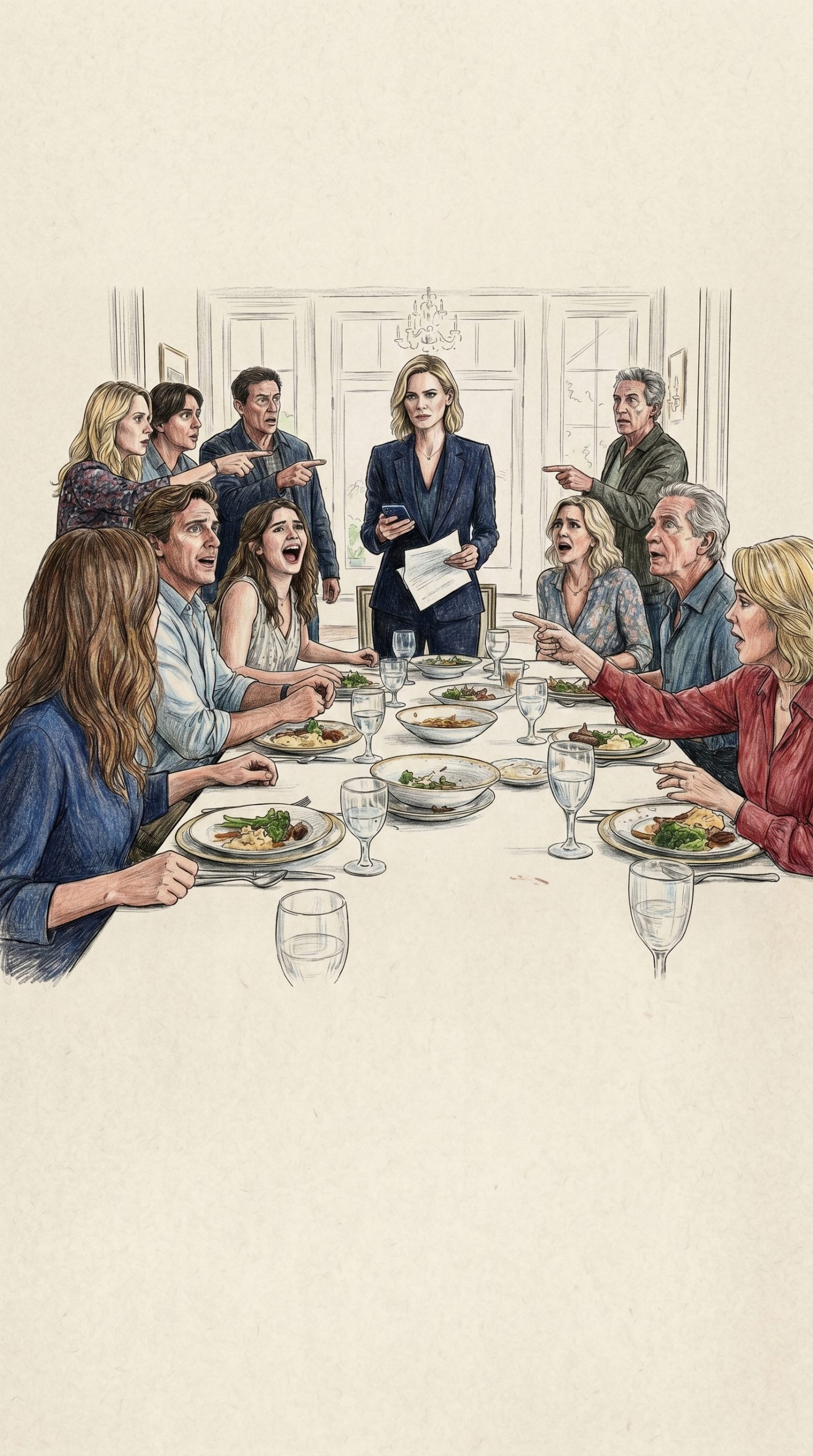
Part 4:
If you’ve never had to explain your own family to a fraud investigator, let me save you the suspense: there is no dignified version.
There is just a fluorescent-lit conference room in a downtown branch office, a box of tissues no one mentions, a man named Paul with polite eyes asking if you’re certain you did not authorize the charges at a Belltown utility company, a department store in Bellevue, and a card-not-present purchase from a luxury skincare site I knew for a fact my mother called “frivolous nonsense.”
There is the sound of your own voice saying, “No, I didn’t open any of those,” over and over until the words stop sounding like language.
There is the strange humiliation of seeing your name attached to other people’s appetites.
Rachel sat beside me taking notes while I answered questions. She had a legal pad, a fountain pen, and the kind of patience that made me think she’d spent years watching people try to wriggle out from under paper trails. Every now and then she’d ask one clean question that cut straight through a muddy answer.
Who had access to the Tacoma property?
Who handled the household mail?
Did your sister ever receive utility service at an address in Seattle matching this account?
By the time we left, my head felt stuffed with cotton.
Outside, December had finally shown up for real. The wind off Elliott Bay cut through my coat, bringing that metallic wet smell Seattle gets when the cold settles in but snow never quite commits. We stood under the bank awning while Rachel tucked documents back into her briefcase.
“You were right,” I said.
She raised an eyebrow. “About?”
“It wasn’t one bad decision.”
She looked at me for a long second. “No. It was a system.”
That word stayed with me all week.
System.
Not accident. Not emergency. Not one desperate choice. A structure. A workflow. Information collected. Mail intercepted. Bills paid until they weren’t. New accounts opened when old ones strained. Me at the center like a resource nobody bothered naming.
My family adapted fast.
Once they realized I wasn’t answering calls, they moved on to narrative. My aunt Denise in Spokane texted me a three-paragraph message about how stress can make older people act out of character. A cousin I hadn’t heard from in eighteen months asked whether Mom was “really in danger of losing the house because of some misunderstanding.” My father sent a long email full of phrases like unfortunate breakdown in communication and temporary financial rearrangement, as if what he had done was misfile a syllabus.
Brooke took a more modern route.
She posted a reel to Instagram in silk pajamas, holding tea, talking about “how success can make some women cold” and “the sadness of watching people choose career over connection.” She never said my name, but she didn’t have to. Half the comments were heart emojis from women who thought she was being brave. One said, Some people are just bitter because they don’t have a family of their own.
I watched it once, then again, then put my phone face-down on my kitchen table so hard my spoon jumped in the cereal bowl.
Leah texted from across the office: Do you want me to key her car or just emotionally support you?
I laughed for the first time in days.
What hurt more than Brooke’s post were the old reflexes it stirred. The instinct to defend myself. To explain. To list facts until somebody reasonable would see reason. But reasonable was not what this was built on. It was built on my silence and their certainty that I would protect them from consequences the way I had always protected them from discomfort.
Rachel advised me not to engage. “Let people tell on themselves,” she said.
So I did.
I saved screenshots. I archived voicemails. I drank too much coffee and not enough water and learned the ugly geometry of fraud claims. Every account had to be disputed separately. Every signature had to be compared. Every point of access mapped.
The utility account turned out to be tied to Brooke’s old apartment in Belltown, the one with the rooftop view and the white kitchen she’d insisted was “important for content.” The luxury skincare purchase had shipped there too. The card itself had been opened online using my email with one letter changed. Close enough that confirmation notices wouldn’t bounce, far enough that I’d never see them.
That one detail made me so angry I had to sit down on my office floor and breathe into my palms like I was the one being dramatic after all.
A few days later, Paul from the bank called Rachel with something they’d pulled from internal records. A certified packet related to the home equity application had been signed for in person at the Tacoma branch after it failed to reach the mailing address on file.
“Can they identify who picked it up?” Rachel asked.
“There’s a branch camera still,” he said. “Quality isn’t great.”
It was good enough.
He emailed it over.
I opened the attachment at my desk and the world narrowed to the glossy rectangle on my monitor.
Brooke. Oversized sunglasses, baseball cap, hair tucked up, like a celebrity trying not to be recognized in a grocery store. She stood at the teller window with one hand braced on the counter. In the other was a white envelope.
My envelope.
My name.
My stomach dropped, then hardened.
Until then, some stupid part of me had kept trying to separate her from it. Brooke was selfish. Brooke was spoiled. Brooke took and took and took. But maybe Dad had done the paperwork. Maybe Mom had looked away. Maybe Brooke was just the loud one at the table, not the one in the machinery.
That image killed that fantasy dead.
She had not just benefited.
She had participated.
That night I couldn’t make myself go home right away, so I walked aimlessly through Capitol Hill in the dark, past the Thai place Adam and I used to like, past a florist closing up shop, past bars breathing warm music out onto the sidewalk every time the door opened. Seattle smelled like wet pavement and garlic and cigarette smoke and pine from somebody’s Christmas wreath. Everybody I passed looked busy with their own small life.
Mine suddenly felt split clean down the middle. Before I knew. After I knew.
When I finally got back to my apartment, there was another message waiting from Rachel.
We need to talk tomorrow. New document surfaced.
I called her instead of texting.
“What is it?” I asked.
Her voice was calm, which somehow made the words worse. “We found the signature source they likely used for the loan file.”
“Meaning?”
“Hospital consent paperwork. From your mother’s surgery year.”
I leaned against my kitchen counter until the granite edge bit into my back.
My mother had been on morphine. My father had been “overwhelmed.” Brooke had cried in the hallway and gone live from the parking lot later that night to thank followers for “prayers.”
And somewhere in all that, somebody had kept my signed forms.
My fingers went numb around the phone.
If they had saved my signature from the worst week of our lives, what else had they been collecting while I was busy saving them?
Part 5
The first person in my family who spoke to me like I wasn’t crazy was Aunt Helen.
She wasn’t really my aunt, not by blood. She was my mother’s older cousin from Puyallup, the one with cropped silver hair and blunt opinions and a habit of sending birthday cards with actual checks in them because “gift cards are lazy.” She had worked twenty-five years as a school librarian and carried herself with the kind of practical dignity that made manipulative people itchy.
She texted me two days after the branch photo surfaced.
Coffee tomorrow. Not at your parents’ house. Don’t argue.
We met at an old diner off Highway 16 where the booths were cracked red vinyl and the coffee tasted like it had opinions. The windows were fogged from the kitchen heat. Somewhere behind us, silverware clattered into plastic bins. Helen stirred cream into her mug and looked at me over the rim.
“You’ve lost weight,” she said.
“Great. Fraud, but make it flattering.”
That almost got a smile out of her.
She waited until the waitress walked away before getting to it. “Linda called me.”
I sat back.
“She wanted me to talk sense into you,” Helen said. “That was her phrase.”
“And?”
“And I told her the last person in that family who needs more sense talked at is you.”
I looked down at my coffee because my eyes suddenly stung. It embarrassed me, how quickly kindness could do that when you’d gone without it for long enough.
Helen reached into her tote bag and pulled out a long white envelope, old enough that the edges had gone soft. “I think this belongs to you.”
It had my name on it in a hand I recognized immediately.
My grandmother’s.
Nana June died when I was twenty-three. Stroke. Fast. Terrible. She smelled like Chanel No. 5 and face powder and peppermints and let me sit in her kitchen as a kid drawing floor plans of houses I swore I’d live in someday. Brooke got compliments from Nana June because Brooke was pretty and sparkly and knew how to perform sweetness. I got quiet things. Books. Notes slipped into coats. A hand on the back of my neck when I was upset and trying not to show it.
“This was in a box Linda gave me after the funeral,” Helen said. “Told me it was just papers. I found it months later and asked about it. She said she’d already handled whatever was in there. I should’ve given it to you then.”
My fingers felt clumsy opening it.
Inside was a folded card and a copy of an investment statement.
The card was short.
For my steady girl,
Being useful is not the same as being loved.
Don’t let anybody teach you otherwise.
Love, Nana June
I read it twice because the first time my brain only caught the shape of the words, not the meaning.
Then I looked at the statement.
An education bond in my name. Not enormous, but not nothing either. Enough to cover a decent chunk of tuition or give a twenty-three-year-old a start. Closed thirteen years ago.
I looked up slowly. “What is this?”
Helen’s mouth tightened. “There were two. One for you, one for Brooke. Your mother said yours needed to go toward a family medical issue. I always suspected that wasn’t the whole truth.”
“What medical issue?”
She held my gaze. “There wasn’t one then.”
The diner noise went strangely muffled.
A memory surfaced, jagged and stupid in its timing. Brooke at nineteen in a boutique downtown, twirling in front of a mirror in a dress she said she needed for a scholarship pageant. Mom telling me they were stretched thin. Dad saying, “You know how your sister is. We have to give her a chance while she has momentum.”
I had worked weekends in college. I had taken the cheaper apartment. I had said it was fine.
I pressed my thumb hard into Nana June’s note until the paper bent. “So this started before I even graduated.”
Helen didn’t soften it. “Grace, this started when they noticed you would carry more than your share if it kept the peace.”
I sat there with the smell of bacon grease and burnt toast in my nose and felt old pieces of my life snapping into place with horrible neatness. Not because the facts were new exactly, but because they finally had a shape. The favoritism. The guilt. Brooke being “still finding herself” at twenty-eight while I was “so capable” at nineteen. The way every compliment I ever got from my parents had an assignment hidden in it.
Reliable. Mature. Strong. Sensible.
All beautiful words if they aren’t being used to mean available.
When I got back to Seattle, I opened the box where I kept old papers and dug until I found the hospital folder from Mom’s surgery. Bills. discharge instructions. visitor stickers. Consent forms. My own signature, exhausted and rushed and written standing up on a counter in a cardiology wing while machines beeped down the hall.
Rachel had been right. The G loop matched.
Worse, there were initials on the front page in my mother’s handwriting. A little blue L.W. in the corner by the family contact section.
Linda Whitaker had handled that packet.
The house was silent except for the hum of my refrigerator. I sat cross-legged on my living room rug with papers spread around me like a forensic map and thought about my mother laughing at Brooke’s joke. Not even out of cruelty, maybe. Out of relief. Relief that for one stupid dinner-table moment, the conversation was about my lack, not her theft.
My phone rang. Rachel.
“I’ve got another update,” she said. “We subpoenaed electronic records related to the application. A scan of your signature was uploaded from a home IP address registered to the Tacoma property.”
“So it came from their house.”
“Yes.”
I closed my eyes. “All of them knew.”
There was a small pause. “I can’t prove everyone’s knowledge yet,” Rachel said carefully. “But your mother’s initials are on the source packet, your father’s contact number is on the file, and your sister picked up certified mail. We’re past accident.”
After we hung up, I stayed on the rug a long time, Nana June’s note in my lap.
Being useful is not the same as being loved.
I had built my whole adult life as if proving usefulness would eventually cash out into safety.
Instead, it had made me easier to rob.
I picked up my phone and scrolled to Brooke’s number. My thumb hovered once, then pressed call.
She answered on the second ring, annoyed. “What?”
I stared at the hospital forms on my floor. At Mom’s initials. At my own exhausted signature turned into a weapon.
When I spoke, my voice was so calm it scared me. “Tell me exactly how much Mom knew.”
Brooke went quiet.
And in that silence, I got my answer before she said a word.
Part 6
Brooke didn’t answer my question that night.
She hung up.
That was her move when she couldn’t charm, bully, or outtalk a thing. Exit first, rewrite later.
So I went to her.
Brooke was living in a one-bedroom in Belltown with concrete counters, a fake fiddle-leaf fig in the corner, and a view of a parking garage wall that she somehow kept cropping out of every photo. I knew the building because I’d paid one month’s back rent there last spring when she’d cried on the phone and told me she was “one bad week away from total collapse.” Total collapse had looked, in person, like a place that smelled faintly of vanilla body mist and boxed PR skincare.
She opened the door wearing an oversized blazer over bike shorts and full makeup at seven-thirty on a Wednesday, which told me she had either been filming or expected company.
“What are you doing here?” she asked.
“You hung up on me.”
“Because you’re being insane.”
I pushed past her before she could decide to be theatrical and slam the door. Her apartment looked like every stage set version of a young woman’s life I’d ever seen online: ring light by the couch, unopened brand packages stacked by the wall, a bowl of lemons nobody was eating, expensive candles burned just enough to look used. On the coffee table sat a purse I recognized from the Bellevue charge dispute.
“Cute bag,” I said.
She folded her arms. “Don’t start.”
“Who paid for it?”
She scoffed. “Oh my God.”
I turned and looked at her fully then. We have the same eyes, which I hated noticing in moments like this. Mine just sit in my face differently. Brooke’s always seemed lit from underneath by expectation.
“I know about the bank,” I said. “I know about the cards. I know Mom’s hospital paperwork was used for the signature file. So you can either tell me the truth now, or I can keep collecting it without you.”
For a second she looked young. Not innocent. Just stripped of polish. Then the hardness came back.
“You always do this,” she said.
“Do what?”
“Act like you’re the only one who’s ever carried anything.”
I laughed because the alternative was screaming. “Carried? Brooke, you’ve been using my name like a coupon code.”
She flinched, then got mean. “Dad said you’d make it dramatic.”
“Dad can get in line.”
She turned away and grabbed a water bottle from the counter, twisting the cap too hard. “The house was behind. Mom’s meds were expensive. Dad’s consulting dried up. Everybody was stressed.”
“So you stole from me.”
“We borrowed.”
“In my name.”
She whipped back around. “You had the money.”
There it was. Bare. Not need. Not shame. Logic, as she understood it.
“You had the money,” she repeated. “You were always fine. It’s not like you had kids to support or a husband depending on you.”
The room went absolutely still.
My own sister had taken the worst thing she could find and built a philosophy out of it.
“Did Mom know?” I asked again.
Brooke stared at me, breathing through her nose, and I saw the exact moment she decided honesty might feel better than pretending.
“She knew enough,” she said.
“How much is enough?”
“She knew Dad used your surgery forms because he’d saved them. She told him not to do the whole amount at once.” Brooke’s voice had gone flat now, almost bored. “She said if it was small, you’d never notice. Then the card thing happened later when rent got bad and Dad said—”
“What did Dad say?”
Brooke looked past me, toward the window. “That you owed the family.”
I could hear traffic six floors down, a siren fading somewhere toward the waterfront, the low whir of Brooke’s ring light still plugged in but off.
“Owed,” I repeated.
She shrugged, but it was brittle. “You had the good job. You had the brains. You were always the one everybody could count on. Mom said you buried yourself in work anyway.”
“Mom said that.”
Brooke’s lips pressed together. She knew she’d gone too far, and that made me push harder.
“Did she say I owed because I didn’t give her grandchildren too? Since that seems to be the family joke this week.”
Brooke looked away first.
That was answer enough.
All at once I was back at the dining table, my mother laughing in that thin high way, not because Brooke had been funny, but because the joke had reinforced the story they told themselves: Grace has less claim to her life than we do. Grace is incomplete, therefore available.
I picked up the purse from the coffee table and turned it over. The receipt was still inside, crumpled. Same week as the unauthorized purchase.
“This was you.”
Brooke snatched it from my hand. “Fine. Yes. I used the card twice. I paid it back once.”
“With what money?”
She didn’t answer.
I should tell you I felt vindicated then. Powerful. Clear. The truth is I mostly felt tired. A deep cellular tiredness, like my whole body finally understood what my mind had been refusing for years.
“You need to start telling the bank exactly what you did,” I said. “Not to me. To them.”
She laughed once, shaky. “You think I’m going to go down for this because you suddenly found your self-respect?”
“No,” I said. “I think you’re already going down for it because you mistook access for immunity.”
Her face changed. Fear, finally. Small, but real.
I walked toward the door.
“Grace,” she said behind me, and for the first time in the conversation, she sounded like my sister instead of my parasite. “I didn’t think it would get this bad.”
I put my hand on the knob and looked back.
“That’s because none of you ever thought I was a person this could happen to.”
I had barely made it to the elevator when my phone rang.
Mom.
I almost let it go. Then I answered.
Her breathing was quick and wet. “Grace, sweetheart, I need you. Your father and Brooke are fighting. My chest feels tight.”
Every nerve in my body lit up. Heart surgery changes the meaning of certain sentences forever.
“Are you having pain?” I asked.
“I don’t know. I’m scared.”
I closed my eyes. Rachel had warned me. Document everything. Don’t get dragged back into panic as leverage.
But this was my mother.
I stepped off the elevator and back into the hallway, torn clean down the middle between training and truth.
Then I heard my father in the background, not panicked, just irritated. “Tell her to come home.”
Not call 911. Not go to the hospital. Tell her to come home.
I opened my eyes.
“Mom,” I said, very evenly, “I’m calling an ambulance.”
She went silent.
“No, don’t do that,” she said too fast. “I just need you here.”
Cold moved through me, colder than rage.
“You need a medic,” I said. “Or you need to stop using your heart as a leash.”
I hung up and called 911 anyway.
And while the operator asked for the Tacoma address, all I could think was this: if my mother would use her own scar to drag me back, was there any piece of this betrayal they wouldn’t touch?