Part 7
The ambulance went.
My mother was not having another cardiac event. By the time EMTs arrived, her vitals were stable, her pain had “eased,” and the whole thing was logged as anxiety and family stress.
Family stress.
I laughed when Rachel read that phrase aloud from the incident note the next day. Not because it was funny. Because sometimes your options are laugh or grind your own teeth down to powder.
“Was I wrong to call?” I asked.
“No,” Rachel said. “You did exactly the right thing. You treated it like a real emergency instead of a private manipulation.”
That mattered more than I expected. Not because I needed permission, but because I was still learning how different healthy action felt from trained obedience. Calling 911 was care. Driving straight there because my mother said jump would have been surrender dressed up as love.
The official process moved slower than emotion and faster than denial. That was the strange comfort of it.
Forms got filed. Affidavits were signed. The bank’s forensic team compared signatures and IP logs. I sat in a police substation one Monday morning with flickering fluorescent lights overhead and gave a statement to a detective with kind tired eyes who had clearly seen families destroy each other in cheaper ways and costlier ones. He never once asked why I hadn’t noticed sooner. For that alone, I could have hugged him.
Dad still thought he could fix it with tone.
He cornered me outside my building on a Thursday evening just after six, when the sky was already black and the wet sidewalk was reflecting taillights like red paint. He stepped out from beside the hedge in his camel coat, looking older than he had a month earlier but still arranged, still carrying himself like a man who expected rooms to adjust around him.
“Grace,” he said.
I stopped but didn’t move closer.
He looked over my shoulder at my apartment entrance, lowering his voice as if intimacy could be manufactured by volume. “This has gone far enough.”
“That depends on your definition of far.”
He ignored that. “The bank is overreacting. Lawyers escalate things because that’s how they make money.”
“My lawyer didn’t open a loan in my name.”
His jaw clicked. “I did what I had to do.”
I stared at him. People talk about confession like it’s some explosive movie moment. Sometimes it sounds like fatigue. Sometimes it sounds like a man who has spent so long justifying himself that the truth slips out dressed as practicality.
“What exactly did you have to do?” I asked.
“Keep this family afloat.”
“No,” I said. “You mean keep your lifestyle intact.”
He took a breath, irritated now that his appeal to noble sacrifice had failed. “You think life is clean because you sit in an office moving boxes around on a screen. Real life isn’t clean. Real life requires compromise.”
“That wasn’t compromise. That was fraud.”
His eyes hardened. “I taught you everything you know about responsibility.”
I actually smiled then, and it startled him. “No. You taught me that if I was competent enough, you’d take whatever I didn’t lock down.”
For a second his face emptied. The performance dropped. I saw not remorse exactly, but calculation failing in real time.
Then he tried once more. “If you keep pushing this, the house will have to be sold.”
I thought about the dining room. The wall clock. The smell of garlic. My mother laughing. Brooke lifting a glass like she was queen of a kingdom I paid for.
“Then sell it,” I said.
I went inside and locked the lobby door behind me.
Two days later, Rachel called while I was grocery shopping. I was in the produce section holding avocados, squeezing them like I knew what I was doing, when her name lit up my screen.
“You’re cleared,” she said without preamble.
I forgot where I was. “What?”
“The bank completed its review. The home equity line is confirmed fraudulent. You are removed from liability effective immediately. The credit cards and utility account are being rescinded as identity theft. We’ll still pursue the rest, but the debt is no longer yours.”
I leaned one hand against the cold misting unit by the lettuce and shut my eyes.
For months—maybe years, if I was honest—I had been carrying invisible weight I hadn’t named. A pressure behind the ribs. A sense that my money wasn’t really mine, my future wasn’t really mine, even my name wasn’t entirely mine if family needed it badly enough.
And then, in the middle of QFC under fluorescent lights and a display of pears, that pressure broke.
“So it’s over?” I asked.
“Legally, the biggest piece is,” Rachel said. “Emotionally, that part’s still your territory.”
I laughed a little through my nose. “Always my territory.”
She made a sound that might have been agreement, then added, “There will be fallout. The bank is pursuing the property side. If your parents can’t refinance or repay, they’ll have to sell.”
That part landed quieter.
Not guilt. Not exactly. More like the last click in a trap I hadn’t built but had once kept oiled.
That evening I sat on my couch with takeout noodles and looked up the Tacoma listing sites out of sheer terrible curiosity.
The house wasn’t up yet.
It appeared four days later.
FOR SALE.
There it was on the screen. My parents’ split-level with the peeling porch rail and the hydrangea bush Mom always meant to trim. The realtor photos were brightened within an inch of dishonesty. The dining room looked larger than it was. The kitchen looked less tired. The family room, stripped of half its clutter, had the generic sadness of a place already being translated for strangers.
I clicked through every image.
Photo twelve was the dining table.
Not our old tablecloth. Not the roast chicken. Just polished wood, a bowl of green apples, staged sunlight.
I stared at it until my reflection ghosted over the screen.
Later that night, Brooke left me a voicemail. She was crying and furious in equal measure, which had always been her preferred ratio.
“You got what you wanted,” she said. “You stole our house. Hope your spreadsheets keep you warm.”
Two minutes after that, my father sent a text.
One last dinner before the house is gone. You owe your mother that much.
I read it twice.
The audacity almost made it abstract.
Still, my stomach turned.
Because if they had lost the house and still believed I owed them one more performance of daughterhood, what exactly were they planning to ask for at an empty table?
Part 8
I went.
Not because I owed my mother anything.
Not because closure is sacred.
I went because some doors are easier to lock once you’ve seen the room empty.
The house looked wrong the minute I pulled up. The front curtains were down. The living room lamp that used to cast that orange little pool of light onto the porch had been packed away. Through the front window I could see stacked boxes with black marker on the sides: KITCHEN. BOOKS. WINTER. A strip of painter’s tape hung from the banister like a white tongue.
Inside, the familiar smell was gone. No roast chicken. No coffee on the burner. Just dust, cold drywall, and cardboard.
My mother had ordered takeout. Plastic containers of fettuccine and salad sat open on the kitchen counter beside paper plates. The dining room table was still there but pushed off-center because a rug had been rolled halfway underneath it and forgotten. It all felt temporary and mean.
Brooke looked awful. Not movie awful. Real awful. Mascara scrubbed off too fast. Hair in a knot. Nails chipped. She still had on expensive sneakers, which felt somehow on brand even in collapse. Dad looked smaller without the house around him, less like a patriarch and more like a retired man in a sweater he’d slept in.
Mom tried to smile when I came in. “Thank you for coming.”
I set my coat over a moving box. “Say what you need to say.”
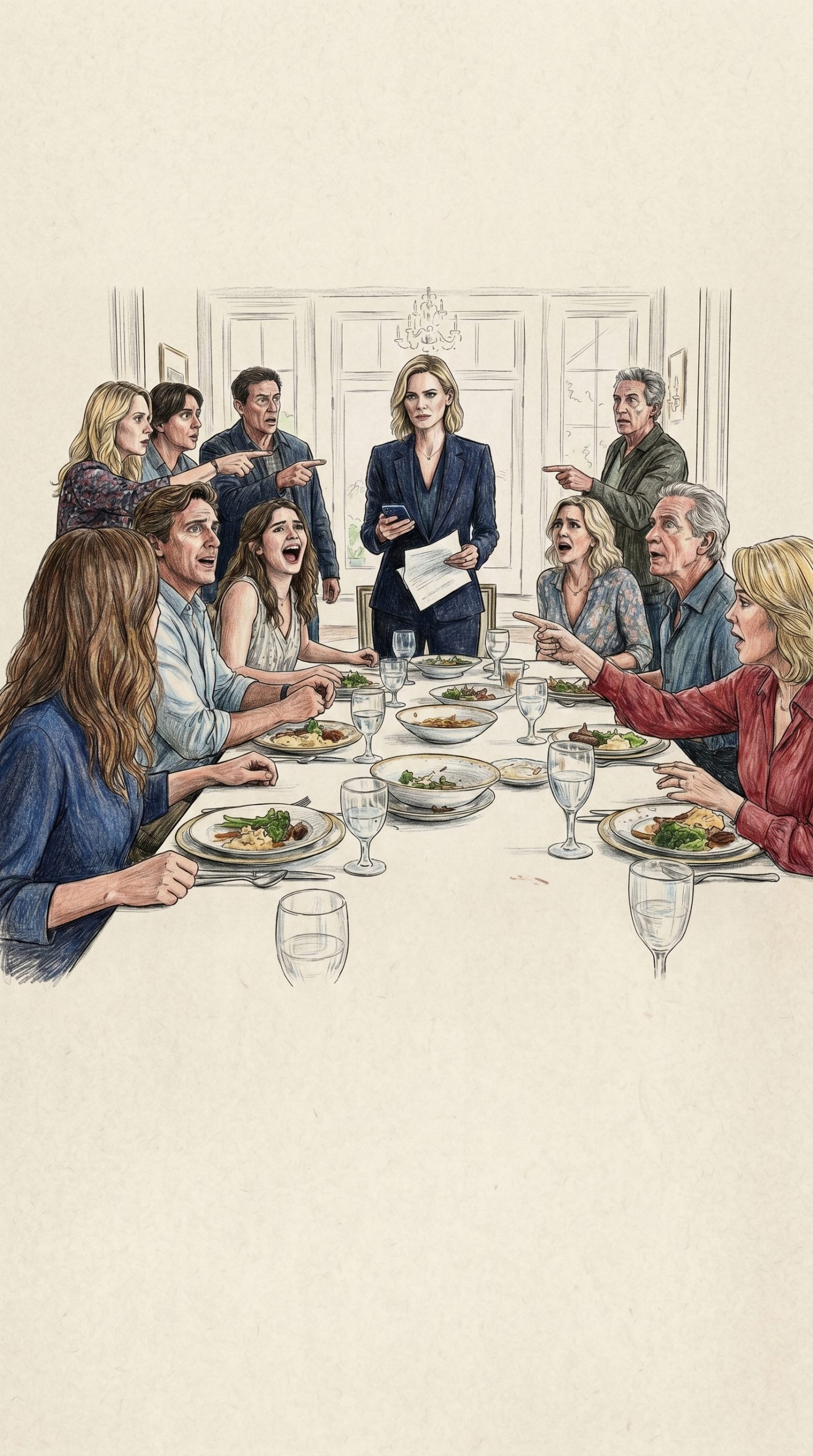
We ate first because apparently even ruin comes with habits. Forks scraped paper plates. Nobody mentioned the realtor lockbox on the front door. Nobody asked about my work. Nobody said grace, which was funny because my mother used to insist on it when company came.
Finally Dad folded his napkin and looked at me like we were at a settlement conference, which, I realized, in his mind we probably were.
“There’s a possibility,” he said, “that if you make it clear to the bank and the district attorney that you don’t wish to cooperate further, this can remain a civil matter.”
Rachel had predicted something like this.
I put my fork down. “No.”
Mom’s face pinched. “Grace, please don’t answer like that before hearing everything.”
“I heard everything months ago. It was called forged documents.”
Dad ignored the interruption. “The house sale won’t cover all of it. If criminal charges proceed, it affects future housing, employment, your mother’s medical access—”
“You should have thought about that before using my identity.”
Brooke let out a sharp laugh from across the table. “You really love this. You love finally being the good one out loud.”
I turned to her. “You think this is about me being good?”
“I think this is about you enjoying punishment.”
That hit something unexpected in me, not because it was true, but because it was such a revealing lie. Brooke had built her whole life around the idea that consequences were cruelty. That if something felt bad, the person enforcing it must be bad too.
“No,” I said. “This is about reality finally catching up with all of you.”
Mom’s eyes filled. “We are your family.”
I looked at her for a long second. Her face seemed older in the thin kitchen light, the soft skin under her eyes looser, the line between her brows deeper. I could see the woman who sat by my childhood bed when I had the flu. I could also see the woman who laughed when my sister mocked my empty life while she had already been helping empty my accounts.
Both things were true. That was the hardest part.
“And I was your daughter,” I said. “Still did it.”
Dad sat forward. “Do not talk to your mother that way.”
Something in Brooke snapped then, maybe because she sensed Dad steering the story back toward hierarchy. “Oh, please. This was your plan.”
Mom whipped around. “Brooke—”
“No, I’m serious,” Brooke said, shoving her plate away. “You keep acting like we all just got dragged into Thomas Whitaker’s genius strategy. You told him Grace wouldn’t notice. You said to start with small accounts. And you”—she pointed at Mom—“literally handed over the surgery papers.”
Mom went white.
Dad slammed a hand against the table. “Enough.”
But Brooke had found the seam and couldn’t stop picking at it. “And now you want her to save us again? That’s the whole thing, isn’t it? Grace cleans it up. Grace always cleans it up.”
The room vibrated with the force of truths nobody had wanted said in front of me. Or maybe nobody had cared if I knew as long as I kept functioning.
I stood up.
Not out of anger this time. Clarity.
They all stopped and looked at me. Mom crying. Dad furious. Brooke heaving, hair falling out of her knot, face blotched and young and ugly with panic.
I heard my own voice before I decided on the exact words.
“I don’t forgive any of you.”
Nobody moved.
I kept going.
“Maybe one day I won’t wake up angry. Maybe one day I’ll tell this story without feeling it in my teeth. But forgiveness is not something you get because you ask on the right night with the right tears. You don’t get it because we share blood. You don’t get it because this house is empty now and you finally understand consequences.”
Mom made a sound like I had slapped her.
I picked up my coat.
Dad’s voice came low and dangerous. “Blood is blood.”
I looked at him. Really looked. At the man who had taught economics and used my name like a line of credit. At the father who had mistaken dependence for loyalty.
“No,” I said. “Character is character.”
On my way out, I passed a box of framed photos by the hall closet. One had slipped halfway out. I bent without thinking and pulled it free.
It was an old picture from the Puyallup Fair. Me at maybe twelve, Brooke at eight, Nana June between us in sunglasses and a cardigan. Somebody had started to crop it for a smaller frame but stopped too soon. Brooke was centered. Dad’s shoulder made the left edge. My body was there, but just barely.
On the back, in Nana June’s handwriting, were four words.
Stand where you are seen.
I held the frame in both hands for a second too long.
Then I tucked it under my arm and walked out.
Behind me, the house went quiet one window at a time.
The drive back to Seattle felt longer than usual, maybe because for the first time in years I wasn’t headed away from something unfinished. The city lights showed up at last, soft in the mist, and it hit me that the next Sunday would come with no obligation attached.
If I wasn’t their emergency exit anymore, what did a life look like when it actually belonged to me?
Part 9
At first, freedom felt suspicious.
That’s the truth nobody tells you. When you’ve been useful for long enough, peace can feel like negligence. The first Sunday I didn’t drive to Tacoma, I woke up at seven with my body already braced, like I’d forgotten an exam. The apartment was quiet except for the radiator ticking and the distant grind of a bus stopping on Pine. Gray light came through the blinds in stripes.
No messages. No grocery list from Mom. No “quick favor” text from Brooke. No call from Dad asking if I could “bridge them until next Friday.”
I lay there staring at the ceiling, almost nauseous with the space of it.
Then I got up and made coffee the slow way, not because I needed to but because I could. I ground the beans. I heated the kettle. I stood at the counter in bare feet listening to water move through the filter cone and smelling the dark bitter steam rise into the kitchen. I ate toast at the table instead of in the car. At eleven, I walked to Volunteer Park in a wool coat and watched the pond ripple under a low white sky.
Nobody needed anything.
By week three, that started to feel less like abandonment and more like oxygen.
I set up a real savings account. Not a vague mental category called eventually. An actual account with automatic transfers going to me. I took the promotion at work I’d been hesitating over because it came with more responsibility and I had always assumed family chaos could spike at any moment. I signed up for a night photography class at Seattle Central because I’d wanted to do it since I was twenty-six and had spent six years telling myself later.
The first class smelled like dust, printer ink, and wet coats drying on chair backs. There were twelve of us. A retired dentist who photographed birds, a college kid with film cameras hanging off his backpack, a woman who wanted to document construction sites, and a man named Nate who introduced himself as an architect and said he was there because “I keep designing buildings around light but I’m bad at actually seeing it.”
He had kind eyes and a habit of listening all the way to the end of people’s sentences.
I noticed that because I had gotten very good at noticing the opposite.
We weren’t a romance in a movie montage. Not even close. We were two adults standing over contact sheets after class, talking about why fluorescent grocery stores can somehow feel lonelier than empty streets. He laughed easily. He never once asked an intrusive question. When I mentioned I was dealing with family stuff, he said, “I’m sorry,” and left the sentence there instead of prying it open.
That felt almost intimate.
The legal side settled into outcome.
The house sold in January. My parents moved into a two-bedroom rental farther south, somewhere between Tacoma and the place people say is Tacoma when they don’t want to explain suburban geography. Brooke moved in with a friend, then out again, then apparently with some guy in Kent if the occasional gossip text from relatives was accurate. I didn’t ask. Rachel told me the criminal referral had been resolved through restitution agreements, financial penalties, and recorded admissions. No jail. Enough consequence to mark them. Not enough to let them pretend they’d been misunderstood.
She asked if I wanted to review the final documents in person.
“No,” I said after a pause. “Just send me what I need to sign.”
Thanksgiving came and went. Then Christmas.
The first holiday season alone is oddly physical. You notice the empty chair before you notice the emotion. The silence while chopping onions. The fact that nobody has brought up politics too loudly or overcooked the rolls or said something mean wrapped in a joke. I spent Thanksgiving at Leah’s apartment in Ballard with five people, two dogs, and a turkey that needed another forty minutes but was eaten anyway. We sat around mismatched plates drinking too much red wine and arguing about which year of reality TV had ruined civilization. When I got home, I stood in my apartment doorway with leftovers in a foil pan and realized I wasn’t lonely.
I was calm.
That was new enough to be almost holy.
The messages from my family slowed once they understood money would never enter the conversation again. Dad sent one email in December asking if I’d be willing to “consider a short-term bridge during a difficult transition.” I deleted it without replying. Brooke sent a late-night text on New Year’s that just said hope you’re happy. I blocked her after that, not in anger, just completion.
Mom was harder.
She sent three messages over two months. The first was a photo of the rental’s tiny kitchen with the caption figuring things out. The second said Merry Christmas, sweetheart, with a heart I did not return. The third I didn’t open for two days because I knew from the preview it was longer.
When I finally read it, it wasn’t money. It wasn’t guilt. It was one sentence.
There is one truth I never told you, and you deserve it.
No explanation underneath. Just that.
I stared at the screen until it dimmed. Outside, January rain slid down the window in crooked lines. The apartment smelled like tomato soup and the rosemary candle Nate had brought to class as a joke because he said my photos of kitchens looked like they needed “a scent design consultant.”
One truth.
As if truth were singular. As if the worst part hadn’t been the thousand small lies that made the big one possible.
I put the phone down. Picked it up. Put it down again.
Nate texted then, almost absurdly normal.
Coffee after class Thursday?
I smiled despite myself and typed yes before I could overthink it.
Then I looked back at my mother’s message.
I had spent so much of my life chasing the next explanation, the next piece of context that might make betrayal easier to digest. Another bill. Another excuse. Another family emergency with a footnote.
But this felt different.
Not because I trusted her.
Because I didn’t.
And that meant if I chose to hear her, I would hear her as I was now, not as the daughter still trying to be won.
I typed back two words.
Public place.
Her reply came almost immediately.
Saturday. Harbor café. Noon.
I set the phone aside and listened to the rain a while.
After everything, after the house and the loan and the laughter and the lawyer, my mother still had one more thing she believed belonged in my hands.
The question was no longer whether I could survive hearing it.
The question was what I would do once I had it.
Part 10
The harbor café sat above the water with big windows and overpriced soup, the kind of place tourists loved because ferries passed close enough to make them feel cinematic. In February, it mostly smelled like wet wool, espresso, and chowder. Boats moved through Elliott Bay under a low silver sky. Everybody inside spoke in that softened public-places voice people use when they are trying not to let their lives spill onto strangers.
My mother was already there.
She had a paper cup of tea in both hands and looked smaller than I remembered, though maybe that was just the absence of the house. Homes do a lot of costume work for families. Without hers, she looked like what she was: a woman in her sixties with tired eyes, careful lipstick, and a face that had learned too late it was not exempt from consequence.
When she stood, I stayed where I was.
“Hi, sweetheart,” she said.
I sat across from her. “Don’t call me that.”
She swallowed and nodded once. “Okay.”
For a moment neither of us spoke. A little kid in a yellow raincoat pressed both palms to the window behind her and squealed when a gull landed on the railing outside. Milk hissed through a steam wand. Somewhere, a spoon hit the floor.
My mother stared into her tea like it might help her organize the truth.
Finally she said, “Your father told me not to meet you.”
“That tracks.”
A quick, pained smile touched her mouth and vanished. “He said if I apologized, it would make things worse.”
“Did you come to apologize?”
She looked at me then, properly. “I came to tell you something I should have told you the first time you asked.”
I waited.
“When I had surgery,” she said, “the insurance covered more than we told you.”
I felt no surprise. Only confirmation, and with it a strange clean sadness.
“How much more?”
“Most of it. There were bills, but not what we said. Your father was already behind before that. He used my recovery to justify asking you for more money. Then when that became normal, it was easier for him to say you could carry us a little longer.”
“And you let him.”
“Yes.”
She said it without cushioning. That, more than tears would have, kept me in my chair.
“Why?” I asked.
She blinked rapidly, but she held my gaze. “At first because I was scared. Then because it worked. Then because I was ashamed and every month it got harder to say we’d lied.”
“That’s not the whole truth.”
Her fingers tightened around the tea cup. “No.”
I waited again.
She took a breath. “Sometimes I resented you.”
That one hit.
Not because I hadn’t sensed it. Because mothers are supposed to be the place resentment goes to die, and mine had apparently fed it.
“For what?” I asked, and my voice came out flatter than I intended.
“For being able to do what I couldn’t.” Her eyes shone now, but she did not look away. “You were stable. Clear. Capable. You made decisions and lived with them. You had a life that looked clean to me, and instead of being proud of that the way I should have been, I let it turn into this ugly belief that you would be fine no matter what we took.”
A ferry horn sounded low through the glass.
She kept going.
“And after Adam left… your father said you were pouring everything into work anyway. That if you didn’t have children and you didn’t have a husband, then helping family was how you gave your life meaning. I didn’t say that. But I didn’t stop it either.”
There it was. The table laughter explained all the way down to bone.
Not random cruelty. Not one bad joke.
A story they had told themselves long enough to believe: that what I lacked made me available. That my life had open space in it by right. That because I had not built a family in the shape they respected, I could be consumed by theirs.
I looked out the window for a second because the alternative was crying in front of her, and I was not going to do that. Water slapped the pilings below. A gull lifted off, white against the gray.
When I turned back, she was waiting.
“I am sorry,” she said. “Not just for the money. For laughing. For every time I let your usefulness stand in for love. I was wrong.”
The words were plain. Real, maybe. Late, definitely.
And still.
It still wasn’t enough.
Not because apologies have no value. Because some damage does not become forgivable just because it is finally named correctly.
“I believe you’re sorry,” I said.
Hope flashed across her face so fast I almost hated myself for what came next.
“But I do not forgive you.”
The hope dropped out of her like a stone.
I didn’t rush to fill the silence.
Around us, people kept living. A couple split a muffin. Somebody opened the door and let in a gust of cold air and diesel smell from the water. The espresso machine screamed briefly, then quieted.
My mother’s eyes filled. “Grace—”
“No.” I leaned forward slightly. Not harsh. Final. “I need you to hear me without turning this into another plea. I am not going to punish you forever. I’m not going to spend my life feeding this wound. But forgiveness is not required for me to move on, and I’m done acting like my peace has to be purchased through mercy.”
She covered her mouth with one hand.
“I hope you tell the truth from now on,” I said. “I hope you stop using guilt as a family language. I hope you and Dad figure out how to live honestly, even now. But I will not be your daughter in the old way. I will not send money. I will not take emergency calls unless there is a real medical professional involved. And I will not sit at another table where my life gets measured by what you think it lacks.”
Tears slipped down her face. She did not wipe them right away.
“Does this mean goodbye?” she asked.
I thought about the dining room. The crop-marked photo. Nana June’s note. My father in the dark outside my building. Brooke in sunglasses picking up my mail. My own hand on a hospital counter, signing papers while my mother lay in recovery, never imagining those same strokes of ink would be used to hollow out my future.
Then I thought about my apartment on Sunday mornings. The smell of coffee. My camera bag by the door. Nate texting bad weather jokes. My savings account growing quietly. The absence of fear.
“It means this version of us is over,” I said. “And it’s not coming back.”
I stood.
My mother looked up at me like there were a hundred more things she wanted to say and no room left to put them. Good. Some silences deserve to stay earned.
I left cash on the table for the coffee I hadn’t touched and walked out into the cold.
The wind off the water cut across my face, sharp and clean. I stood on the sidewalk for a second letting it hit me. Ferries moved in and out. Cars hissed over wet streets. Somewhere behind me, inside the café, my mother was still sitting at that small round table with her tea gone cold.
I did not turn back.
That evening I went to photography class. Nate held the door open for me and said, “You okay?” in that easy, undemanding way of his.
I thought about lying. Then I didn’t.
“Yeah,” I said, and for once it was true in the way truth matters. “I think I finally am.”
After class we walked to a corner place for soup and grilled cheese. Rain tapped the windows. The neon OPEN sign buzzed softly above the door. He told me about a bridge project in Tacoma he’d turned down because the client was impossible. I told him about how grocery store lighting makes everyone look like they’ve recently received bad news. We laughed. We ate. Nothing was asked of me that wasn’t freely offered.
Months later, when spring finally started softening Seattle at the edges, I hosted brunch in my apartment on a Sunday. Leah came. Nate came. The retired dentist from class brought ridiculous pastries. The table was too small and the coffee ran out once and nobody cared. Sun slid across my floorboards in a pale gold stripe. Someone knocked over a spoon and laughed. Not sharp laughter. Not laughter with teeth.
The kind that leaves room.
I still have Nana June’s note taped inside my kitchen cabinet where only I can see it when I reach for mugs.
Being useful is not the same as being loved.
I know that now.
I also know this: I never forgave them. Not my father for forging my name. Not my mother for laughing while helping herself to my life. Not my sister for turning my pain into a joke and my identity into a convenience.
I stopped carrying them anyway.
And in the space where their weight used to be, I finally had room to stand where I could be seen.
THE END!