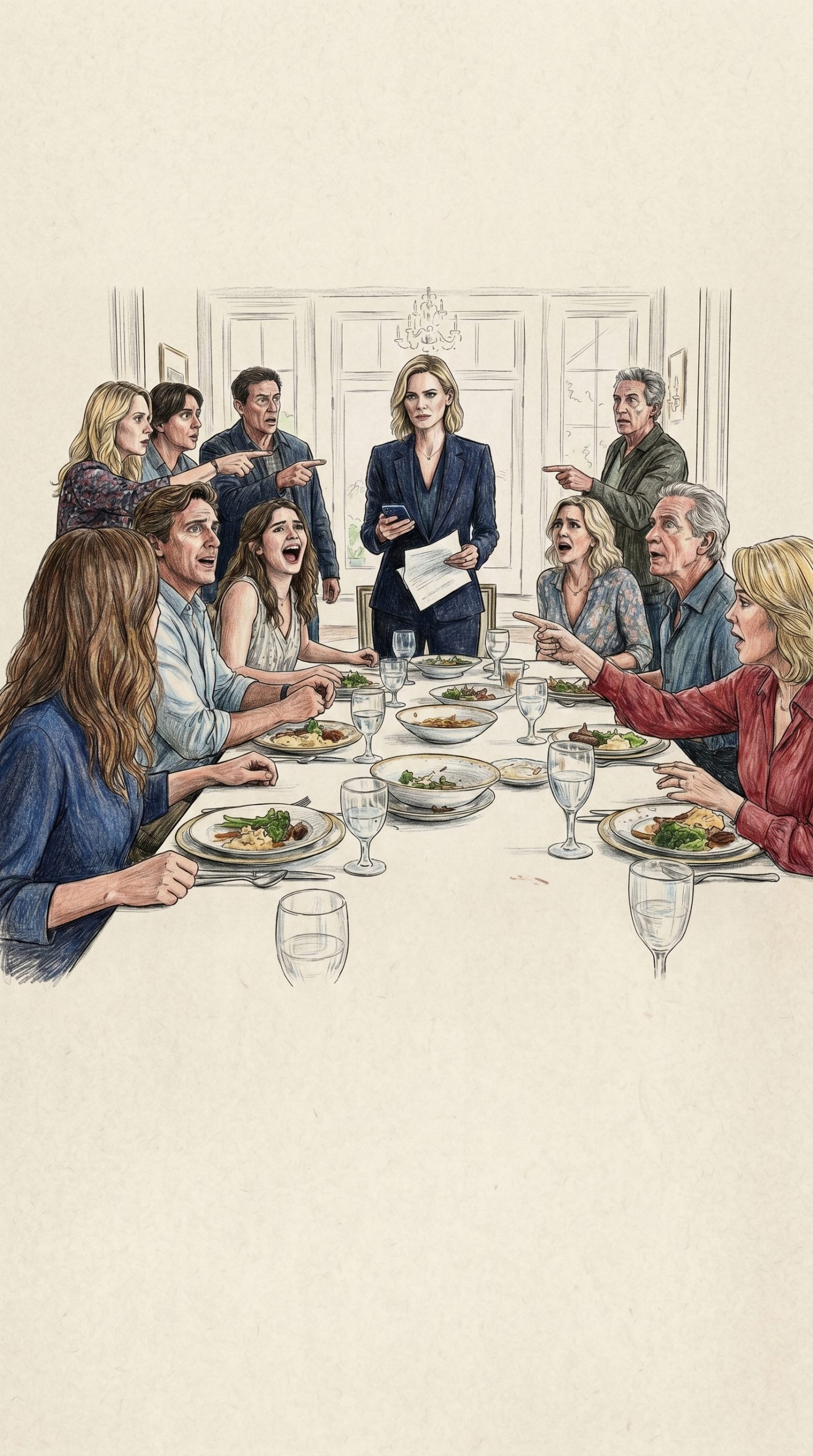
Part 1: My Sister Mocked Me: “Where’s Your Husband And Kids? Oh Right, You Don’t Have Any.” My Parents Laughed, So I Said: “Where’s Your Money? Oh Right, I’ve Been Supporting You… Until Today.” The Table Went Silent. And That Was The Night… Everything Changed.
My sister lifted her wineglass and smiled like she was about to say something clever enough to be forgiven in advance.
“Clear as daylight,” Brooke said, looking straight at me from across my parents’ dining table. “Where’s your husband and kids? Oh, right. You don’t have any.”
The laugh that followed wasn’t loud. That was what made it worse. My mother let out that soft little breathy laugh she used when she wanted to pretend she wasn’t taking sides. My father chuckled into his mashed potatoes like Brooke had made some harmless observation about the weather. The fork in my hand stopped halfway to my mouth.
Steam curled off the roast chicken. The overhead light threw a yellow shine across the table, making the cheap wine in our glasses look expensive. Outside, rain ticked against the kitchen window. Inside, all I could hear was the wall clock over the fridge and my own pulse.
Brooke sat back in her chair, pleased with herself, one hand still wrapped around her stemware, the other resting on her phone. Her nails were painted a glossy brown, the trendy kind of color with a name like saddle or tobacco. She wore a cream sweater that probably cost more than the rent she kept asking me to help with. Her hair fell in a perfect blowout over one shoulder. If you didn’t know her, you’d think she had her life together.
I set my fork down carefully. Not dramatic. Not shaky. Just deliberate.
I looked right at her and said, “Where’s your money? Oh, right. I’ve been supporting you until today.”
The room went flat.
My mother’s hand froze around the gravy boat. My father turned slowly toward me, his eyebrows drawing together, not in shame, but annoyance. Brooke blinked, like I had broken some rule she hadn’t expected me to know existed.
“Excuse me?” she said.
“You heard me.”
Nobody laughed then.
You don’t get to that kind of silence out of nowhere. It takes years. Years of swallowing things. Years of showing up and being useful enough that people mistake your love for a system they can rely on.
I’m Grace Whitaker. I’m thirty-two, and I live in a one-bedroom apartment in Capitol Hill, Seattle, with plants I remember to water more consistently than I remember to eat lunch. I’m a UX researcher at a fintech company downtown. My life, from the outside, looks neat enough to be enviable if you catch it in the right light. I have a stable job, a decent couch, a coffee grinder that sounds like a chainsaw every morning at 6:45, and a view of a brick wall with one clean triangle of sky above it.
What people don’t see is where half my paycheck goes.
For seven years, money has moved out of my account and into my family’s life like a second bloodstream. My mom’s prescriptions after her heart surgery. My dad’s mortgage payment when consulting “was slow.” Brooke’s rent when a brand deal “fell through at the last second.” Her tuition, years ago. Her car repair. A utility bill. A dental balance. A couch my parents “desperately needed.” A dishwasher. A late property tax payment. A dozen little emergencies strung together until they became the shape of my adult life.
Every Sunday, I drove an hour south to Tacoma for dinner because my mother said families who stop eating together stop loving each other. The house always smelled the same when I walked in: coffee that had sat on a burner too long, lemon furniture polish, old wood, and whatever was roasting in the oven. The hallway photos never changed. Brooke in a white pageant dress at seventeen, smiling like she’d already been promised something. Dad shaking hands with somebody in a suit from back when he still wore ties to work. Mom in her old blue scrubs, her face open and proud and younger than I remembered it being. There were pictures of me too, technically. In group shots. On edges. Half turned. Half cropped.
Reliable people don’t get framed alone. They get put in the background and thanked for carrying the weight.
I used to tell myself that was fine. I had friends, work, a routine. There had even been an Adam once, three years and a ring conversation and a Sunday in Portland where we’d wandered through open houses and argued cheerfully over whether we were “modern kitchen people” or “weird old charm people.” That relationship died quietly, not because we stopped liking each other, but because crisis had become my family’s native language and I kept translating. Another transfer. Another drive south. Another canceled weekend. Adam never said, “It’s me or them.” He didn’t have to. One day, sitting across from me at a Thai place on Pine, he just said, “You’re never really here, Grace. There’s always a fire somewhere else.”
Brooke knew that. She knew exactly why her little joke landed where it did.
At the table, my father cleared his throat. “That’s enough,” he said, but his tone was mild, almost irritated that the evening had become inconvenient.
“For who?” I asked.
My mother put down the gravy boat. “Grace, Brooke was teasing.”
“No,” I said. “She wasn’t.”
Brooke rolled her eyes. “Oh my God. Don’t be so sensitive.”
Sensitive. That word had followed me my whole life anytime I noticed a thing other people benefited from me not noticing.
I stood up, not fast, just final. My chair legs scraped the floor. “I’m leaving.”
“Over one joke?” Dad said.
I looked at the table. At the chicken. At the rolls. At Brooke’s smug face finally beginning to waver. At my mother, who would call me dramatic in exactly three minutes if I stayed long enough to hear it.
“Not over one joke,” I said. “Over years.”
The rain had picked up by the time I got back on I-5. Tacoma disappeared in my rearview mirror, all wet streets and gas station light. I drove in silence except for the squeak of the wipers and the hiss of tires through water. My hands stayed steady on the steering wheel. That surprised me.
By the time I got home, my apartment felt different, like I’d unlocked someone else’s place. The radiator clicked in the corner. My kitchen counter was still cluttered with unopened mail and the basil plant I kept meaning to repot. I kicked off my shoes, turned on one lamp, and opened my laptop.
I told myself I was only going to check the recurring transfers. Just pause them for a month. Breathe. Think.
Instead I went line by line.
I pulled up old statements. Search history. Venmo records. Zelle confirmations. Rent payments. “Temporary loan” notes that had never been repaid. I built a spreadsheet because that is the sort of woman I am when my heart is breaking: I color-code it.
At 1:14 in the morning, I had a total.
$84,216.43.
I stared at the number until it blurred. Eighty-four thousand dollars. Not gifted joyfully. Not invested. Not used to travel or buy a home or pay off my own student loans faster or take the ceramics class I kept saying I’d try someday. It had been fed, year by year, into the same open mouth.
I canceled the recurring transfer to my parents first. Then the auto-pay I’d set up for Brooke’s rent after her “short-term setback” six months earlier.
The screen asked, Are you sure?
“Yes,” I whispered, and clicked.
My phone buzzed face-down on the desk.
I almost ignored it. Then I looked.
The subject line of the email on my lock screen read: Action Required: Confirm Recent Home-Secured Application.
I didn’t recognize the bank.
And I had never applied for a loan in my life.
So who had signed my name?
Part 2
I slept maybe two hours.
Not real sleep either. The shallow kind where your body goes still but your brain keeps pacing. By six-thirty I was standing in my kitchen in mismatched socks, waiting for the kettle to boil and staring at the email again like the words might rearrange themselves into something ordinary.
They didn’t.
First Cascade Bank. Action Required. Confirm Recent Home-Secured Application. Please contact our fraud department immediately if you did not authorize this inquiry.
The kettle clicked. I poured water over grounds anyway and made coffee I barely tasted. Outside, the street below my building was slick and dark, delivery trucks backing up with those long electronic beeps. Somewhere in the hallway, a neighbor’s dog barked three times and stopped. My phone started vibrating on the counter before I’d even taken the first sip.
Mom.
I let it ring out.
Then Dad.
Then Brooke.
By eight-fifteen I had six missed calls, two voicemails, and a stack of texts.
Mom: Sweetheart, the mortgage payment didn’t go through. Call me.
Dad: This is irresponsible. We need to discuss your behavior.
Brooke: Seriously? Rent’s due.
Brooke again, seven minutes later: Don’t be psycho.
I put the phone in my bag and left for work.
My office was all glass walls and soft lighting and expensive coffee beans in jars by the machine, the kind of place built to suggest calm productivity to people one Slack notification away from a nervous breakdown. I sat through a ten a.m. research review with six engineers and a product manager named Colin who said “friction point” so many times I wanted to throw a stapler at him. I nodded, shared my screen, walked everyone through interview findings on user trust, and all the while my phone buzzed against my thigh like a trapped insect.
The irony was almost funny. There I was, explaining to a room full of adults why people stop trusting financial tools when transparency breaks down, while some bank I’d never heard of was telling me my name had been attached to a home-secured application.
At lunch, Leah from design cornered me by the coffee machine.
“You look like you murdered someone and are trying to be chill about it,” she said.
Leah had silver hoops, a shaved undercut, and the irritating gift of noticing exactly what I was trying hardest not to show.
“Family stuff,” I said.
“That’s code for bad enough you don’t want to explain.”
I blew out a breath. “I got an email from a bank about a loan I didn’t apply for.”
Leah’s expression changed immediately. “That’s not family stuff. That’s fraud.”
“Maybe it’s a phishing scam.”
“You don’t believe that.”
I didn’t.
I called the number in the email from one of the little soundproof booths near the elevators. I expected hold music, maybe a dead end, something that would let me go back to pretending this was all a mistake.
Instead a woman named Denise in the fraud department verified my identity and said, very carefully, “Ms. Whitaker, there is a home equity line of credit application associated with your Social Security number and a property in Tacoma, Washington. Because you reported this as unauthorized, I’m flagging the file for immediate review.”
My hand tightened on the desk built into the wall of the booth. “What property?”
She hesitated. “I can confirm the mailing address once I’ve completed additional verification.”
My throat went dry anyway, because I already knew.
My parents’ house.
The booth suddenly felt too small. The air smelled faintly of dust and somebody else’s cologne. Through the glass I could see coworkers walking past with salads and laptops tucked under their arms, living their completely normal Tuesdays.
“I didn’t sign anything,” I said.
“Do you have reason to believe someone close to you had access to your personal information?”
I thought about tax forms. Birthday cards. Medical paperwork. A dozen years of being the organized daughter. My parents knew my birthday, obviously. My Social Security number? Probably somewhere in an old file cabinet. My signature? There were plenty of cards and forms and copies of things I’d never thought twice about leaving around when I visited.
“I don’t know,” I said, and hated how weak it sounded.
Denise told me a fraud packet would be sent electronically and by mail. She told me to pull my credit reports, place a freeze, document any suspicious accounts. Her voice was even and professional in that way people get when they do this every day and know your world is tilting.
When the call ended, I sat there for a full minute with my phone in my lap.
Then a memory floated up, small and ugly.
Six months earlier, after Mom’s follow-up cardiology appointment, Dad had called me and asked if I could email him a copy of my driver’s license because “the hospital needs to update emergency contact paperwork and insurance beneficiary records.” I’d been between meetings and annoyed and distracted. I remember scanning it on my phone in my office kitchenette while somebody reheated fish in the microwave. I remember sending it without thinking.
Maybe it was unrelated. Maybe that was the thing making me paranoid.
That was the problem with families like mine. They trained you to mistrust your own instincts first.
By four o’clock I had frozen my credit and downloaded a report. One hard inquiry from First Cascade. Two newer credit card accounts I didn’t recognize. One utility account in Seattle opened fourteen months earlier with my name attached.
Seattle.
Not Tacoma.
My stomach turned.
Brooke lived in Seattle. Or rather, Brooke cycled through apartments in Seattle the way other people cycled through scented candles: easily, expensively, and with no regard for who paid.
I worked until almost seven because routine felt safer than panic. When I finally got home, there was a white envelope jammed into the brass slot in my apartment door. No stamp. Hand-delivered.
Inside was a printed copy of the bank email I’d already received and a note in my father’s blocky handwriting.
Come home Sunday. We need to talk.
No greeting. No explanation. No apology.
A minute later my phone lit up with a new message from Brooke.
Can’t believe you’d do this over a joke. Grow up.
I opened the fraud packet Denise had sent and scrolled until I found the attached application.
There was my name.
There was my address history.
There was a signature that looked enough like mine from a distance to fool someone who wanted to be fooled.
But up close, the G loop was wrong.
I stared at it until my skin went cold.
Someone hadn’t just used my information.
Someone had practiced being me.
Part 3
Leah gave me Rachel Tran’s number before I could talk myself out of needing a lawyer.
“Her brother got my lease issue fixed in three days and she once made a dealership cry,” Leah said, leaning against my desk the next morning. “Call her.”
Rachel’s office was on the twelfth floor of a building in Pioneer Square with old brass elevator doors and a lobby that smelled faintly of rain-soaked wool. She wore a dark green blazer, no nonsense makeup, and the kind of expression that made people stop performing and start answering.
She read through the loan application, my credit report, the note from my father, and the spreadsheet of transfers I’d printed that morning at work.
When she got to the total, she looked up. “You paid them eighty-four thousand dollars over seven years?”
“A little over.”
Her pen paused. “And they still opened debt in your name.”
Hearing it said out loud made something in my chest shift. On my own, I could still slip into maybe I’m overreacting. In Rachel’s office, with the blinds half open and the city gray beyond them, it sounded exactly as ugly as it was.
“What do I do?” I asked.
“You document everything. You communicate in writing as much as possible. You don’t sign a thing. If they admit anything, save it. If they threaten you, save that too. I’ll contact the bank. Depending on what comes back, we can pursue civil remedies and cooperate with a fraud investigation.”
I rubbed at the base of my thumb, a habit I had when I was trying not to unravel. “They want me there Sunday.”
Rachel leaned back in her chair. “Go if you think it’ll get them talking. Don’t go there to negotiate. Go there to observe.”
“Observe my own family.”
Rachel’s expression didn’t soften, exactly, but it lost its edge. “People think fraud is about money. Half the time it’s really about entitlement. They don’t believe the rules apply because they believe access is love. Don’t let them rewrite this into a daughter being difficult.”
I laughed once, sharp and humorless. “That is exactly what they’re going to do.”
“Then let them,” she said. “Truth doesn’t change because someone tells the story louder.”
Sunday came low and cold, with a sky the color of dirty dishwater. I drove south with the heat too high and the radio off. The Tacoma exit signs looked weirdly intimate, like names from a life I might have outgrown if I’d been allowed to.
My parents’ porch light still flickered. The pumpkin my mother had put out in October had collapsed into itself, rind soft and shiny with rot. When I opened the front door, the house smelled like coffee and onions and tension.
Nobody hugged me.
Mom was at the table folding napkins she didn’t need to fold. Dad sat at the head like he was chairing a meeting. Brooke leaned against the counter in an oversized sweatshirt, phone in hand, the posture of somebody trying very hard to seem casual.
“We can’t live like this,” my mother said before I’d even taken off my coat. “The mortgage didn’t go through, and the electric—”
“I know what didn’t go through,” I said, hanging my coat over the back of a chair. “That was the point.”
Dad clasped his hands. “You don’t get to make unilateral decisions that affect this household.”
I almost smiled. A professor voice. The one he used when he wanted his words to sound objective. “This household has been making unilateral decisions with my money for years.”
“We are your parents,” he said.
“Yes,” I said. “And?”
That landed harder than I expected. Mom flinched. Dad’s jaw went tight.
Brooke set down her phone at last. “This is insane. You’re spiraling because I made one joke.”
I turned to her. “Do you know what First Cascade Bank is?”
Her face changed, but just for a second. It was enough.
Dad cut in too fast. “What are you talking about?”
I took the folder from my bag and laid it on the table. The sound of paper hitting wood was oddly satisfying. “I’m talking about the home equity line opened against this house with my Social Security number. I’m talking about the credit cards in my name. I’m talking about the utility account tied to a Seattle address.”
Brooke crossed her arms. “I have no idea what you’re talking about.”
“You might want to work on your lying voice,” I said. “It gets thin.”
Mom pressed a hand to her chest, not dramatic yet, but getting there. “Grace, sweetheart, there must be some misunderstanding.”
“No,” I said. “There isn’t.”
Dad stood up slowly. He was still broad-shouldered, still capable of filling a room when he wanted to. When I was little, that used to make me feel protected. Now it just made the wallpaper behind him look old.
“You’re making serious accusations based on incomplete information,” he said.
I pulled out another sheet and slid it toward him. “Good thing I brought complete information.”
It was the transfer summary first. The total at the bottom in black ink. His eyes flicked to the number and away.
Then the copy of the loan application.
Then the email from the bank.
Then Rachel’s letterhead with her name and contact information.
My mother sat down heavily.
Brooke’s mouth parted. “You got a lawyer?”
That was the line that told on all of them. Not What lawyer? Not Why? Just confirmation that the threat had become real.
“Yes,” I said. “I did.”
Dad picked up the application with two fingers like paper could burn him. “This is ridiculous. Anyone could have done this.”
“Not anyone,” I said. “Someone with my personal information. Someone with access to this house. Someone who expected I’d be too loyal or too stupid to check.”
Mom’s eyes filled on cue. “We only did what we had to do to protect the home.”
The room went so quiet I could hear the refrigerator motor kick on.
We.
Brooke looked at her. Dad looked at her. Mom put her hand over her mouth like she could catch the word and shove it back in.
I felt something inside me go very still.
“Thank you,” I said softly. “That’s useful.”
Dad slammed his palm against the table hard enough to rattle the silverware. “Linda.”
But it was too late.
Brooke snapped first. “Oh, please. You act like we robbed a bank. It was just paperwork until Dad’s contract came through.”
I turned my head toward her slowly. “Just paperwork?”
Her lips pressed together.
There it was.
Not confusion. Not innocence. Familiarity.
I slid Rachel’s card across the table. “You have thirty days to remove my name from every account, provide a full accounting, and communicate through my attorney. If you don’t, we file formally and let the bank and the state sort out the rest.”
Mom started crying in earnest then, the practiced kind with tears but no shame. “You would do this to your own family?”
I put the folder back in my bag. “You already did it to yours.”
Dad’s voice dropped low. “You don’t understand what you’re doing.”
“I understand exactly what I’m doing,” I said. “For the first time in years.”
I walked out before any of them could rearrange themselves into victims again. The air outside hit my face cold and wet. My hands didn’t shake until I got to the car.
My phone rang before I’d even backed out of the driveway.
Rachel.
I answered on speaker, breath still uneven.
“Grace,” she said, “the bank just sent over preliminary findings. There aren’t three unauthorized accounts.”
I gripped the steering wheel.
“There are five.”
And one of them had been used last week.