PART 1: The Woman Sleeping in Seat 8A
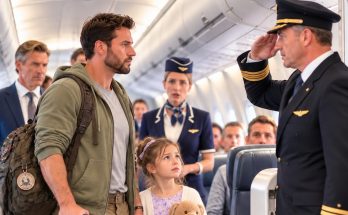
For nearly two hours, Flight 412 had crossed the Atlantic without anything unusual happening. The overnight flight from New York to Madrid was carrying almost three hundred passengers, most of whom were sleeping, watching movies, or quietly passing the time beneath the dimmed cabin lights.
Then the captain’s voice suddenly came through the speakers.
“If there is anyone aboard with fighter-pilot experience, please identify yourself to a member of the cabin crew immediately.”
Confused conversations spread through the aircraft. Parents instinctively pulled their children closer, couples exchanged worried looks, and passengers began scanning the surrounding rows, trying to understand why a commercial airliner thousands of feet above the Atlantic could possibly need a military pilot.
Sitting beside the window in seat 8A was thirty-eight-year-old Laura Vance. Wearing an ordinary green sweater with a blanket covering her legs and a closed book resting in her hands, she looked like another exhausted traveler hoping to sleep until breakfast.
Nobody around her knew that Laura had once flown F-16s for the United States Air Force. Years of demanding missions had trained her to make life-or-death decisions in seconds, but eighteen months earlier, a devastating aviation accident had ended that chapter of her life.
Laura had walked away from the military and everything connected to flying. She wanted no medals, recognition, or responsibility, and she certainly never wanted another person’s survival to depend on a decision she made inside a cockpit.
That was why she had chosen an anonymous seat among hundreds of strangers.
The announcement came again.
“Ladies and gentlemen, this is your captain. We are experiencing a technical situation requiring immediate assistance. Anyone with military fighter-pilot experience should contact a flight attendant now.”
Laura opened her eyes.
Something in the captain’s voice immediately caught her attention. His delivery remained calm and professional, but Laura recognized the strain beneath it because she had heard that same controlled fear during emergencies in the air.
A flight attendant hurried along the aisle, questioning passengers. When she reached Laura’s row, she stopped and glanced between the people seated there.
“Excuse me, ma’am. Do you know whether anyone near you has military aviation experience? The captain urgently needs a military pilot.”
Laura initially looked away.
She had spent eighteen months convincing herself that aviation belonged to her past. Returning to that world, even for a few minutes, meant reopening memories she had worked desperately to bury.
Then she looked around the cabin.
A frightened mother held her child against her chest. Several rows away, another little boy watched the flight attendant with wide eyes, while everyone else remained trapped inside an aircraft over an endless dark ocean with no idea what was happening beyond the cockpit door.
Laura remembered something her years of service had taught her.
Walking away from aviation was one thing.
Walking away from people who needed help was another.
“I’m a pilot.”
The flight attendant stared at her.
“Excuse me?”
Laura unfastened her seat belt and sat upright. Almost instantly, the tired passenger who had been sleeping beside the window seemed to disappear, replaced by the disciplined officer she had spent eighteen months trying to leave behind.
“I’m a former United States Air Force fighter pilot. I flew F-16s.”
The passenger beside her blinked.
“You?”
Laura nodded.
The flight attendant’s expression changed immediately.
“Please come with me.”
Laura stood and followed her toward the front of the aircraft. With every step, memories of warning alarms, military briefings, and a mission that had ended in tragedy returned more vividly.
She had no idea what emergency was waiting inside the cockpit.
More importantly, she didn’t yet know that the crisis unfolding aboard Flight 412 was directly connected to the accident that had destroyed her career eighteen months earlier.
PART 2: Something Was Wrong Inside the Cockpit
When the cockpit door opened, Laura immediately realized the emergency was far more serious than the captain’s announcement had suggested. Captain Andrew Vance was sitting rigidly in the left seat, struggling to keep the aircraft stable, while the first officer lay unconscious beside him with an oxygen mask covering his face.
Andrew studied Laura’s ordinary sweater and travel clothes with obvious uncertainty. She looked nothing like the military pilot he had expected to appear, and his hesitation became even clearer when he learned how long she had been away from aviation.
“You have military flight experience?”
“Yes.”
“What aircraft?”
“F-16 Falcons.”
“When did you last fly?”
“About eighteen months ago.”
Andrew admitted that he had hoped for someone with more recent experience, but before Laura could respond, the aircraft began vibrating in an unusual repeating pattern. She immediately recognized that the movement didn’t feel like ordinary turbulence because it was too regular, almost as though the aircraft itself were producing it.
Laura stepped closer to the instruments and studied the flight-control indications. Years in fighter cockpits had taught her to distinguish unpredictable weather from mechanical instability, and she quickly suspected that Andrew might actually be making the problem worse by instinctively fighting the controls.
“How long has the control column been doing that?”
“About ten minutes.”
“Tell me exactly what happened.”
Andrew explained that the autopilot had disconnected unexpectedly before the flight-control computer began producing contradictory warnings. Around the same time, his first officer complained about numbness in his arm and suddenly collapsed, leaving Andrew alone in the cockpit as the aircraft became increasingly difficult to control.