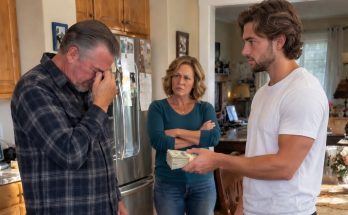
Not together this time. Rebecca first, with Lucy and Ben in the back seat and a casserole she didn’t need because she was still carrying the old daughter habit of wanting to arrive useful when ashamed. Michael came the following weekend with Claire and Owen and a face that looked permanently altered by seeing too much of his father’s interior machinery too fast. They stood on Joan’s porch one by one, rain-damp and careful, waiting to see whether you would answer.
You did.
Not because the past had become easy. Because the grandchildren did not build the weapon that had been used with their names on it. Lucy rushed you first, all elbows and ponytail and summer freckles, hugging your waist as if the year between had been ordinary instead of strategically starved. You held her and felt something warm and painful move through you, not forgiveness exactly, but the refusal to let another generation inherit a silence they did not choose.
The adults cried. The children did not.
Children rarely understand why grown people weaponize time around them, but they understand absence with cruel precision. Ben asked if the goats still liked crackers. Claire wanted to know whether the blue room upstairs was “still the pancake room” because last summer you made blueberry pancakes there while rain hit the windows. Owen, younger and more direct, simply asked why Grandpa said you were too tired to visit if you were standing right there in jeans and boots.
No one answered him quickly enough.
That, too, was a kind of truth.
You did not rush reconciliation.
You did not say everything was fine. You did not let your children cry against your shoulder and call the whole disaster a misunderstanding born of pressure, age, or one terrible final mistake. Charles had built the machinery, yes, but they had chosen silence where questions belonged. Love does not require pretending otherwise. So you set terms, just as you should have years ago.
The children could come. The grandchildren were always welcome. But contact would no longer travel through threat, inheritance, or your ex-husband’s moods.
You sold Oakridge that fall.
People assumed you would move back in, reclaim the porch, sit under the maple tree with tea and a vindicated smile. That fantasy belonged to strangers who think revenge is always real estate. But by then you knew the difference between winning a house and wanting to live in the rooms where your life had been dismantled. You took the sale proceeds, net of fees, and did three things with them.
First, you established education trusts for each grandchild, structured so no parent or grandparent could use them as leverage.
Second, you bought a smaller stone house fifteen minutes from Joan’s farm, with a big kitchen, wide windows, and a porch that faced a line of birches instead of memory. Third, you funded a legal aid fellowship through Mara’s firm for older women facing financially coercive divorces, because there are too many of you and too few lawyers willing to smell intent through expensive paper. None of that made headlines. That suited you just fine.
As for Charles, he moved from hospital recovery to a private assisted living residence outside Stamford.
Katherine did not stay. Women like that rarely do once the courts freeze their oxygen. There were rumors of separate counsel, settlement negotiations, even one spectacular dinner scene at a Greenwich restaurant where she stood up so abruptly red wine hit the linen. None of it mattered. In the end, he had his health compromised, his estate exposed, and his children suddenly speaking to him in the tone people reserve for men they have finally recognized.
He wrote you once.
The letter arrived on cream stationery, his old kind, the kind he used when business needed to look like lineage. He wrote that age had made him arrogant, that illness had given him perspective, that he regretted “how events unfolded.” He did not write I used the grandchildren to control you. He did not write I stole your inheritance into a house and then tried to hide that house from you. He did not write I laughed when you left. Regret without naming the wound is just vanity in softer clothing. You put the letter in the stove and watched the corner curl black.
The grandchildren came for Christmas.
All four of them. Boots by the door. Wet mittens on the radiator. Pancake batter on the counter. Joan pretending to complain while slipping extra maple syrup onto the table. At some point in the afternoon, Lucy, now old enough to hear the edges of adult history even when people lower their voices, asked you whether the big Connecticut house had really been as beautiful as everyone said.
You thought about that.
It had been beautiful in the way magazines mean the word. Wide porch, paneled library, birch-lined drive, good bones, expensive wallpaper, old money trying to look inevitable. But beauty that has to be defended by silence curdles faster than people admit. You looked at the children in your kitchen, their faces bright from snow and heat and real appetite, and answered honestly.
“It was impressive,” you said. “This is better.”
Rebecca cried quietly over dishes later that night.
Not performance. Not the graceful tears of a daughter seeking to be told she did nothing wrong. The ugly, muffled kind that come when a person realizes exactly how much life they offered up to fear because fear was dressed as duty. You stood beside her at the sink and dried plates while she talked about the trusts, the threats, the relief of hearing a judge say out loud what she had only half-admitted even to herself. When she finally whispered, “I’m sorry I let him use my children against you,” you did not tell her it was nothing.
“It was something,” you said. “That’s why we don’t do it again.”
She nodded into the dish towel.
That was enough for the moment.
In the spring, Michael brought a toolbox and helped you repair the sagging gate by the vegetable garden. Neither of you mentioned the first months after the divorce, when he called sounding like his father’s caution wearing a kinder shirt. Instead you talked about bolts, weatherproofing, and whether Owen would ever stop putting pinecones in his pockets until the washing machine found them. Families heal awkwardly when they heal at all. They do not become pure. They become honest enough to function without rehearsed lies.
On the one-year anniversary of the day you drove away from Oakridge with your suitcase and folded court order, you woke before dawn.
The house in Vermont was quiet. The birches outside the window held a little mist. Joan’s dog snored in the hallway like an offended landlord. You made coffee, carried it to the porch, and sat wrapped in a wool blanket while the sky turned from slate to silver over the pasture. There was no dramatic revelation waiting in the light, only the simple astonishment of being somewhere your life had not been arranged against you.
At 8:03, your phone rang.
For one second the old current moved through you, because betrayal teaches the body to remember first and reason second. Then you looked down and saw Claire’s name. Your granddaughter was calling from the school bus because she had gotten a ninety-two on a science test and wanted to know whether that was “good enough for a future botanist.” You laughed and told her it was excellent, though her grandfather would probably have called it room for strategic improvement.
When you hung up, you realized that was the real ending.
Not the courtroom. Not the stroke. Not the frozen accounts or voided transfers or the satisfying expression on Katherine’s face when the judge used the word fraud in a full sentence. Those things mattered. They corrected the record. They put weight back where it belonged. But the ending was this: your phone ringing not with threats, not with manipulated emergencies, not with children forced into silence by the fear of losing their children’s future. It rang because a little girl wanted to share a test score with her grandmother.
That is how you know you have your life back.
He told you that you would never see the grandchildren again. He said it like a man who believed love could be routed through property and paperwork the same way money can. He took the house, laughed when you left, and trusted the old machinery of fear to finish the job. But a lie built that carefully eventually requires too much maintenance, and when his body finally collapsed under the weight of his own cleverness, the whole scaffold came down fast enough to show everyone what had really been holding it up.
Not him.
You.