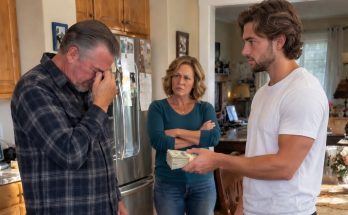
Dad turned toward me. “We have to leave now.”
“You’re ill,” Mom said. “You can’t go running through the rain chasing shadows.”
“They aren’t shadows,” he snapped. “They’re why Ethan died.”
The word died made Leo flinch.
Dad noticed immediately and his expression softened. “I’m sorry.”
Leo swallowed hard. “It’s okay.”
But it wasn’t.
Nothing about this was okay.
Five minutes later, we climbed into Dad’s old pickup truck. Mom refused to stay behind, despite Dad telling her to remain home. She climbed into the back seat beside Leo and held an umbrella over both of them until the doors were closed.
I sat beside Dad in the passenger seat.
He drove.
The town looked unfamiliar through the rain-covered windshield. Streets I had known. Corners I remembered. The diner where I once studied after school. The church where Mom used to sing in the choir. The grocery store where Dad had bought strawberry cupcakes for my thirteenth birthday.
Now every memory seemed to hide another one beneath it.
A secret town beneath the town I thought I knew.
Eastridge Storage stood behind a closed hardware store near the edge of town. The office lights were off, but a keypad guarded the front gate. Dad stopped the truck beside it and frowned.
“I don’t know the code.”
Before anyone else spoke, Leo leaned forward from the back seat.
“Try Ethan’s birthday.”
I turned to look at him. “How do you know that?”
His face turned red. “You told me once. March 18.”
I had.
On one of those quiet evenings when grief made me reveal more than I meant to.
Dad typed in 0318.
The gate buzzed and slowly swung open.
No one said a word.
We drove between endless rows of storage units, the truck’s tires hissing across the rain-soaked pavement. The red tag attached to the key read C-17.
We found the unit near the rear of the property.
Dad shut off the engine.
Rain drummed loudly across the roof.
“Stay inside the truck,” I told Leo.
“No.”
“Leo—”
“This is about my dad too.”
His voice was quiet, yet unwavering.
Mom rested a hand on my arm. “Let him be with us.”
I hated it. I hated that my son had to carry any part of this burden. But I had spent ten years trying to shield him from the truth, and somehow the truth had still reached him.
Together, we stepped into the rain.
Unit C-17 was secured with an old padlock, rusty but still solid. Dad inserted the key.
It turned smoothly.
The metal door groaned as it rolled upward.
The smell reached us first.
Dust. Cardboard. Aging paper. Damp concrete.
Dad switched on a flashlight.
Inside stood three filing cabinets, two large plastic containers, and a wooden desk with a single drawer.
Resting on top of the desk was an envelope.
My name was written across the front.
EMMA.
My knees almost gave way.
With trembling hands, I picked it up.
The paper had grown yellow with age.
Inside was a letter.
Ethan’s handwriting.
Emma,
If you’re reading this, then I never made it home.
I’m sorry. I know those words are far too small for everything I’m leaving behind. There were things I couldn’t tell you because I feared that knowing them would place you in dan.ger. But there is one thing you must understand.
Your father is not my enemy.
He helped me.
At first, I didn’t trust him. I believed he was like the others—remaining silent because silence paid better than honesty. But Robert found me after one meeting and handed me copies of internal reports. He said, “There are kids drinking from that river. Someone has to stop this.”
He was frightened. But he helped anyway.
If he ever turns against you, something is wrong.
Trust the evidence.
Trust the boy.
And trust the sentence I taught you.
My breathing stopped.
The sentence.
I read those words again.
Trust the boy.
Leo looked up at me. “What sentence?”
I couldn’t answer.
Because all at once, I remembered.
Ethan had once laughed and said that if we ever had a child, the very first sentence he would teach him would be, “The river remembers what people bury.”
I laughed too. It sounded beautiful and oddly mysterious.
But Ethan had never been joking.
I carefully folded the letter, my hands still trembling.
Dad opened the filing cabinets. They were packed with paperwork. Shipping logs. Laboratory reports. Printed emails with dates. Employee memorandums. Medical complaints submitted by families living nearby.
Mom opened one of the plastic containers and discovered cassette tapes, each marked with a date.
“Who was still using these?” she whispered.
“Someone who didn’t trust computers,” Dad replied.
Leo stood beside the desk, staring at the drawer.
“Mom,” he said, “there’s something in here.”
I pulled it open.
Inside rested a small silver voice recorder.
Beneath it lay a sealed legal envelope addressed to:
ATTORNEY SAMUEL PRICE — DELIVER ONLY IF ETHAN BROOKS IS DEAD OR MISSING.
Dad looked at me. “Samuel Price?”
I recognized the name.
Everyone in town did.
He had been the community’s most respected attorney, a man who challenged powerful corporations and usually lost—but never without making them fight for every inch. He had passed away six years earlier.
Mom suddenly gasped. “His daughter.”
“What?”
“His daughter took over the firm. Nora Price.”
Dad picked up one of the cassette tapes. “Then we bring all of this to her.”
A sound drifted in from outside.
The faint crunch of gravel beneath shoes.
Dad switched off the flashlight.
We stood motionless in complete darkness.
Another sound.
A car door closing.
Then a voice echoed outside the storage unit.
“Robert Hale.”
Mom’s hand instantly reached for Leo’s shoulder.
Dad stepped toward the entrance, but I caught hold of his sleeve.
The voice came again.
“You have something that doesn’t belong to you.”
My entire body went cold.
I knew that voice.
Older now. Harsher.
But unmistakable.
Charles Voss.
The plant director from the photograph.
Dad’s face turned pale with recognition.
“Stay behind me,” he whispered.
But Leo moved before anyone could stop him.
He stepped toward the open doorway of the storage unit and called into the rain,
“The river remembers what people bury.”
The words cut through the darkness.
Outside, everything fell silent.
Then Charles Voss whispered, “Who told you that?”
Leo stood his ground, rain settling across his face.
“My father.”
Voss stepped into the doorway, holding an umbrella. He looked much older than he had in the photograph, his hair now silver, his face lined with age, but his eyes remained sharp and icy.
He stared at Leo as though he had seen a ghost.
Then he smiled.
Not with kindness.
“Ethan always did enjoy theatrics.”
Dad’s hands clenched into fists. “What did you do to him?”
Voss looked at him with quiet amusement. “Robert, after all this time, you still can’t remember?”
Dad became perfectly still.
Voss took another step forward.
“You created quite a problem for us. You and that young man. We spent years cleaning up your mess.”
Mom whispered, “Leave us alone.”
Voss paid no attention to her. His eyes never left Leo.
“That child was never supposed to exist.”
I stepped in front of my son.
Something inside me ignited.
“Don’t look at him.”
Voss’s smile widened. “Emma Hale. The girl who disappeared. We searched everywhere for you.”
“I know.”
“You should have remained hidden.”
Dad stepped forward. “That’s enough.”
Voss sighed quietly. “Robert, you were always such a disappointment. You could have enjoyed a comfortable retirement. Instead, you handed confidential documents to a student you barely understood.”
Dad’s voice trembled with anger. “You po!soned innocent people.”
“We managed liability.”
“You murdered Ethan.”
Voss’s expression never changed.
But he said nothing.
That silence told us everything.
Then bright headlights flooded the storage lane.
Another vehicle sped into the lot.
Voss turned immediately.
A woman stepped out wearing a blue raincoat, holding a phone in one hand.
“Nora Price,” she called. “And everything you just admitted has been recorded.”
Voss’s expression shifted.
For the first time, fear crossed his face.
Nora Price walked toward us, rain streaming down the hood of her coat.
“I received a scheduled delivery tonight,” she said, raising the legal envelope. “From my father’s old case system. Ethan Brooks arranged for it to activate the moment someone opened this storage unit.”
I stared at her.
“How?”
She smiled faintly. “Your father helped him create a de:ad man’s switch.”
Dad whispered, “I did?”
Nora looked at him with quiet sympathy. “Yes, Mr. Hale. You did.”
Voss slowly stepped backward.
“You have no idea what you’re getting involved with,” he warned.
Nora raised her phone.
“Actually, I do. And now the county sheriff does too.”
Sirens echoed in the distance.
Voss turned to run.
But Leo spoke once more.
Not loudly.
Not with anger.
Only with certainty.
“You can’t bury a river.”
Voss stopped.
For one strange moment, his shoulders slumped.
Then flashing police lights washed the storage units in red and blue.
As officers rushed through the rain toward us, my father reached out for my hand.
I almost pulled away.
But I didn’t.
Because inside that storage unit, surrounded by the evidence Ethan had given his life to protect, I finally understood the impossible truth.
My father had never betrayed Ethan.
Someone had stolen the memory of his bravery.
PART 5 — The Trial Of Buried Years
The arrest of Charles Voss did not repair our family.
Real life is far harsher than stories in that way.
It opened doors, certainly. It shattered old locks. It brought reporters, attorneys, investigators, and federal agents into our quiet Ohio town. It transformed Ethan Brooks from a forgotten missing person into the symbol of a scandal stretching across counties and decades.
But it did not erase the night Dad forced me out.
It did not return the ten years I had lost.
It did not give Leo his father.
And it did not make forgiveness any easier.
For three days, we remained at my parents’ house while Nora Price organized the evidence. I slept in my old bedroom beneath the faint marks where posters had once hung before I left for college. Leo slept on a mattress beside my bed because he insisted the house made “weird noises.”