Part 2: The Evidence They Forgot
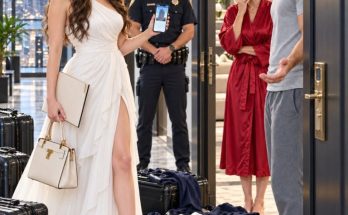
When Vanessa arrived, police vehicles lined the street. A city inspector stood near the driveway, and a locksmith waited nearby.
Melissa rushed toward her.
“Are you insane? You sent police to my house!”
Vanessa calmly corrected her.
“My house.”
Todd stepped forward. “You could have called us like a normal person.”
“I chose something more effective.”
Officer Daniel Ruiz approached. Vanessa had already sent him the deed, years of utility bills, insurance records, and images from her security cameras.
“The unlawful entry and property damage have been documented,” he explained. “The city has also confirmed that no permits were issued for demolition, plumbing, or electrical work.”
The building inspector described exposed wires, improperly disconnected pipes, and water collecting beneath the bathroom floor.
“This structure is unsafe,” she said. “A stop-work order is being issued.”
Todd raised his hands. “We were improving the house!”
“Not without the owner’s permission,” the inspector replied.
Then Diane arrived, already demanding that Vanessa stop.
“These people are your family,” she said.
“And I am the owner,” Vanessa answered.
Diane argued that Melissa needed somewhere to live and that everything could have been settled privately.
“No,” Vanessa said. “It could have been requested privately.”
Officer Ruiz entered the house with Vanessa to document the damage. In the kitchen, cabinets had been pulled from the walls, granite was cracked, and drywall had been opened. The bathroom floor was destroyed, and fixtures had been removed incorrectly.
Then they reached Vanessa’s office.
The filing cabinet stood open. Documents were scattered across the floor, and a locked box had been forced apart.
Officer Ruiz noticed Vanessa’s expression.
“What is missing?”
She checked the contents.
“My jewelry case.”
Melissa, who had followed them inside, suddenly asked, “What jewelry case?”
Vanessa looked at her. “The blue leather case from my desk.”
Todd appeared behind her. “How would we know about that?”
Ruiz narrowed his eyes. “Nobody asked you.”
The case contained diamond earrings inherited from Vanessa’s grandmother, a gold bracelet she had purchased after her first promotion, and an expensive watch she had bought after paying off her student loans.
Every item had been photographed and appraised.
A police officer called from outside.
Inside Todd’s truck, visible through the window in a grocery bag, was the missing blue leather case.
Melissa began crying.
Todd turned pale.
Todd was arrested first because the stolen property was found in his vehicle. Melissa was arrested shortly afterward when the security footage was reviewed.
One recording showed Melissa and Todd entering the house three days before the workers arrived. They carried storage containers inside and removed documents from Vanessa’s office.
Another clip showed Todd carrying the jewelry case to his truck late at night.
Todd’s parents tried to help but only made things worse. Frank admitted he knew Vanessa legally owned the property. Loretta admitted Melissa had told them Vanessa would not return until Thursday.
That destroyed any claim that they believed they had permission.
As officers placed Melissa in handcuffs, she turned toward Vanessa.
“You’re really going to let them do this to me?”
Vanessa held her gaze.
“No. I simply stopped protecting you from the consequences of what you did.”
Part 3: Forgiveness Does Not Mean Access
The following months were exhausting and expensive.
Vanessa’s insurance company initially resisted paying the entire claim because the damage was deliberate and caused by unauthorized occupants. Fortunately, Vanessa had kept thorough records.
She provided photographs, purchase receipts, security footage, contractor estimates, and a complete timeline.
The final damage exceeded sixty-one thousand dollars. The kitchen and bathroom required major reconstruction. Plumbing, electrical wiring, flooring, walls, locks, and water damage all had to be repaired.
The criminal investigation uncovered even more evidence.
Police recovered a message Melissa had sent Todd the night before their arrest:
“Take the blue case too. She never uses that stuff anyway.”
That message destroyed Vanessa’s remaining sympathy.
Diane repeatedly tried to convince her to settle matters privately. She called, emailed, cried in voice messages, and once appeared at Vanessa’s temporary rental carrying food and a speech about family unity.
Vanessa did not open the door.
Her attorney explained what Diane truly wanted.
“She is not trying to solve the problem. She wants to restore the old arrangement—the one where you absorb the damage, remain silent, and everyone else avoids consequences.”
He was right.
The house remained uninhabitable for nearly four months. Vanessa rented a small townhouse while licensed professionals repaired the destruction. She replaced every lock, upgraded the security cameras, changed the gate code, and removed Diane from all emergency-contact and key-holder lists.
Melissa called once from an unknown number.
“I never thought you would go this far,” she said.
“That was your greatest mistake,” Vanessa replied.
Todd lost his job after news of the arrest surfaced. His parents were forced to help with legal expenses, and Diane withdrew money from her retirement savings to assist Melissa.
The case eventually ended in plea agreements because the evidence was overwhelming.
Todd pleaded guilty to reduced property-damage and stolen-property charges. Melissa pleaded guilty to unlawful entry and theft. Neither went to prison, but both received probation, restitution orders, and civil judgments that would follow them for years.
Vanessa also won compensation for temporary housing and losses not covered by insurance.
Seven months after returning unexpectedly from Chicago, she finally entered her restored home.
The kitchen was brighter than before. The cabinets had been repaired, the counters replaced, and every detail had been completed legally—with permits, signed contracts, and Vanessa’s name on every document.
No strangers occupied the rooms. No one acted as if her home were available simply because they wanted it.
At sunset, Vanessa stood in the center of the kitchen and allowed the silence to settle around her.
Her phone buzzed.
It was a message from Diane:
“I hope you can forgive your sister one day.”
Vanessa looked at the restored walls and thought about everything it had cost to reclaim her home.
Then she placed the phone facedown without replying.
She had learned an important truth.
Forgiveness was not the same as access.
A person could be forgiven and still never receive another key. Boundaries were not cruelty, and family did not create automatic ownership over someone else’s money, property, or life.
The police cars that had filled Vanessa’s driveway had done more than stop an illegal renovation.
They had ended a thirty-year pattern of entitlement—one that Melissa had mistaken for love and Vanessa had finally refused to continue.