Chapter 8 — The Drafts
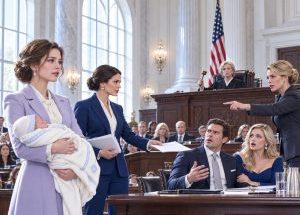
Ione was going through the scattered photographs now with shaking hands.
“These are from before you told me it was over,” she said, her voice cracking.
“You swore to me you were already separated.” Kingston said nothing, and the nothing was its own confession.
“There’s a flash drive, too,” Otis said.
Ione’s father — a senior partner at a rival firm, a man whose good opinion Kingston had spent years courting — stepped forward and picked it up off the table.
“What’s on it?” “Messages,” Otis said.
“Emails.
Things he wrote and saved.” What was on it, it turned out, were drafts — careful, rehearsed versions of a story, tailored for different audiences.
Notes to himself on how to describe me to his colleagues, to his family, to their mutual friends: unstable, unfaithful, impossible to live with.
A whole quiet architecture of lies about my character, composed at his office and revised like legal briefs, while he came home every night and ate dinner at my table and let me pour his coffee in the morning.
Ione read one, and then another, and the color that came into her face was not grief.
It was disgust.
“You rehearsed this,” she said.
“You sat in your office and drafted how to destroy your wife’s name.”
Those drafts were, in a way, worse than the photographs, and I watched the room understand it in real time.
An affair, people can file under weakness — a man who fell, who was carried away, who made a terrible human mistake.
The drafts were not weakness.
They were labor.
They were a man sitting alone at a desk, hour after hour, deliberately engineering the ruin of the reputation of the woman he was still living with, workshopping which lie would land best with which audience, editing for maximum damage. Tell my mother she’s been cold for years.
Tell the Hendersons she was drinking.
Frame it to the partners as her instability, not my absence. He had not been swept away by anything.
He had been project-managing my destruction with the same cold competence he brought to a deposition, and doing it at night, at home, ten feet from where I slept.
That was the thing that turned the room.
You could see it move across their faces — the junior associates, the cousins, the people who had laughed at his joke ten minutes earlier — the slow horror of realizing that the charming man they had toasted was not a flawed romantic but a genuinely calculating one, and that the woman at the back table, the one they had all agreed not to look at, had been telling a truth none of them had bothered to ask her for.
Chapter 9 — The Wedding Is Over
“It basically was over,” Kingston said, his voice climbing toward a pitch I recognized — the sound he made when he had lost control of a room and knew it.
It was the wrong thing to say, and I watched it be the wrong thing.
Ione’s father turned on him.
“You lied to every person in this room,” he said, and it carried.
The whispering started, and then the phones came out, and the polished evening came apart at the seams.
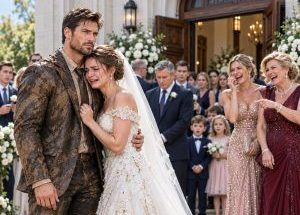
Ione stood very still for a moment, holding a photograph in one hand, and then she reached up and pulled the veil from her hair and set it down on the head table, gently, the way you set down something you are done with.
“No,” she said.
“You built this whole thing on a lie.
This wedding is over.”
There was a terrible dignity in the way she did it.
She did not scream at him or throw the photograph in his face or make a scene worthy of the scene he had made of his life.
She simply took off the veil — the whole expensive symbol of the day, of the future she had believed in that morning — and set it down, and named the truth, and was finished.
I watched a woman decide, in the space of a minute, that she would rather walk out of her own wedding with nothing than stay in it with a lie, and I thought: there is more courage in that quiet gesture than in anything her groom had done in his whole polished life.
Kingston had built everything he had on the management of appearances.
Ione, in one motion, refused to manage a single thing.
She let it all be exactly as ruined as it was, in front of everyone, and walked out of the wreckage with her head up.
It was the bravest thing I saw any adult do that night, until she caught up with us in the parking lot and did something braver.
After that it was noise — chairs pushed back, voices rising, people choosing in real time whose side of the room to stand on.
Kingston turned and found me in the crowd, and his face was full of a fury that had nowhere left to go.
“You planned this,” he said.
I shook my head.
“You documented it yourself.” But it was Otis who said the truest thing, quietly, not as an accusation but as a simple fact.
“You started it,” he told his father, “when you laughed at Mom.”
I want to sit for a moment with Kingston’s accusation, because it reveals him completely. You planned this. Even then, even standing in the ruins of his own wedding surrounded by the evidence of his own conduct, his first instinct was to make himself the victim of a scheme.
He could not conceive that this had simply happened — that a boy had found the truth and told it.
In his world, everything was strategy, everyone was running an angle, and so my son’s act of grief and love had to be, in his mind, a plot I had engineered, because a plot was the only kind of thing Kingston understood.
He looked at a ten-year-old defending his mother and saw a weapon I had aimed.
That was the tell, in the end — not the affair, not even the drafts, but the fact that when the truth arrived he could only understand it as an attack.
A person who has never once acted except from calculation cannot recognize an act of love when it stands in front of him holding a microphone.
And Otis’s answer — you started it when you laughed at Mom — was the last correction of the night, gentle and absolute: this was not a scheme with an author.
It was a consequence with a cause, and the cause was Kingston himself.
Chapter 10 — Barefoot on the Gravel
We left soon after.
The night air outside was sharp and clean and I filled my lungs with it and felt, for the first time in two years, that I could.
We walked out through the valet stand together, my son and I, past the white roses wilting a little now under the lights, past the guests spilling out onto the terrace with their phones and their whispers, and no one stopped us and no one laughed.
The laughing was over.
I held Otis’s hand — or he held mine; I could no longer tell which of us was steadying which — and we crossed the gravel toward my ordinary car among all the expensive ones, and I remember the particular sound of our footsteps on the stones, the two of us, walking away from the whole glittering machine that had been built to make me small.