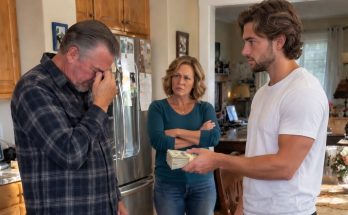
Chapter 2 — I Want to See
But Otis found it that afternoon.
He picked it up off the counter and turned it over in his hands, studying the gold foil the way he studied everything, quietly and for a long time, and then he asked, “Are we really invited, Mom?” I told him we were.
He kept looking at the lettering.
“I want to go,” he said.
I searched his face.
“Why?” He gave a small shrug, the kind that costs a child something.
“I want to see if he acts different when we’re there.
If he acts like a real dad when everyone’s watching.”
No ten-year-old should sound that old.
That was my first thought, and it has never entirely left me since.
My son had learned, somewhere in the last two years, to watch adults the way you watch weather you don’t trust — carefully, from a little distance, looking for the change before it arrives.
He had learned it because his father had taught it to him, one broken promise at a time, and I had not been able to stop the lesson from landing.
I wanted to say no.
Everything protective in me wanted to keep him out of that country club and away from the man who had made him this watchful.
But I looked at my son, at the quiet steadiness in him, and I understood that he was not asking for permission to be hurt.
He was asking for something he needed to see with his own eyes.
So I said yes.
I have replayed that conversation many times, looking for the moment I should have known more than I did.
But the truth is that I had watched my son change over those two years without ever quite naming the change, because naming it would have meant admitting how much his father’s leaving had cost him — and I was already carrying so much that I could not bear to add his grief to mine.
He had stopped asking when his dad was coming to his games.
He had started, at nine, doing small competent things around the house without being asked, refilling the dog’s water, bringing in the mail, as though he had appointed himself the man of a house that had lost its man.
I had told myself this was maturity, and been quietly proud of it, and it was only much later that I understood I had been watching a child parent himself because the adult who should have been doing it had walked away.
The watchfulness in him was not a gift.
It was a scar with good manners.
And when he said I want to see if he acts like a real dad when everyone’s watching, what he was really telling me, in the only language a careful boy has, was that he had already stopped believing his father would — and needed, all the same, to give him one last chance to prove him wrong.
So I said yes, and I spent the two weeks before the wedding quietly dreading it, and never once suspected that my son was spending those same two weeks preparing.
I noticed nothing.
That is the part that humbles me still.
I thought I was the watchful one, the parent tracking her child’s moods, alert to any sign the wedding was hurting him.
And the whole time, in the next room, a ten-year-old was doing something I had no idea was possible — going carefully through the wreckage of his father’s betrayal, deciding what to do with it, and saying not one word to me, because he had decided that protecting me meant carrying it alone.
I have replayed those two weeks looking for what I missed.
He was a little quiet, maybe.
A little far away.
But he was always a little quiet and a little far away by then; his father had made him that way, and I had stopped being able to tell the ordinary quiet from the kind that means a child is holding something too big for him.
I said yes to the wedding thinking the worst that could happen was a hard afternoon.
My son said yes knowing exactly what he intended to make happen, and he let me go on not knowing, one more time, so that I would not have to carry it with him.
Chapter 3 — The Wedding He Always Wanted
The wedding was everything Kingston had ever wanted — polished, expensive, performed.
White roses everywhere.
A live string quartet.
Guests dressed for the photographs rather than for comfort.
His bride, Ione, was nearly a decade younger, beautifully styled, smiling the smile of a woman who believes she has won something.
Otis stood beside me through the ceremony in his navy blazer, and he did not fidget and he did not complain.
He just watched his father with a flat, unblinking attention that I found, if I am honest, a little unnerving.
I kept my hand near his shoulder.
He did not seem to need it.
Sitting through that ceremony was its own quiet trial.
I had promised myself I would feel nothing — that I would be a pleasant, composed stranger at the wedding of a man who no longer had any power over me — and I discovered, as the string quartet played and Kingston recited his vows about honesty and forever, that I could not manage nothing.
What I felt was not jealousy; I did not want him back, had not wanted him back for a long time.
It was something closer to vertigo, watching a man promise a room full of witnesses to be truthful and faithful with the exact warm sincerity he had once promised me, and watching the room believe him the way I once had.
He was so good at it.
That was the thing that turned my stomach.
The sincerity was flawless.
If I had not lived on the other side of it, I would have believed him too.
I sat there and understood that everyone in that beautiful room was watching a performance I had already seen, and that they had no way of knowing it was a performance, because the whole genius of Kingston was that the performance was seamless.
Beside me, my son watched his father make those promises with that flat, careful attention, and I did not yet understand that he was not simply watching.
He was gathering the last piece of evidence he needed — confirmation, in his father’s own vows, of exactly what kind of man made them.
At the reception they seated us at a back table with distant relatives and junior associates from the firm — people who knew exactly who I was and looked anywhere but at me, to spare themselves the discomfort of my face.
I kept my composure.
I focused on Otis, who ate slowly and deliberately, the way a person eats when they are saving themselves for something.
I want to be honest about how that back table felt, because it is a particular species of humiliation that people who have not lived it tend to underestimate.
It was not the cruelty of strangers.
It was the careful, well-mannered avoidance of people who knew.
Every one of them had heard Kingston’s version — the brave reinvention, the difficult ex-wife — and not one of them had ever heard mine, and now here I was in the flesh, an inconvenient reminder that the charming man at the head table had a first family he had discarded, and the kindest thing they could think to do was pretend not to see me.
A woman I had hosted for dinner twice gave me a small tight smile and then found something fascinating in her napkin.
A man Kingston had mentored looked through me as though I were a coat rack.
I understood it, even.
It is easier to keep believing a likable man’s story than to sit with the discomfort of the woman it was told about.
But understanding it did not make it weigh less.
I sat at that back table feeling the whole room’s soft collective decision to find me slightly embarrassing, and I held my spine straight, and I focused on my son, and I did not yet know that my son was, very quietly, about to make every one of them look directly at what they had spent two years arranging not to see.
I should have known then that something was coming.
He had the stillness of a boy who had already decided.
Chapter 4 — The Speech
Then came the speeches, and Kingston took the microphone with a drink in his hand and confidence coming off him like heat.
He opened with the usual things — fate, second chances, perfect timing — and the room laughed on cue.
I remember thinking, in the first minute of it, that I could survive this: the clichés, the toasts, the performance of a happiness assembled on the ruins of my family.
I had come this far.
I had sat through the ceremony and the dinner and the careful avoidance of the back table.
I could sit through a groom’s speech.
I was already counting the minutes until I could take my son’s hand and walk out into the parking lot and drive us home.
And then his voice changed, sharpened, reached for a bigger laugh, and I felt the change before I understood the words, the way you feel a room tip toward you a half-second before the cruelty arrives.
“I’ll be honest,” he said, grinning out across the tables, “walking away from that mess was the best decision of my life.” The laughter that rolled through the room was easy and warm and it went through me like cold water.
Heads began, discreetly, to turn toward our table.
Beside me, Otis set down his fork.
“Sometimes,” Kingston went on, enjoying himself now, “you’ve got to clear out your old mistakes to make room for something worthy.” Ione laughed and leaned her head against his shoulder.
I stood up so fast my chair scraped hard against the floor.
I don’t know what I meant to do — leave, or say something, or simply not sit there one more second being the punchline at two hundred people’s tables.
But Otis put his hand on my arm.
His small fingers were cool against my skin.
“It’s okay, Mom,” he said quietly.
And then my son stood up, and walked toward the center of the room.
I need to describe what that laughter did to me, because it is the hinge the whole night turns on.
It was not that Kingston insulted me; he had insulted me many times, in private, in that same reasonable voice.
It was that a room full of people I had fed and hosted and stood beside laughed — easily, warmly, without a flicker of hesitation — at the idea that I was trash to be cleared out.
In that sound I heard the full success of his two-year campaign.
He had not just left me; he had convinced an entire world that leaving me was a thing to celebrate, and here was the world, celebrating, with the string quartet and the white roses and their glasses raised.
Something in me went very small and very cold.
I have felt shame before, but nothing like the shame of being laughed at by a crowd while your ten-year-old son sits beside you and hears every note of it.
And that, I think, was the exact thing my son could not bear — not the insult to me, but the laughter, the sound of a room agreeing that his mother was garbage.
He had come to see whether his father would act like a real dad.
He had just gotten his answer, in stereo, and the answer had made two hundred people laugh.
That was the moment he set down his fork.