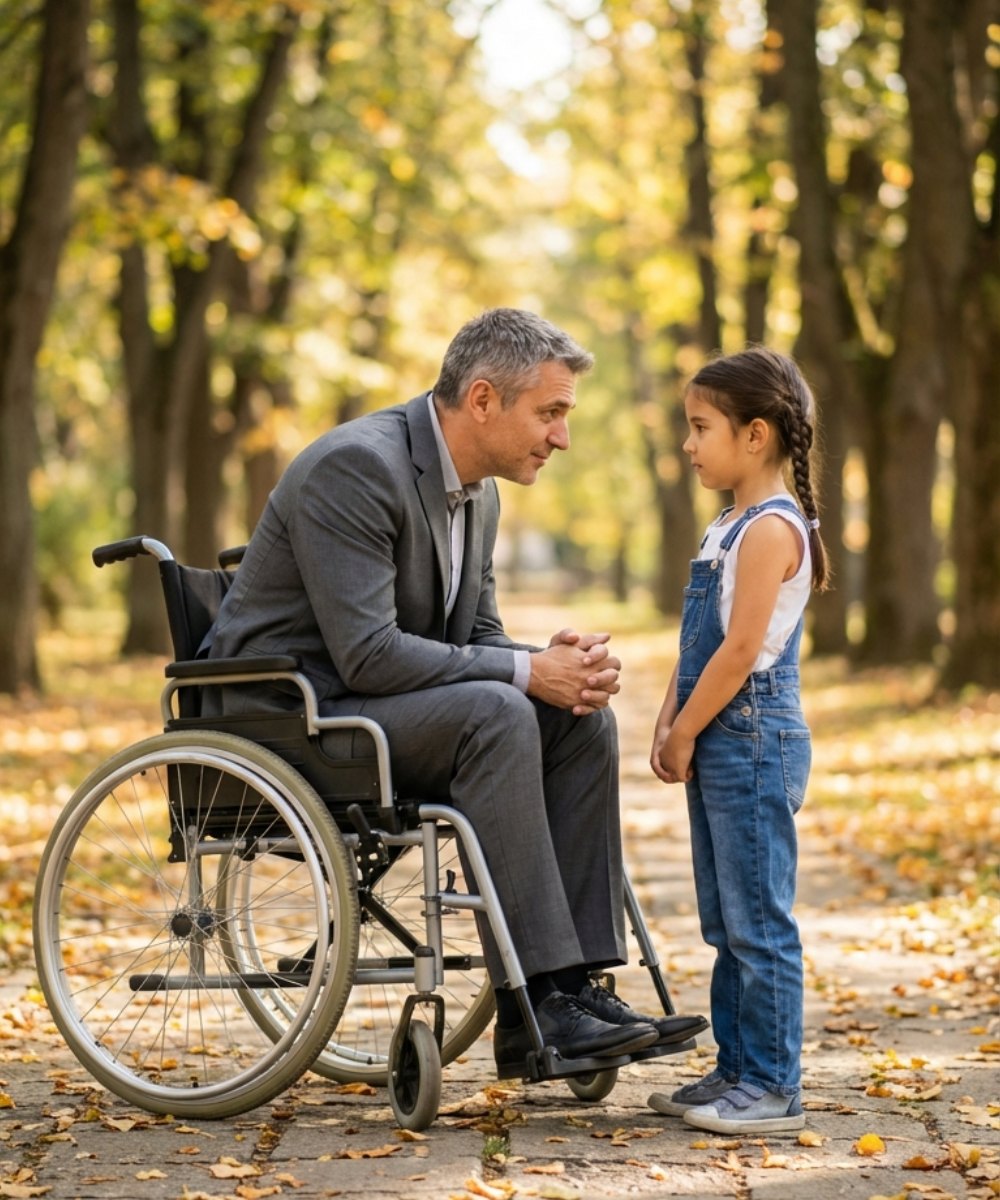
The Afternoon He Tried to Buy a Miracle
By the time he turned fifty-one, Preston Hale had convinced himself that everything in life could be negotiated, because he had spent three decades rescuing failing aerospace suppliers, smoothing over regulatory obstacles with strategic donations, and surrounding himself with people who laughed a little too quickly at his dry remarks. He understood leverage the way other men understood prayer, and although he had lost the use of his legs in a helicopter accident six years earlier, he had never lost the habit of believing that enough money, applied in the right direction, could bend reality back into shape.
Yet no specialist in Boston, no discreet clinic in Zurich, and no experimental therapy flown in under private contracts had given him back the simple sensation of standing barefoot on grass and feeling the earth press gently against his soles.
On a mild Saturday afternoon, the landscaped courtyard of the Silver Pines Neurological Institute looked less like a medical facility and more like a country club preparing for a magazine spread. The hedges were trimmed into obedient shapes, waiters carried trays of amber bourbon poured into crystal, and a string quartet played something light and forgettable while donors in tailored linen pretended to be casual. In the center of it all sat Preston in a titanium wheelchair, polished to a dull shine, positioned carefully so that the late sunlight framed him like a portrait.
At his side were three long-time associates—Garrett Boone, Silas Mercer, and Owen Whitaker—men who measured loyalty in retained earnings and whose laughter rose on cue whenever Preston delivered a cutting observation about a rival. They did not laugh because he was amusing; they laughed because he was powerful, and in their world, power was the only reliable currency.
Across the courtyard, moving quietly along the marble terrace, a woman in a plain housekeeping uniform scrubbed at a faint wine stain that no one else had noticed. Her name was Maribel Cruz, and she had spent years perfecting the art of being present without being seen. A few feet away, her daughter, Elena, balanced a broom nearly as tall as she was, sweeping fallen petals into neat piles while the adults drank and compared investment strategies.
Elena was ten, slight for her age, with a faded cotton dress that had been let out twice at the hem and sneakers that carried the memory of better days. She worked carefully, though her eyes kept drifting, not with envy but with open curiosity, toward the man in the wheelchair who commanded the space without ever standing.
Preston noticed.
He had always noticed who looked at him and how, because pity irritated him more than pain ever had.
“Hey, kid,” he called out, his voice deep and edged with impatience. “You’re raising dust. Some of us are trying to enjoy something older than your entire house.”
Maribel stiffened and hurried toward her daughter, placing a protective hand on the girl’s shoulder.
“I’m sorry, sir,” she said quickly. “We’ll finish up over there.”
Elena did not lower her gaze.
She studied Preston the way a student studies a complicated equation, and that quiet attention unsettled him in a way that open defiance never could.
He rolled closer, the electric motor humming softly, until he was directly in front of her.
“You’ve been staring at my legs since you got here,” he said. “What’s the verdict? Feel bad for the rich guy who can’t take a step?”
Elena’s voice, when she answered, was steady.
“No, sir. I don’t feel bad.”
He arched an eyebrow.
“Then what do you feel?”
“I feel sad,” she replied, as though she were explaining something simple. “Because you can buy the best shoes in the world, but you don’t seem to have anywhere you want to go. And because you have a lot of people laughing around you, but your eyes look like you’re by yourself.”
The courtyard grew still in a way that felt unnatural, as if someone had lowered the volume on the afternoon.
Garrett let out a short, nervous chuckle that died when Preston’s expression hardened. No one spoke to him that way, not employees, not board members, and certainly not children.
He could have dismissed her, but something sharper than anger took hold of him—a restless impulse born of boredom and a long habit of turning discomfort into spectacle.
He reached into the inner pocket of his blazer and pulled out his checkbook.
With a deliberate flourish, he wrote a number that would have transformed Maribel’s life and tore the check free.
“One million dollars,” he announced, holding the paper between two fingers. “It’s yours. Buy a better house. Better clothes. Whatever you want. All you have to do is fix me. Make me walk. Right now.”
Silas lifted his phone to record, already anticipating a story he could share later over dinner. Owen muttered something about whether the girl could even count that high.
Maribel’s face flushed with humiliation.
“Please, sir,” she whispered. “We don’t want trouble.”
Elena stepped forward instead of back.
She took the check, glanced at the numbers as if they were nothing more than ink, and slowly tore it into pieces that drifted down onto the immaculate lawn.
“My grandmother used to say there are things you don’t pay for,” she said. “You can pay for a hospital room, but not for peace. You can pay for treatment, but not for the part inside that decides to get better. You don’t need money to walk. You need to stop punishing yourself.”
The words struck him with unsettling precision.
For a moment, he could not breathe.
Six years earlier, on a private flight he had insisted on piloting despite limited experience, a sudden mechanical failure had sent the helicopter down in a field outside Santa Fe. His business partner and closest friend had not survived the crash, and although investigators publicly labeled it an unavoidable malfunction, Preston had always known his impatience had placed them there that day.
He had broken his spine, yes, but he had also built a fortress of guilt around himself.
“You don’t know anything about me,” he said, though the conviction in his voice faltered.
Elena knelt in front of him, unafraid of the polished metal and the watching crowd.
“You were in a helicopter,” she said softly. “There was fire. There was noise. You think you should have done something different. You think you should have been the one who didn’t come home.”
His associates stared at her in disbelief.
Preston felt the memory rise like heat, thick and suffocating.
“Stop,” he muttered.
“Your body remembers what your mind won’t say,” she continued. “You’re not just hurt. You’re holding on to blame like it’s a weight you deserve to carry.”
Maribel hesitated, then placed her hands gently on Preston’s shoulders, following her daughter’s quiet instruction.
Elena pressed her small palms against his knees, not in a dramatic gesture, but with a focused, deliberate touch that suggested she was listening to something beneath the surface.
Minutes passed, though they felt suspended outside ordinary time.
Preston’s composure cracked, and with it came a sound he had not allowed himself to make in years—a raw, unfiltered sob that seemed to pull the air from his lungs.
“I should have let him fly,” he choked. “I should have waited.”
“Then say you forgive yourself,” Elena urged. “You can’t keep standing in the crash forever.”
The courtyard had become a silent witness.
Finally, in a voice that trembled with effort, he said, “I forgive myself.”
Something shifted.
It was not theatrical, not accompanied by flashing lights or dramatic music. It was subtle at first, a warmth spreading through muscles that had felt distant and unresponsive for years.
His right foot twitched.
Garrett dropped his glass.
Preston stared at his own leg as if it belonged to someone else.
He focused—not on forcing movement, but on releasing the tight knot of self-condemnation that had defined him since the accident.
His toes flexed.
With assistance from the armrests, and then with less than he expected, he slid forward out of the chair. His legs trembled under him, thin from disuse, yet they held. He sank to his knees, not because he collapsed, but because the rush of emotion overwhelmed him.
He wrapped his arms around Elena, tears streaking across the sleeve of his tailored jacket.
“Thank you,” he whispered, his voice stripped of arrogance.
The Morning After
The video, of course, spread overnight.
By sunrise, local news stations had labeled it an unexplainable recovery, and online commentators debated everything from neurology to faith.
The institute’s medical director, Dr. Adrian Cole, arrived at Preston’s suite with two attorneys and a controlled expression.
“This is problematic,” he said briskly. “There are liability concerns. That child has no credentials. We can’t have the public believing unauthorized interventions are acceptable.”
Maribel drew Elena closer.
Preston, who had insisted on sleeping in the room rather than celebrating elsewhere, stepped out from the adjoining bathroom.
He did so on crutches, yes, but upright.
The attorneys who followed him were not the institute’s.
They were his.
“Doctor,” Preston said evenly, “if you threaten them, you’ll find yourself answering to people who specialize in contracts far more complex than this one.”
Dr. Cole reconsidered his tone.
Within an hour, the legal conversation had shifted from accusation to apology.
A Different Kind of Investment
Preston did not hand Maribel another check.
Instead, he invited her and Elena to his office two weeks later, once his rehabilitation team confirmed that his recovery, while astonishing, was medically stable.
He had spent long nights reconsidering the way he defined success.
“I built companies,” he told them, seated across a broad wooden desk that once felt like a throne. “But I neglected the part of myself that needed to grieve. What you did wasn’t magic. It was reminding me to face something I kept avoiding.”
He proposed funding a center dedicated to integrative neurological recovery, where traditional therapy would work alongside emotional counseling and community support. He insisted Maribel oversee operations, not as charity, but as employment with authority and respect.
Elena listened, her expression thoughtful.
“It won’t work if it’s about proving something,” she said gently. “It has to be about helping people feel less alone.”
He nodded.
“Then that’s what it will be.”
Opening Doors
Six months later, at the dedication of the Hale Center for Restorative Medicine in Denver, Preston stood unaided at the podium. His steps were not yet graceful, but they were his.
Maribel wore a tailored suit instead of a uniform, though she carried herself with the same quiet strength.
Elena, in a simple blue dress, approached the microphone with calm composure.
“He offered me a million dollars,” she told the audience, her voice carrying across the auditorium. “But nobody can buy what has to come from inside. We can support each other, we can guide each other, but each person has to decide they’re ready to let go of what’s holding them back.”
She glanced at Preston.
“Sometimes the hardest part isn’t learning to walk again. It’s learning to forgive yourself for the moment you fell.”
The applause that followed was not thunderous in the way of spectacle; it was sustained, thoughtful, and sincere.
Preston felt it in his chest like a steady rhythm rather than a burst of noise.
As he stepped down from the stage and took Elena’s hand in gratitude, he understood that the true shift had not been in his legs but in the quiet space behind his ribs, where resentment and remorse had once crowded out everything else.
He had tried to purchase a miracle.
Instead, he had been reminded that the most profound changes are rarely transactions at all.