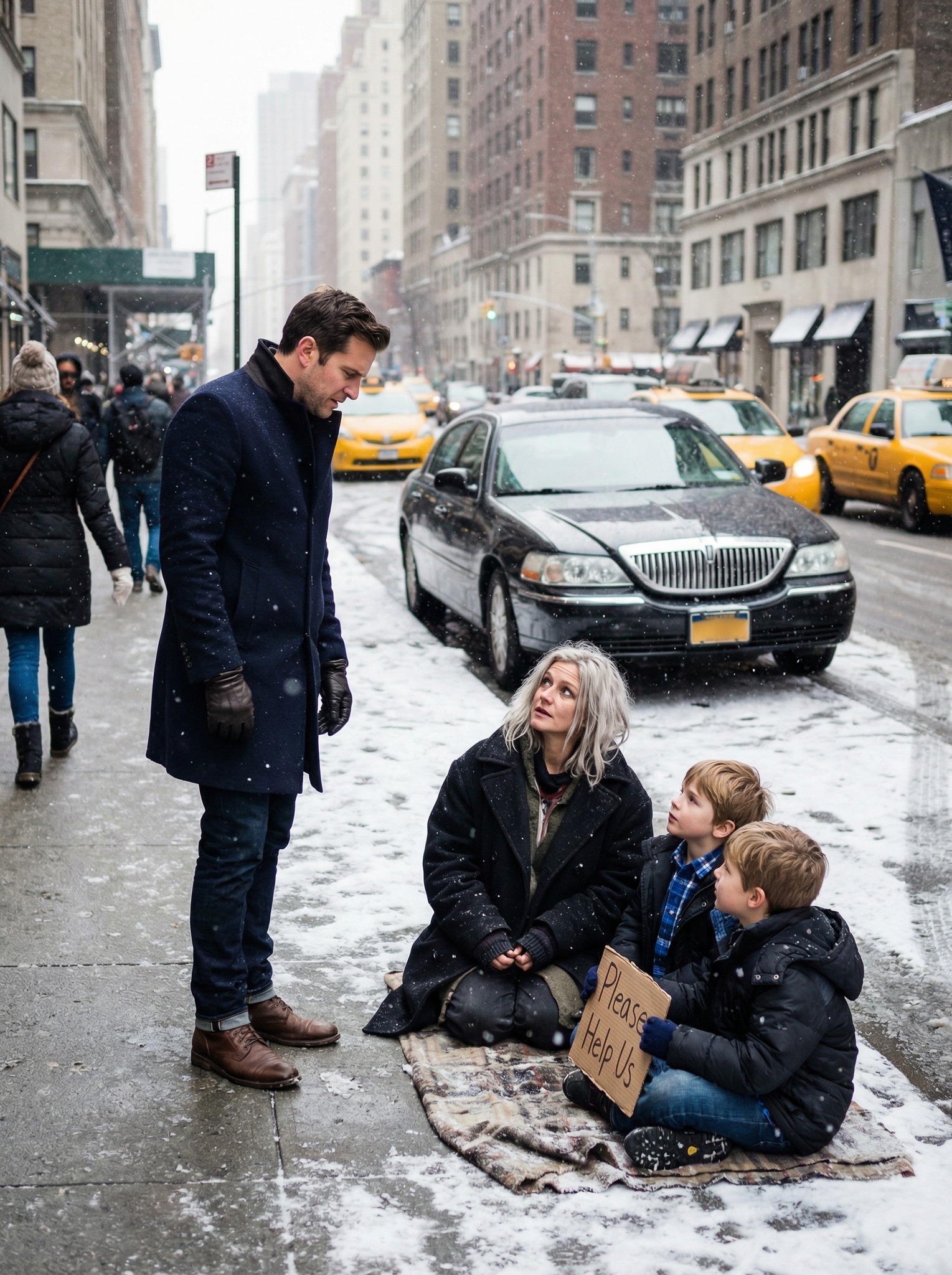
A December Morning on Wabash Avenue
The wind that swept through downtown Chicago that morning carried the kind of sharp cold that seemed to slice through wool and leather alike, and Wyatt Rowan, who had stepped out of his dark sedan with one hand still occupied by his phone, barely noticed it at first because he was already halfway inside his inbox, skimming investor updates while planning the afternoon presentation he was scheduled to deliver at a clean-energy conference near Millennium Park.
He had built his reputation on discipline and forward motion, on never lingering too long in one place or on one emotion, because ever since he had left Chicago nearly a decade earlier to join a renewable-technology incubator in Seattle, he had told himself that ambition required a certain narrowing of the heart, the kind that left little room for nostalgia or regret.
It was only when he heard a child’s thin cough cut through the hum of traffic that his attention shifted from the glow of his screen to the brick wall across the sidewalk, where a woman sat with her back pressed against the cold surface, her coat frayed at the sleeves, three children gathered close to her as though she were the only source of warmth left in the city.
She held a piece of cardboard that trembled in her hand, and on it were written the words, “Please help. Anything is appreciated.”
Yet it was not the sign that held him there.
It was her face.
The Woman He Once Loved
For a long second, Wyatt wondered whether memory had learned to imitate reality, because the woman beneath the tangled hair and exhaustion carried the unmistakable features of someone he had once known so intimately that he could have described the faint curve of her smile even in darkness.
It was Lila Hartwell.
Years earlier, they had shared a cramped apartment near the University of Illinois at Chicago, had mapped out futures on paper napkins while eating cheap takeout on the floor, had whispered about starting a family someday once their lives felt stable enough to hold something fragile.
He had left before that stability ever arrived.
When an opportunity surfaced in Seattle, promising funding and mentorship and the kind of career momentum that rarely knocks twice, he had convinced himself that distance was temporary, that love could withstand ambition if ambition moved fast enough.
He remembered telling her, “We’ll figure this out. I just need to go for a while.”
The while had turned into years.
Now she was here, and the three children beside her had the same chestnut eyes he saw in his own reflection each morning, the same narrow chin, the same small indentation in one cheek when they shifted their expressions in confusion at the passing crowd.
His pulse thudded in his ears as he stepped closer.
“Lila?” he said quietly, uncertain whether speaking her name would shatter whatever fragile thread connected this moment to reality.
She lifted her gaze, and recognition passed across her face like a flicker of sunlight before she lowered her eyes again.
“Wyatt,” she replied, her voice hoarse from cold and something heavier than weather. “It’s been a long time.”
Questions Without Air
He wanted to ask everything at once, to demand explanations for the years between them, to know why she had never reached out and why he had not tried harder to be reachable, yet the smallest of the three children leaned against her shoulder and began coughing again, his thin jacket no match for December in Chicago.
Without thinking, Wyatt shrugged off his own coat and wrapped it around the child, who looked up at him with wary curiosity.
“You don’t have to do that,” Lila murmured, as though kindness itself were a burden.
“Yes, I do,” he answered, surprising himself with the steadiness in his voice. “Come with me. You can’t stay here.”
She hesitated, and in that pause he sensed pride, fear, and exhaustion woven together so tightly that untangling them would take more than a single conversation.
“I can’t just walk into your life,” she said softly.
“You’re not walking into it,” he replied. “You were always part of it.”
Warmth and Pancakes
The café on the corner smelled of coffee and maple syrup, and the children—whose names he soon learned were Maren, Elias, and Jude—sat stiffly at first, as though expecting someone to tell them they did not belong in upholstered chairs.
When plates of pancakes arrived, they ate with the focused urgency of children who had learned not to assume a second serving would follow.
Lila cradled a cup of hot tea in both hands, her fingers trembling despite the warmth that surrounded them.
Wyatt watched her carefully, trying to reconcile the woman before him with the memory he carried.
“Tell me what happened,” he said, keeping his tone low so that the children would not feel the weight of adult worry.
She closed her eyes briefly before answering.
“I found out I was expecting a few weeks after you left,” she said. “I tried calling, but your number had changed, and by the time I heard about your company taking off, I didn’t know how to reach someone who seemed to belong to a different world.”
He felt the words settle heavily in his chest.
“I worked at a clinic during the day and at a bookstore at night,” she continued, her voice steady despite the exhaustion in her posture. “When the shutdowns happened, both places closed, and the savings I had disappeared faster than I thought they would. We managed for a while, but eventually the landlord stopped waiting.”
Wyatt glanced at the children again, and this time he did not see resemblance alone; he saw lost time measured in school recitals he had not attended and scraped knees he had not bandaged.
“They’re mine, aren’t they?” he asked, though the answer was already etched into their faces.
She nodded once.
“I never wanted to force anything on you,” she said. “I just tried to keep them safe.”
The Night of Reckoning
That evening, Wyatt reserved rooms at a boutique hotel near the river and made calls until midnight, contacting colleagues who owed him favors and administrators at a private elementary school willing to review late applications.
He had spent years mastering negotiations that moved millions of dollars, yet none of those deals had prepared him for the quiet realization that he had been absent from the only investment that truly mattered.
When he returned to the hotel the next morning, Maren greeted him at the door with a cautious smile.
“Are you coming back?” she asked, as though testing whether promises could survive a single night.
He knelt so that his eyes were level with hers.
“I’m not going anywhere,” he said.
Lila watched from a few steps away, uncertainty still lingering in her expression.
“You don’t have to solve everything,” she told him later, once the children were busy examining the television remote as though it were a treasure.
“I’m not trying to solve it,” he replied. “I’m trying to show up.”
Learning to Stay
Weeks turned into months, and Lila accepted a position as an administrative coordinator at one of Wyatt’s partner firms, a role that provided steady hours and health benefits without placing her directly under his supervision, because he understood that rebuilding trust required space as much as support.
The children enrolled in school and began bringing home drawings and spelling tests, each one offered to him with shy pride.
On Saturdays, they visited Lincoln Park Zoo or baked cookies in the spacious kitchen of his penthouse, where laughter gradually replaced the echo that had once dominated the high ceilings.
One evening, as the sun lowered itself behind the skyline and painted the windows in amber light, Lila joined him on the balcony.
“You’ve done more than I ever expected,” she said quietly.
He shook his head.
“I’m only beginning to understand what I missed,” he answered. “Success felt urgent back then, and I thought love would wait until I circled back. I was wrong.”
She looked at him for a long moment.
“The kids care about you,” she said.
“I care about them,” he replied, then added after a pause, “And about you.”
A Different Measure of Wealth
A year after that December morning, Wyatt stood outside a renovated brick building on the South Side, where a new community center was preparing to open its doors to single parents seeking job training and temporary childcare.
He had insisted that the center not carry his name.
Instead, a modest sign near the entrance read “Hartwell Family Resource Center,” a tribute that made Lila blink back quiet emotion when she first saw it.
Reporters gathered, curious about why a technology entrepreneur known for clean-energy ventures had shifted his focus toward community support.
When one journalist asked what had inspired the project, Wyatt answered simply, “Sometimes you realize that the most important return isn’t financial. It’s human.”
Maren, Elias, and Jude stood beside him holding a ribbon, their laughter drifting upward as cameras clicked.
Lila reached for his hand, and in that small gesture he felt something settle within him, not as dramatic revelation but as steady certainty.
He understood then that the measure of his life would no longer be determined by valuations or conference invitations, but by the evenings spent helping with homework and the mornings when a child’s voice called out from the kitchen.
On another cold December day, exactly one year after he had first seen her against that brick wall, Wyatt walked along Wabash Avenue with Lila and the children, the air still sharp yet no longer unforgiving.
He glanced at the place where their paths had crossed again and felt gratitude rather than regret, because while he could not alter the years he had missed, he had chosen to remain for the years ahead.
And in choosing to remain, he discovered that the kind of richness he had chased across the country had been waiting, quietly and patiently, in the simple act of staying.