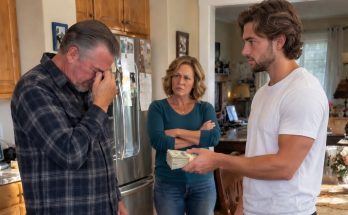
Whatever the reason, he sat.
I turned the laptop toward him.
The spreadsheet remained open.
Ryan glanced at it.
“What is this?”
“What I’ve paid for Mom during the last twelve months.”
He studied the total.
His eyebrows rose.
“That can’t be right.”
“It is.”
“Thirty-one thousand dollars?”
“Thirty-one thousand eight hundred forty-two.”
He scrolled.
Mortgage.
Insurance.
Phone.
Medical coverage.
Utilities.
Car expenses.
Maintenance.
Subscriptions.
Then I opened another worksheet.
“That’s the previous year.”
$38,109.
Another.
$44,770.
Ryan stopped scrolling.
“What happened that year?”
“Her roof.”
His mouth tightened.
“I thought insurance covered it.”
“It covered part of it.”
“You never told me.”
“I did. You said money was tight.”
“It was.”
“You bought a boat three months later.”
His eyes narrowed.
“That has nothing to do with this.”
“It has everything to do with this.”
He pushed the laptop away.
“Fine. You’ve helped her. A lot. Nobody is denying that.”
“Mom did.”
“What?”
“She told me I don’t put family first.”
“She was emotional.”
“Interesting how her emotions always create obligations for everyone else.”
He stood again.
“This isn’t getting us anywhere.”
“It got me somewhere.”
“Where?”
“Out.”
He stared at me.
“I’m done being the family account.”
“That’s not what you are.”
“Then there shouldn’t be a crisis when I stop paying.”
His jaw tightened.
For the first time, Ryan seemed to understand there was no version of this conversation in which I restarted those automatic payments.
“What do you want?” he asked.
“Nothing.”
“An apology?”
“I don’t want an apology someone gives because the mortgage is due.”
“So you’re just cutting Mom off?”
“I am no longer paying her recurring expenses.”
“That’s cutting her off.”
“No. She has income. She has a house with significant equity. She has a car. She has retirement benefits. She has two adult children.”
Ryan looked irritated.
“Don’t bring me into this.”
There it was.
I leaned forward.
“Why not?”
“Because this was always your arrangement with her.”
“No. This was the arrangement everyone allowed because it was convenient.”
“I never asked you to pay.”
“You also never offered.”
He opened his mouth.
I lifted a hand.
“I don’t care anymore. You don’t have to justify yourself to me. And I don’t have to justify myself to you.”
Security eventually escorted him downstairs when he refused to leave.
By Friday, Mom changed strategies.
The accusations stopped.
An apology arrived.
It came as a voicemail from another number.
“Emily, honey, this is Mom. I know you’re upset. I shouldn’t have said what I said. I was frustrated, and sometimes mothers say things they don’t mean. Please call me so we can straighten this out. I love you.”
I listened twice.
Not because it moved me.
Because something about it felt wrong.
Daniel noticed too.
“She didn’t actually apologize.”
“She said she shouldn’t have said it.”
“That isn’t the same thing.”
I nodded.
She hadn’t said, “I’m sorry I hurt you.”
She had said she shouldn’t have said it.
To someone outside our family, that distinction might sound petty.
Inside ours, it meant everything.
Mom had spent decades treating cruelty like a communication mistake instead of a choice.
She didn’t regret causing the wound.
She regretted the consequences.
I still didn’t respond.
The following week, she came to my house.
Daniel spotted her first through the doorbell camera.
“Your mom’s here.”
I was upstairs changing after work.
“Did she call?”
“No.”
“Of course she didn’t.”
When I came downstairs, Mom stood on the porch holding a paper grocery bag.
For one irrational second, I felt eleven years old again.
I remembered her waiting at the kitchen table after I came home with a B-minus.
The disappointment on her face when I chose a university four hours away.
Being twenty-three and hearing her tell relatives that Ryan “needed help” while I was “independent.”
Eventually, I understood what independence meant in my family.
It was the word they used when they wanted to give me less while asking me for more.
I opened the door without inviting her inside.
“Hi, Mom.”
She looked tired.
Her hair was tied back, and she wore the beige cardigan Dad had bought her years earlier.
“I brought your casserole dish.”
I glanced at the grocery bag.
“You drove two hours to return a casserole dish?”
“I thought we could talk.”
“We can talk here.”
Her mouth tightened.
“On the porch?”
“Yes.”
She looked past me.
“Is Daniel home?”
“He is.”
“I don’t need an audience.”
“You don’t have one.”
She stared at me, then set the bag down.
“I said I was sorry.”
“No. You said you shouldn’t have said it.”
“Oh, for heaven’s sake.”
There was my mother.
Not the gentle voicemail version.
The real one.
I almost smiled.
She noticed.
“What?”
“Nothing.”
“No, say it.”
“You’re angry because apologizing didn’t immediately restore your access to me.”
Her face reddened.
“That’s an ugly thing to say.”
“So was wishing I’d never been your daughter.”
“I told you I didn’t mean it.”
“Didn’t you?”
She looked away.
That hurt more than I expected.
Not because I needed an answer.
Because I suddenly realized I already had one.
Mom loved me.
In her own way.
But she had also resented me for years.
She resented that I left North Carolina for college in Virginia and eventually returned on my terms.
She resented that I earned more than Ryan.
She resented that I made decisions without asking permission.
Most of all, she resented that Dad trusted me with financial matters during his final illness.
After he died, I became both the person she depended on and the person she blamed.
“Mom,” I said, “why do you think I owe you?”
Her eyes snapped toward me.
“I never said you owe me.”
“You remind me constantly that you sacrificed for me.”
“Because I did.”
“You chose to have children.”
“That doesn’t mean it was easy.”
“I never said it was.”
“You have no idea what I gave up.”
“And there it is.”
“What?”
“The bill.”
She frowned.
“What bill?”
“The invisible bill you’ve been handing me my entire life.”
She shook her head.
“You’ve changed.”
“Yes.”
“I don’t know who put these ideas in your head. Daniel, probably.”
I nearly laughed.
Daniel had been part of the family for eight years and somehow became responsible for every boundary I ever established.