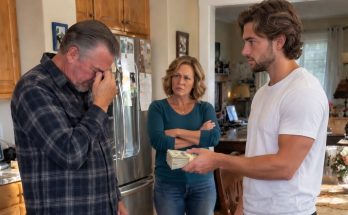
The applause stopped instantly.
Dad accused me of choosing money over family.
I asked Renee to tell everyone what Grant had said before the airport trip.
She did.
Then Mom finally said the sentence that stripped away every excuse.
“I wanted you to feel dependent on the family for once. You walk around acting like you never need anybody.”
The room went completely silent.
There it was.
Not a joke.
Not a misunderstanding.
Not a moment of anger.
They had intentionally tried to make the daughter funding their lives feel powerless.
I opened the sealed folder I had brought.
Inside were documents confirming that every recurring payment had ended. There was also the airline cancellation, my reimbursement receipt, Dad’s “Walk home” message, Evan’s warning about the workplace visit, and screenshots showing the false stories that had been spread among relatives.
The final page established a new boundary.
No personal calls.
No unannounced visits.
No social-media contact.
One email address would remain open only for legitimate administrative matters.
Dad stared at me.
“Then you’re no longer my daughter.”
“You’ve been using belonging as a threat since the airport. It doesn’t have power over me anymore.”
Several relatives tried to mediate.
I refused.
There was nothing to mediate while Dad continued calling a planned punishment a harmless joke.
Chloe asked if I would at least attend her graduation.
“I’m not turning attendance into another bargaining tool.”
Evan demanded compensation for money he had already spent preparing his business.
“You chose those expenses. I never signed a partnership agreement, and I never guaranteed your business.”
Mom began crying.
She complained that nobody cared this was supposed to be her birthday celebration.
Renee and I left before the cake.
Mom followed us into the parking lot and asked for two private minutes.
She told me she missed me.
She blamed Dad’s pride.
She insisted the old photographs she had been sending weren’t manipulation.
Then she asked one final question.
“Could you at least pay the next property-tax installment? Just this once?”
I looked at her.
“No.”
That was our last real conversation.
Afterward, I blocked personal phone numbers and social-media accounts. Renee respected my boundary and refused to become a messenger. I changed my emergency contact information, updated important documents, and removed every informal authorization I had given family members over the years.
And something unexpected happened.
Nothing collapsed.
Dad kept his business, only smaller.
Without my credit, he abandoned the risky expansion loan. He rented trucks when needed and stopped pretending that growing his company was something my finances were responsible for.
Chloe eventually finished her respiratory therapy program after a one-semester delay. She mailed me a graduation announcement but no apology.
I placed it in a drawer and didn’t attend.
Evan continued working and slowly built a modest weekend repair operation with money he earned himself.
My savings were no longer part of his business plan.
Mom worked more hours and adjusted to life without my financial assistance. I also realized how much unpaid work I had been doing beyond writing checks—tracking deadlines, comparing loans, reviewing contracts, making phone calls, and fixing every family emergency.
Four months after the airport incident, my apartment intercom buzzed.
Dad was standing on the public sidewalk outside.
“The family has suffered enough.”
I asked him one question.
“Knowing everything this cost you, would you cancel my ticket again?”
He hesitated.
“I would handle it differently.”
“That wasn’t my question.”
Even after everything, he still couldn’t simply admit it had been wrong.
He invited me to Sunday dinner.
I refused.
“You might regret having nobody when you need help.”
“Needing support is different from accepting disrespect.”
I told him not to return.
Several months later, I finally took the California trip by myself.
I booked a small waterfront hotel near Monterey. I ate wherever I wanted, stopped whenever the ocean looked too beautiful to drive past, and woke each morning without anyone asking what expense I would cover next.
One evening at sunset, I remembered standing at the airport kiosk and reading Dad’s message.
“Walk home.”
For years, I believed home meant the people whose emergencies I solved, whose bills I remembered, and whose problems I quietly carried.
Now I knew better.
My father canceled one airline ticket because he wanted to remind me how much I needed my family.
Instead, he showed me exactly what my family believed they needed from me.
My money. My credit. My forgiveness. My predictability.
I never restored the payments. I never went back to Sunday dinner. And I stopped answering requests disguised as apologies.
They told me to walk home.
So I did.
I just chose a home where none of them had a key.