Part 1 of2

The engagement party at the Riverside Ballroom had been choreographed down to the last sparkling detail.
Crystal chandeliers floated overhead, scattering light over two hundred impeccably dressed guests. A string quartet played unobtrusively in the corner, weaving familiar classical melodies through the low hum of conversation and clinking glassware. Waiters glided like ghosts in black and white, replenishing champagne flutes before they were even half empty.
And right in the center of it all, under the largest chandelier and the undivided attention of most of the room, stood my sister, Brooke.
She held her left hand out at just the right angle, fingers slightly splayed, wrist relaxed, the movement casual enough to seem unpracticed but deliberate enough that the diamond on her finger caught every possible shard of light. The two-carat stone flashed and winked as she laughed, as she covered her mouth in mock embarrassment, as she touched her fiancé’s arm exactly when she recounted the part of the story where he “got down on one knee and totally surprised” her.
I had heard that story fifteen times in the last hour. I knew precisely when the collective “awww” would ripple through the circle of watching guests, when my mother would dab at an entirely imaginary tear, when my father would puff with a fresh wave of paternal pride.
I also knew that not one person in that semicircle would remember to ask me how I was doing.
I leaned against the bar, my glass of pinot noir cradled in my hand, and watched the scene unfold like a play I’d already seen in previews, dress rehearsal, and opening night. Somewhere between the dessert course and the speeches, I’d become part of the scenery—decorative, unobtrusive, useful only when someone needed an extra set of hands to carry gifts or a neutral person to take a group photo.
“Refill, ma’am?” the bartender asked politely.
I glanced at my glass. I’d been nursing the same one for most of the night, letting it warm slowly in my hand.
“I’m good, thanks,” I said.
He nodded and moved down the bar. I turned slightly, putting Brooke back in my line of sight.
She radiated joy, and to be fair, she had every reason to. The ring really was beautiful. Her fiancé, Michael, ticked all of my parents’ boxes: stable job in corporate finance, expensive watch that wasn’t too flashy, a smile that suggested he was “good with people,” and a willingness to laugh at my father’s jokes. The way my mother looked at him—bright, hopeful, almost reverent—made it clear that he had already been mentally grafted into the family tree as the future patriarch of the next generation.
I didn’t begrudge Brooke her happiness. I honestly didn’t. What I did begrudge—quietly, under layers of practiced composure—was the way her happiness had automatically become the central planet in our family’s solar system. Every conversation orbited around her, around them, around their future house, their potential children, their wedding registry.

“You’re so lucky,” an older aunt cooed from the crowd around Brooke. “Two carats! When I got engaged, we could barely afford a ring at all.”
My mother laughed indulgently. “Well, times are different now. And Michael really wanted to show how serious he is about taking care of our girl.”
Our girl.
Not “one of our girls.” Just the one.
I swirled my wine, watching the tiny eddies of red twist against the glass. The faint citrus scent of someone’s perfume drifted past me. Somewhere nearby, someone’s bright, shrill laugh broke over the music, and I felt that odd, familiar sensation of being present and invisible at the same time.
A waiter passed in front of me, his tray laden with mini crab cakes and tiny puff pastries. I shook my head when he offered, and he continued without missing a step.
“Ladies and gentlemen,” the DJ’s voice boomed over the speakers for the first time that evening, the quartet fading out mid-phrase. “Let’s give another round of applause for our beautiful couple, Brooke and Michael!”
Obedient applause rose like a wave. I clapped with everyone else, the sound roaring around me.
The applause was just beginning to die down when I heard my father’s voice from somewhere behind me, threaded with surprise and a touch of relief.
“James! You made it!”
I didn’t straighten immediately. People called each other’s names all evening. But the name—James—landed differently. It cut through my observational haze.
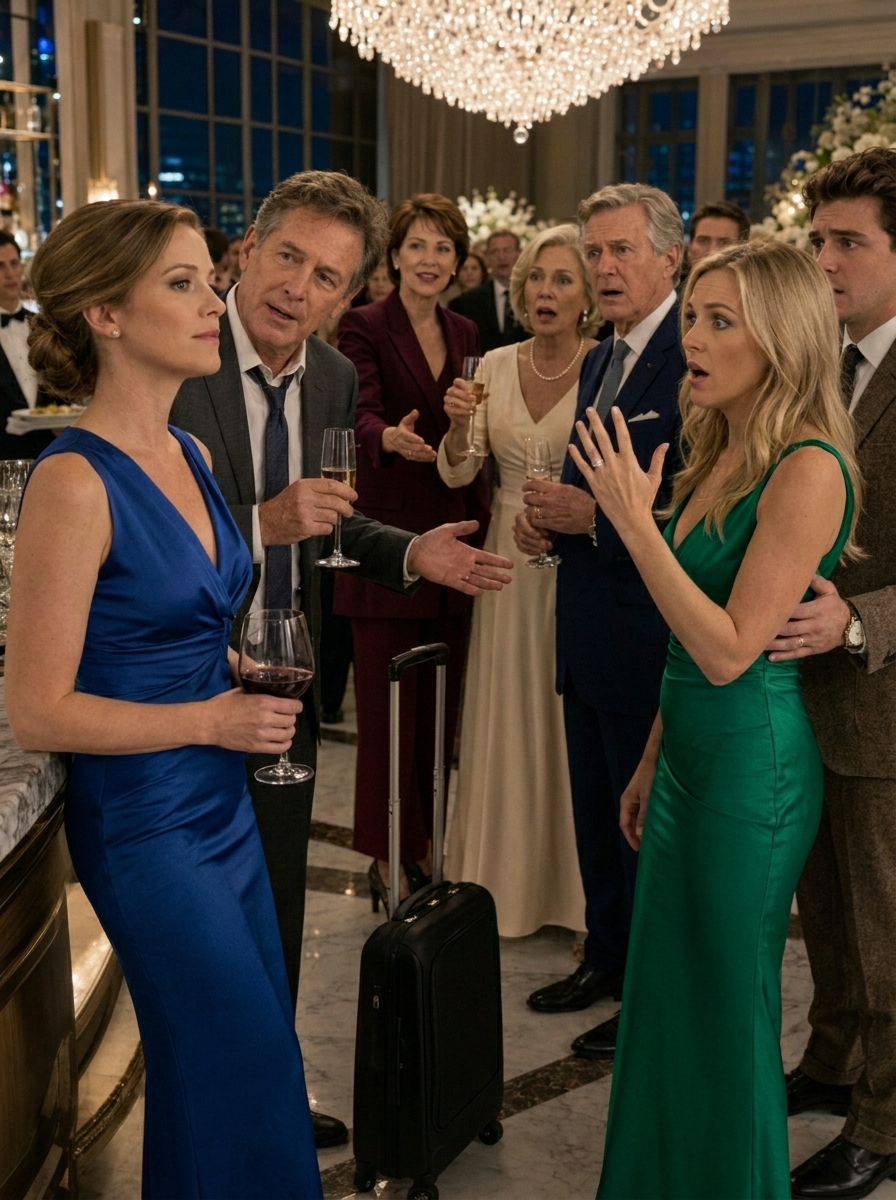
I turned, and there he was, weaving through the crowd toward our family’s cluster near the center of the room: my Uncle James, my father’s younger brother, suitcase still rolling behind him, suit jacket rumpled from travel, tie slightly loosened as if he’d been tugging at it in a rush.
“Sorry I’m late,” he called, raising a hand as he approached. “Connection out of Denver was a nightmare. I swear airports are trying to kill me.”
He said it with the easy, practiced humor of someone who was used to being watched and was comfortable under that scrutiny. Heads were already turning toward him. He had that presence—effortless charm, that faint aura of success that clung to him like an expensive cologne.
James wasn’t just my father’s brother. He was the family success story. The one everyone pointed to whenever they wanted proof that the family genes contained greatness. A venture capitalist who had ridden the late ‘90s tech wave and managed not to crash when the bubble burst, he now lived in San Francisco in a townhouse that my mother had Googled and then shown everyone she knew, whispering the estimated Zillow value like it was a sacred number.
He was, perhaps more importantly to me, the only person in our extended family who had consistently asked how I was. About my work. About my life. About anything that wasn’t Brooke.
He reached my parents first, pulling my father into a one-armed hug, kissing my mother’s cheek, offering congratulations with genuine warmth.
“Look at you two,” he said, stepping back to survey them. “Parents of the bride. Patricia, you’re glowing.”
“It’s the lighting,” my mother demurred, preening anyway. “And the champagne.” She reached for a passing flute.
James laughed. “Always the modest one.”
He turned his attention to Brooke next, his face softening. “There’s the star of the evening.”
Brooke practically sparkled. “Uncle James,” she said, leaning in for a hug, careful to angle her hand so that the diamond caught the light for him to see. “I wasn’t sure you’d make it.”
“For my favorite niece’s engagement party?” he teased. “I’d have chartered a plane if I had to.”
She giggled, and my mother positively beamed.
Then his gaze shifted past them, scanning the space automatically the way people do when they know there is someone else they’re supposed to acknowledge. His eyes found me at the bar, and his entire expression brightened in a way it hadn’t for anyone else.
“Sophia,” he said, voice warm and unmistakably pleased. “God, it’s good to see you.”
He closed the distance between us in three strides, leaving his suitcase near my father, and pulled me into a hug that was solid and unhurried. The scent of airport, cologne, and familiarity wrapped around me.
“You look incredible,” he said as he stepped back, holding me at arm’s length for a moment to really look at me. “Sanity looks good on you. How’s life in that one-point-five million dollar house you bought? Is the neighborhood everything you hoped?”
The words left his mouth casually, as if he were asking about my commute.
The effect on the room was anything but casual.
The conversation in the immediate vicinity dialed down so abruptly that the ending of the DJ’s interlude music sounded unnaturally loud. The guests near us fell silent, their heads angling with that almost imperceptible tilt people get when they know something interesting is happening and they want to catch every word without appearing to be eavesdropping.
NEXT PART >>> 2