My wife smiled as she set the turkey on the table and whispered, “This is going to be our best Christmas ever.” Ten minutes later, she was collapsing in my arms…. Others come to destroy the family.

Part 1: Christmas Turned Into a Crime Scene

I watched my wife die while Christmas lights blinked behind her, cheerful and indifferent.

The turkey was still warm. The gravy sat in the center of the table. Cinnamon candles glowed on the sideboard, and an old holiday song played softly by the window, so calm it made the terror feel unreal.

Elise collapsed first.

One moment, she was laughing at something our seven-year-old son, Noah, had said about Santa needing bigger boots. The next, her fork slipped from her hand and struck her plate with a sharp little sound.

I looked at her.

“Elise?”

Her eyes had changed.

She tried to speak, but only a strained choking sound came out. Her hand flew to her throat. Her face went pale, and then she fell forward against the table.

For half a second, no one moved.

Then Sophie screamed.

My five-year-old daughter had cranberry sauce on her chin and pure fear in her eyes.

“Daddy,” she cried, reaching for me. “It burns.”

Noah gagged beside her. His lips were turning bluish. His small body folded over the edge of his chair.

After fifteen years in special operations, I had seen death in places that still haunted my sleep. I had trained for chemical threats, ambushes, poisoned water, and enemies hidden behind ordinary faces.

But nothing prepares a man for watching his family fall apart at his own Christmas table.

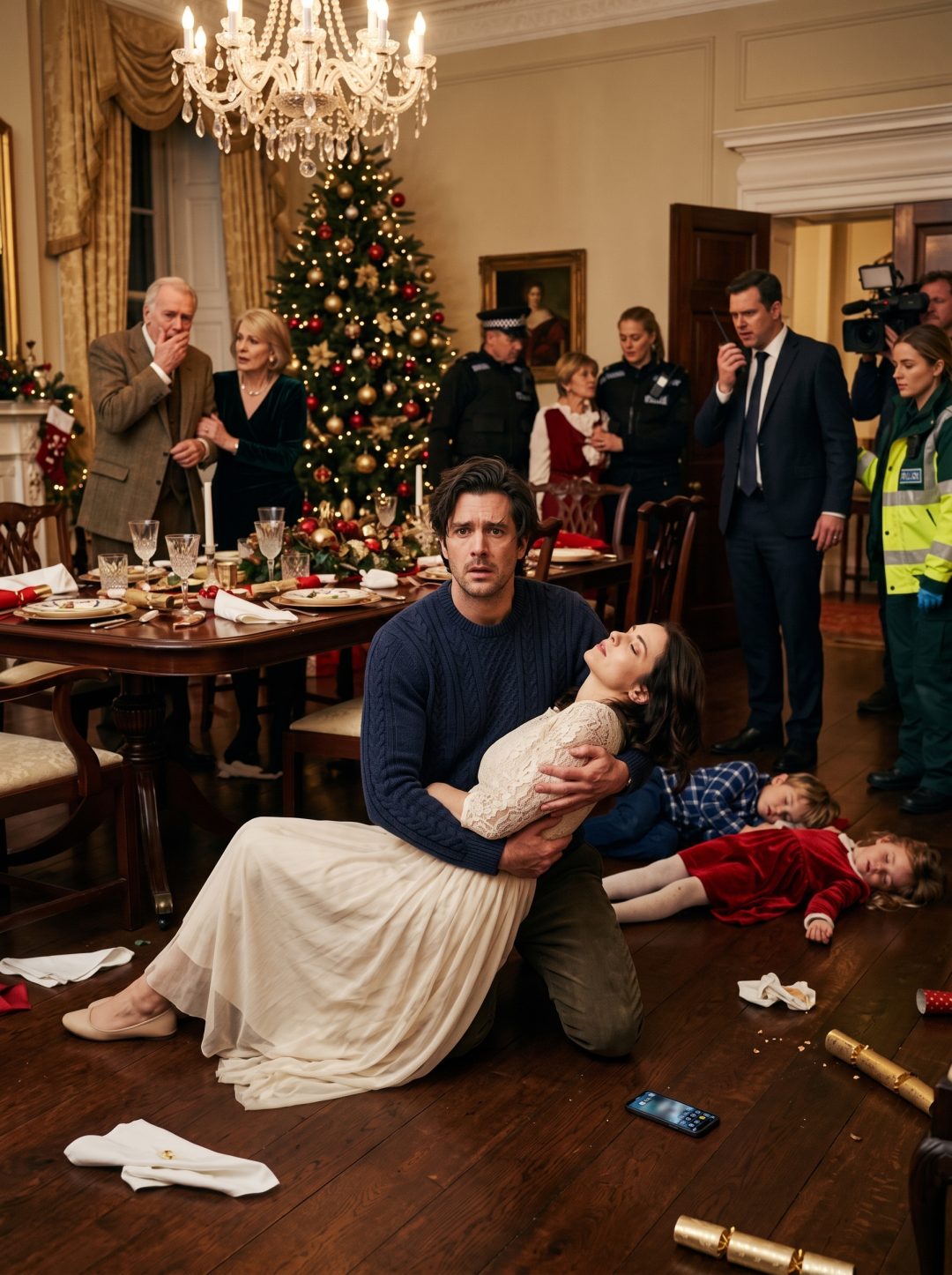
I shoved my chair back so hard it hit the wall. Plates crashed. Someone screamed my name. I got Elise onto the floor and started compressions, counting because counting was the only thing keeping my mind from splitting.

“One, two, three. Come on, baby. Breathe.”

Noah slipped from his chair. Sophie’s cries grew weaker.

“Call 911!” I roared.

Chairs scraped. Glass shattered. My brother-in-law, Martin, stood frozen. His wife, Jenna, sobbed into her phone. Their teenage son, Caleb, backed into the corner, white-faced and silent. Elise’s old college friend, Lucas, stumbled toward the sink, sick with panic.

And near the doorway stood Celia, my mother-in-law, in a cream sweater and pearls, one hand pressed neatly over her mouth.

Too neatly.

The thought flashed through me and vanished beneath panic.

Then I tasted metal.

It spread across my tongue like a warning. My stomach twisted. Sweat went cold across my neck.

Poison.

The word did not arrive like a possibility.

It arrived like a fact.

By the time paramedics burst through the front door, Christmas dinner looked like a battlefield. Food smeared the tablecloth. Wine had spilled across the wall. The tree blinked blue, gold, blue, gold over Elise’s body as medics worked over her.

They loaded Elise first. Then Noah. Then Sophie.

I climbed into the ambulance with my wife and held her hand under the harsh white lights.

“Elise,” I whispered. “You promised me one normal Christmas.”

Her eyes did not find mine.

At the hospital, they pulled me away from her. Two security guards had to do it.

Then I saw Sophie’s stretcher rushing past, my daughter surrounded by tubes and white sheets. Noah came behind her, too still for a child who had been laughing an hour before.

That stopped me.

A doctor came toward me with tired eyes.

I knew before he spoke.

“Mr. Mercer,” he said softly. “I’m sorry. Your wife didn’t make it.”

The world narrowed to my shaking hands.

“What about my kids?”

His pause was small.

It destroyed me anyway.

“They’re alive,” he said. “But critical.”

I slid down the wall. My wife was dead. My children were fighting for their lives. And somewhere behind me, in a dining room full of broken dishes and Christmas music, someone we knew had put death into our meal.

By dawn, grief had hardened into something colder.

I did not know who had done it yet.

But I knew this: someone at that table had smiled at my children while waiting for them to die.

Part 2: The People in the Waiting Room

The hospital waiting room had the kind of fluorescent lighting that made every face look suspicious.

Martin paced near the vending machines. Jenna sat with shredded tissues in her lap. Caleb kept his hood up and his eyes down. Lucas leaned against the wall, pale and restless.

Celia sat apart from everyone.

She always looked expensive, even in crisis. Pressed slacks. Pearl earrings. Cream sweater untouched by the chaos. Her lipstick had smudged slightly, but even that seemed deliberate, as if grief were just another accessory she had chosen carefully.

She noticed me watching.

“Daniel,” she said thinly. “I’m so sorry.”

I did not answer.

Doctors had already pumped my stomach, drawn blood, run fluids, and asked questions that came at me like blows.

Did you eat the gravy?

Did you drink wine?

Did the children eat the same food?

Who prepared what?

Every question opened a door. Behind every door stood someone I knew.

Elise cooked the turkey and rolls. I made the mashed potatoes. Celia brought green bean casserole. Martin and Jenna brought sweet potatoes. Lucas brought wine. Jenna made cranberry sauce. Someone had filled the gravy boat while I was carving.

That last detail stayed blurry.

It bothered me.

Detective Nora Vale arrived at four in the morning with snow melting on her coat and a notebook already open.

“Mr. Mercer,” she said, “I know this is a terrible time for questions, but it is exactly when I need answers.”

“Ask.”

She studied me. “Military?”

“Retired special operations.”

Her grip changed on the pen.

“Then you understand what I’m asking. Was this random?”

“No.”

“You’re sure?”

I looked through the ICU glass. Noah lay beneath a heated blanket, tubes taped to his small face. Sophie was in the next room, still sedated, curls tangled against the pillow.

“I’m sure.”

Vale asked me to walk through dinner. I did it three times. Each time, more details surfaced.

Lucas whispering with Elise in the kitchen. Martin urging people to try the sweet potatoes. Celia watching Elise take the first bite of casserole. Jenna fussing over Sophie’s napkin. Caleb barely eating. The white ceramic gravy boat being passed hand to hand.

“Who ate gravy?” Vale asked.

“The kids,” I said. “A lot. Elise had some. I had a little.”

“Who didn’t?”

I replayed the table.

Celia had touched almost nothing except turkey and salad. Lucas had not eaten gravy. Caleb mostly pushed food around. Martin and Jenna had eaten enough that they should have been sick too.

“That doesn’t make sense,” I muttered.

“Unless the poison wasn’t evenly spread,” Vale said. “Or unless the gravy wasn’t the only source.”

Before I could answer, a nurse came out of the ICU. Her face was so carefully neutral my blood went cold.

“Your son’s pressure dropped,” she said. “We stabilized him. Your daughter is responding. The next forty-eight hours are critical.”

Celia stood.

“Can I see them?”

The nurse looked at me.

“No,” I said.

Celia blinked. “Daniel, I’m their grandmother.”

“My wife is dead. My kids are in there because someone poisoned them. Until I know who, no one sees them but me.”

Martin turned. “Come on. You don’t really think one of us—”

“I don’t think anything yet.”

That was a lie.

I was thinking too much.

At six in the morning, the first toxicology hint came back.

Heavy metal poisoning.

Rare. Deliberate. Not spoiled food. Not an accident.

Vale told me near the elevator, but voices carry in hospitals.

Celia heard.

Her fingers touched her pearls.

Martin cursed.

Lucas sat down hard.

But only one person made no sound.

When I turned, Celia was slipping her phone into her purse, her face calm again.

And for the first time, I wondered who she had been texting while my children fought to breathe.

Next Part 2