“Bobby’s harvested the beans,” he observed.
He pointed toward the lower pasture.
“That field always produces well.”
We passed the old tobacco barn, the cattle grazing near the fence, and the rolling hills where Dad had spent most of his life.
He named each field as we drove.
The bottom.
The long piece.
The hill pasture.
The tobacco patch.
Some hadn’t grown tobacco in years, but he still called them by their old names.
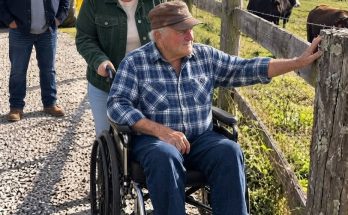
I stopped near a weathered wooden fence post.
Dad asked me to help him into his wheelchair.
Then I pushed him carefully along the gravel lane.
When we reached the corner, he placed one hand on the old cedar post.
“My father and I put this in back in 1961,” he said.
I smiled.
“Really?”
“Took us all afternoon.”
He ran his fingers across the wood.
“Your granddaddy always said a good corner post keeps the whole fence standing.”
He chuckled at the memory.
Then his expression grew thoughtful.
“Sixty-five years, and it’s still here.”
I stood quietly behind him.
A few minutes later, Bobby Whitt approached from the far pasture.
He was sixty years old, broad-shouldered, and had worked the Akers land for more than two decades.
When he recognized Dad, his face brightened.
“Clayton! It’s good to see you!”
They shook hands warmly.
Bobby asked about the nursing home.
Dad asked about the harvest.
For a few minutes, they spoke as though nothing had changed.
Then Bobby mentioned the upcoming rental payment.
“I’ll get your fall check sent out at the beginning of November, same as always.”
Dad looked up.
“Bobby, where have you been sending my rent?”
Bobby appeared confused.
“To Sherry.”
My hands tightened around the wheelchair handles.
“Since when?” Dad asked.
“Since you moved into the nursing home. She said she was handling your bills and showed me the power-of-attorney paperwork.”
Dad remained calm.
“Bobby, have I ever had trouble paying my obligations during the twenty-two years you’ve rented this land?”
“No, sir.”
“Then there’s something you should know.”
He glanced toward me.
“Teresa has been paying part of my nursing home costs from her own retirement money because Sherry told her I wasn’t receiving any rent.”
Bobby’s face lost its color.
“What?”
“Twenty-one hundred dollars a month. For three years.”
Bobby removed his cap.
“Clayton, I had absolutely no idea.”
His voice trembled.
“I thought the rent was going toward your care. I wouldn’t have agreed to anything improper.”
Dad nodded.
“I believe you.”
Then he straightened in his wheelchair.
“Here’s what I want you to do. Until we get the paperwork reviewed properly, contact me directly about the next payment. I want to know exactly where my money is going.”
Bobby agreed immediately.
He also offered to provide copies of every rent check and payment record.
Afterward, he helped me get Dad safely back into the car.
Before we left, he apologized again.
I assured him that I understood.
On the drive back to town, Dad barely spoke.
He held his hat in his lap and looked out the window.
When we reached the nursing home, he finally turned toward me.
“Teresa, call your sister.”
My chest tightened.
“What should I tell her?”
“I want both my daughters here tomorrow morning at ten.”
I nodded.
“Alright, Daddy.”
“And tell Sherry to come alone.”
I made the call from the parking lot.
Sherry answered cheerfully.
“Hey, Teresa! Did you get the tax papers delivered?”
“Yes.”
“Good.”
“Daddy wants us both to come tomorrow at ten.”
She paused.
“Is he okay?”
“He’s fine.”
“Then what’s this about?”
I took a breath.
“I drove him to the farm today.”
Silence.
“We talked to Bobby.”
The silence became so long I thought she’d hung up.
Then she whispered, “Ten o’clock?”
“Yes.”
“I’ll be there.”
That night, Doug sat at our kitchen table reviewing the retirement withdrawals.
He’d calculated how much we’d paid over three years.
The $75,600 in nursing home contributions had also triggered approximately $9,400 in additional taxes.
“That’s close to $85,000 altogether,” he said quietly.
I stared at the documents.
We could have replaced our roof.
Taken several vacations.
Kept more of our retirement savings.
But surprisingly, the money wasn’t what hurt most.
I remembered Sherry holding my hand when I was frightened as a little girl.
I remembered her helping me on my first day of school.
She’d always been the sister who knew what to do.
And now I wondered how she’d managed to look me in the eye for three years while keeping such an enormous secret.
The following morning, I arrived at the nursing home fifteen minutes early.
Dad was already dressed in his favorite green cardigan.
He sat in his recliner, waiting.
Sherry arrived shortly before ten.
Her eyes were red.
She looked as though she hadn’t slept.
“Sit down, Sherry,” Dad said gently.
She obeyed.
He looked at her for a moment.
“I visited the farm yesterday.”
She nodded.
“Bobby’s doing a good job with the fields.”
Another nod.
“Then he told me where he’d been sending the rent.”
Sherry stared at her hands.
Dad continued.
“I’d like you to explain where that money went.”
For several seconds, she didn’t move.
Then she began crying.
“It went toward Roger’s medical bills.”
I closed my eyes.
Of all the explanations I’d imagined, I hadn’t expected that one.
Three years earlier, around the same time Dad injured his hip, Sherry’s husband had suffered a serious heart attack.
Roger underwent major surgery.
His recovery was complicated, and additional medical treatment became necessary.
Although insurance paid much of the cost, the family still faced substantial expenses.
He also couldn’t work for months.
Their income fell.
The medical bills continued.
Eventually, the amount they owed exceeded $61,000.
Sherry wiped her face.
“Collection notices kept arriving. Roger was already frightened about his health. Every time the phone rang, I worried he’d become overwhelmed again.”
She looked at Dad.
“Then Bobby’s first rent check arrived.”
Her voice broke.
“Thirteen thousand dollars.”
She paused.
“I told myself I’d borrow it temporarily. I thought I’d pay it back when Roger recovered.”
She began crying harder.
“But then another bill came. And another. And the following year arrived, and I still hadn’t replaced the money.”
I stared at her.
“You told me Daddy had nothing.”
“I know.”
“And you told Daddy his rental income was paying for his care.”
“I know.”
“Sherry, I’ve been withdrawing money from my retirement for three years.”
She covered her face.
“I’m so sorry.”
Then she reached into her purse.
She removed a small spiral notebook.
Inside were handwritten records of the farm payments she’d received.
Every check.
Every date.
Every amount.
“I kept track of everything,” she whispered. “I always intended to put it back.”
Dad took the notebook.
He turned several pages.
Then he asked one simple question.
“Sherry, why didn’t you ask me for help?”
She looked up.
He continued.
“Roger is my son-in-law. I’ve loved that man for decades. Do you really believe I would have refused to help him when he was seriously ill?”
She began crying again.
“I didn’t want to burden you.”
Dad shook his head.
“I own two hundred acres. I’ve worked my whole life. And I can still understand my own finances.”
He paused.
“All you had to do was ask.”
That sentence struck me deeply.
Because I realized something uncomfortable.
I hadn’t asked Dad about his finances either.
I’d trusted Sherry and made arrangements without involving him.
We’d both treated him as though he no longer had a say simply because he lived in a nursing home.
Dad looked at me.
“Teresa, pull up a chair.”
I sat beside Sherry.
He looked at both of us.
“I’m eighty-four years old. My legs aren’t what they used to be. But my mind still works, and this is my money.”
Neither of us interrupted.
“From now on, I want to review my financial statements myself.”
He explained that the farm rent would be directed to an account he could monitor, with the necessary banking arrangements reviewed and updated.
Both daughters would have appropriate access to the statements.
No more unexplained transactions.
No more decisions made behind his back.
Then he turned to me.
“Teresa, you aren’t paying another $2,100 out of your retirement.”
“Daddy, I can—”
“No.”
His voice was firm.
END PART 2