My Family Dragged Me to Court, Accusing Me of Being a Fake Veteran. My Mother Swore Under Oath That I “Made It All Up.” I Didn’t Argue. I Simply Lifted My Shirt… and the Courtroom Fell Silent.
My family dragged me to court like people drag trash to the curb — without looking back, convinced that my feelings didn’t matter.
The petition was filed by my mother, Linda Caldwell, and my older brother, Travis. They claimed I was a “fraudulent veteran” who had lied about military service to steal sympathy and “the good name of the Caldwell family.” In our small Ohio town, reputation was currency, and my mother guarded hers like a vault.
I am Harper Caldwell. I’m thirty-four years old. I served eight years in the U.S. Army as a combat medic. I have a DD214, discharge papers, medals in a shoebox, and scars I don’t show at barbecues.
But my family never wanted proof. They wanted a story that made them look like victims.
After my father died, I cut off contact for a while. My mother told people I had “run away” and come back with made-up stories. When I didn’t show up to parties, she said it was because I was “too embarrassed.” When I did show up, she’d touch the spot where my old unit patch used to be and laugh, “What branch are you pretending to be today?”
I didn’t confront her publicly. I got my paramedic license, worked night shifts in a trauma ER, and kept my service private.
Then my grandfather’s estate became the battleground. He had left me his old house and a modest investment account — money he had kept out of my mother’s reach. Two weeks after the will was read, the lawsuit arrived: fraud, defamation, “stolen value.” They wanted the court to label me a liar so the estate could be attacked.
On the morning of the hearing, my mother walked into the courtroom as if it were her own. Travis followed, grinning, wearing a cheap camouflage jacket as a joke at my expense.
When the clerk called the case, my mother took the stand and swore to tell the truth. She looked straight at me and snarled under oath:
“She never served in the military. She stole our family’s reputation. She made it all up. We have neighbors who can prove she was here the whole time.”
I didn’t flinch. I didn’t cry. I didn’t plead.
I just stared at the judge, the Honorable Marissa Keane, and waited.
When my mother finished, the judge leaned forward.
“Miss Caldwell,” she said to me, “this is a serious charge. Do you have proof of service?”
“Yes, Your Honor,” I replied. “And I have something else.”
The courtroom stirred. My mother’s mouth curved as if she had already won.
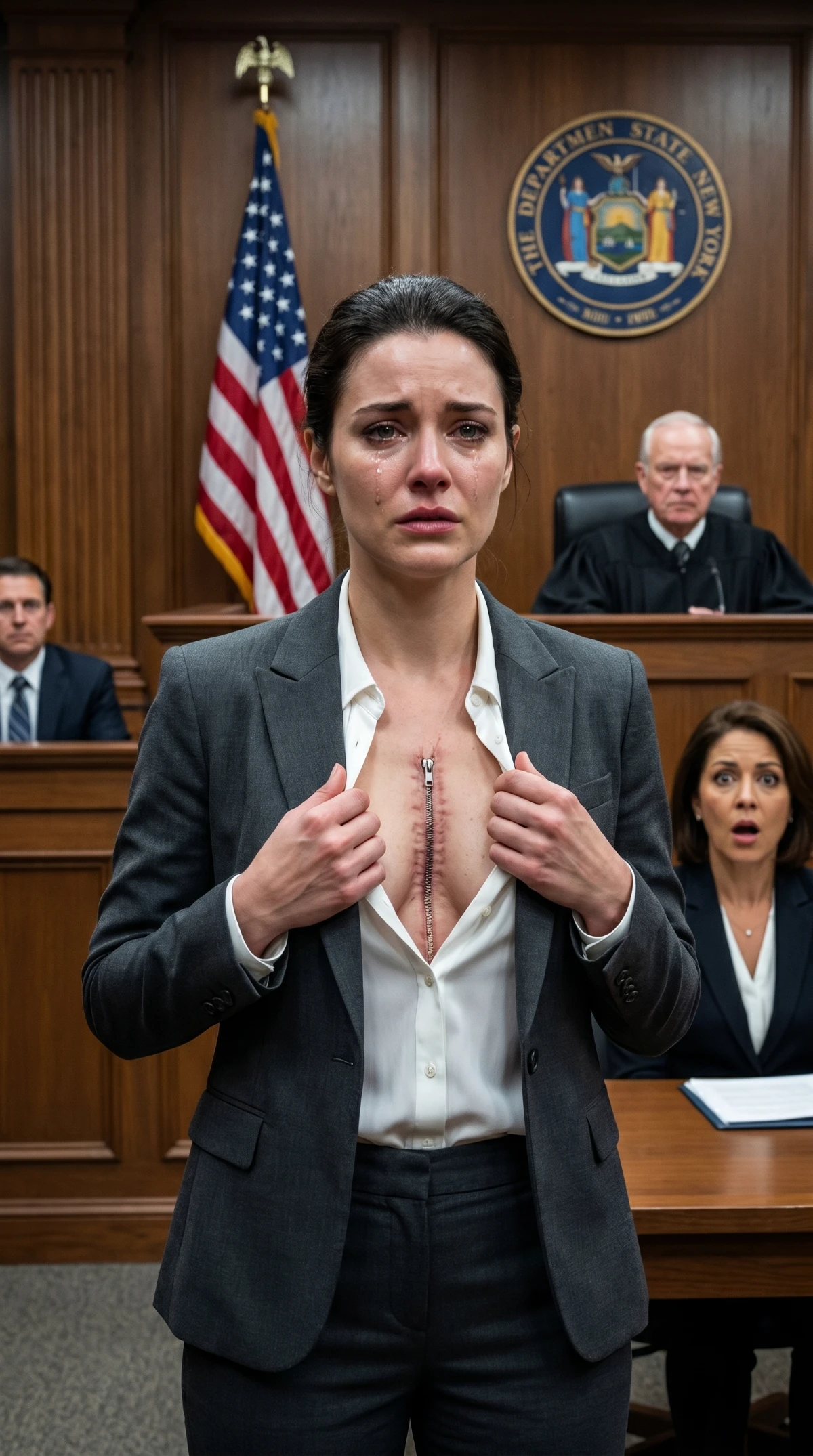
I stood up, took off my blazer, and reached for the hem of my shirt, right where the fabric met my left shoulder.
“Permission to show the court,” I said quietly.
Judge Keane nodded once. “Proceed.”
I lifted the fabric just enough to reveal the raised, pale scar etched across my shoulder — a jagged wound from shrapnel during a firefight in Afghanistan eight years ago.
The courtroom fell completely silent.
Gasps. Murmurs. A few people covered their mouths.
My mother’s face went white. Travis’s smirk vanished.
Judge Keane’s eyes softened for a moment, then hardened as she looked at my family.
“Mrs. Caldwell,” she said, her voice sharp, “you have wasted this court’s time with a malicious and false accusation. This case is dismissed with prejudice. Furthermore, I am referring this matter to the prosecutor for potential perjury charges.”
My mother started to protest, but the judge cut her off.
“Enough. The court has seen more than enough.”
I lowered my shirt, put my blazer back on, and walked out of the courtroom without looking back.
Two months later, my mother and brother were hit with perjury charges. The town finally saw who they really were. I kept my grandfather’s house and finally felt peace.
Sometimes the strongest proof isn’t a piece of paper.
It’s the scar you carry from serving the country they claimed you never protected.
THE END
Ma’am, Step Away From the Firing Line Before You Hurt Yourself The Young Sergeant’s Voice Cracked Across the Range
“Ma’am, step away from the firing line before you hurt yourself.”
The young sergeant’s voice cracked across the range louder than the first rifle shot of the morning, and every soldier on Lane Seven turned to stare at the seventy two year old woman standing alone by the chain link fence.
She did not move.
Her faded gray coat hung loosely from her narrow shoulders. Her white hair was tucked under a plain knit cap, and one gloved hand rested lightly against the fence as spent brass glittered in the gravel near her shoes. The morning was cold enough to turn every breath into smoke. Beyond the range, brown winter grass shivered in the wind, and the paper targets downfield trembled on their wooden frames like they were afraid too.
Sergeant Kyle Briggs lowered his clipboard and let out a laugh sharp enough to make the recruits behind him look up.
“Well, look at that,” he said, loud enough for everyone to hear. “Somebody’s grandma wandered into the wrong field trip.”
A few soldiers chuckled.
The old woman looked at him through thin framed glasses. Her face was calm, almost gentle, but there was something in her eyes that did not belong on the edge of a training range.
“I’m not lost,” she said.
Briggs grinned wider.
He was twenty six, square jawed, freshly promoted, and wore his authority like armor. His tan uniform looked untouched by dust, his boots were polished, and the whistle around his neck bounced against his chest as he walked toward her.
“You here for the county fair?” he asked. “Because the kettle corn is about fifteen miles that way.”
The laughter grew louder behind him.
The woman’s expression did not change.
“This is a live fire training range,” Briggs said. “Not a tourist stop.”
“I can read signs,” she replied.
Two soldiers near the bench tried to hide their laughter and failed.
Briggs tilted his head, amused now, enjoying the attention.
“Can you? Because the big red one behind you says restricted access.”
The woman glanced at the sign, then back at him.
“I saw it.”
His smile sharpened.

“Then maybe you missed the part where gunfire can make people nervous.” He leaned closer, lowering his voice just enough to make the cruelty feel personal. “A loud shot might make you faint.”
This time the recruits laughed harder.
A young private named Ethan Walker shifted uncomfortably near the weapons table. He had been struggling all morning, missing the center of his target again and again while Briggs barked corrections in front of everyone. Ethan was nineteen, all elbows and nerves, with hands that shook whenever too many eyes landed on him. His father had been a soldier. His grandfather too. Everyone in his family had worn a uniform with confidence, but Ethan wore his like he had borrowed it from a braver man.
He looked at the old woman, then at Briggs, as if he wanted to say something.
He did not.
The woman’s eyes moved to Ethan for a brief second. Not long enough for anyone else to notice, but long enough for Ethan to feel it. There was no pity in her gaze. That made it worse. Pity would have been easy to hate. This was recognition.
Then she looked back at Briggs.
“I’m not afraid of noise,” she said.
For the first time, Briggs blinked.
There was no anger in her voice. No trembling. No embarrassment. Just a quiet steadiness that made the air around them feel suddenly colder.
Then Briggs smiled again, but this time it looked forced.
“You’re not afraid of noise,” he repeated, turning toward the recruits. “Hear that, gentlemen? We’ve got a tough one.”
A soldier near the weapons table muttered, “This is gonna be good.”
Briggs reached down, grabbed a pair of safety glasses, and held them out with exaggerated politeness, as if he were handing a toy to a child.
“All right, ma’am,” he said. “Since you’re so confident, let’s give you the full visitor experience.”
Ethan stepped forward. “Sergeant, maybe we should…”
Briggs snapped his head toward him.
“Did I ask you, Walker?”
Ethan froze.
The range went quiet except for the distant crack of rifle fire from another lane.
The old woman accepted the safety glasses without a word. Her fingers moved slowly, carefully, but not weakly.
Briggs turned to the rack and picked up an unloaded training rifle. He checked the chamber with dramatic care, making sure every recruit saw him do it, then held it toward her with a mocking little bow.
“This is heavier than it looks,” he said. “Try not to drop it on your foot.”
The woman took the rifle with both hands.
And the instant her gloves closed around it, Ethan’s face changed.
Because she did not hold it like a confused old woman.
She held it like muscle memory had been waiting seventy two years to wake up.
The barrel dipped once, then steadied. Her left hand found the fore end with no hesitation. Her right thumb brushed the safety as naturally as another woman might touch a wedding ring. She angled the rifle downrange, not pointing it at anyone, not careless for a single breath.
Briggs noticed it too.
The amusement thinned on his face.
“Careful,” he said, softer now.
The woman did not look at him. She was looking at the target line, at the white squares hanging fifty yards away, then one hundred, then three hundred beyond them. Her mouth tightened, not with strain, but with memory.
“What’s your name, ma’am?” Ethan asked before he could stop himself.
Briggs glared at him.
The woman answered anyway.
“Mara Whitcomb.”
At the name, one of the older range officers at Lane Three turned his head. Captain Halvorsen, gray at the temples and broad through the shoulders, had been reviewing scores with another instructor. His pen stopped moving. He looked toward Lane Seven, then slowly removed his earmuffs as if sound had suddenly become important.
Briggs did not notice.
“Mara Whitcomb,” he repeated. “Well, Mrs. Whitcomb, since you came all this way, why don’t we see if you can hit something the size of a barn?”
A few laughs returned, weaker than before.
Mara looked down at the unloaded rifle.
“This one pulls left,” she said.
The laughter stopped.
Briggs frowned. “Excuse me?”
“The front sight post is half a turn off. It pulls left.”
Briggs’s jaw shifted. “You haven’t fired it.”
“I don’t need to.”
He snatched the rifle from her hands, eyes flashing. “That’s enough.”
But Captain Halvorsen had already started walking over.
“Sergeant Briggs,” he called.
Briggs straightened instantly. “Sir.”
Halvorsen’s gaze stayed on the woman. There was something complicated in his face now, something between disbelief and reverence.
“Did she say her name was Mara Whitcomb?”
“Yes, sir,” Briggs said, with an irritated glance at her. “Civilian wandered onto the range.”
Halvorsen stopped three feet from her.
For a moment, he looked like a boy who had seen a ghost in daylight.
“Mrs. Whitcomb,” he said carefully, “may I ask what brings you here?”
Mara slid the safety glasses over her eyes.
“I came to see if the army still teaches young men to breathe.”
The recruits exchanged looks.
Briggs scoffed. “We teach plenty.”
Mara turned her eyes toward Ethan.
“Not him.”
Ethan’s stomach dropped.
Briggs’s face flushed. “Private Walker lacks discipline. That’s not a breathing problem.”
Mara looked at Briggs then, and for the first time something sharp moved beneath her gentleness.
“No,” she said. “That’s a teaching problem.”
The words landed harder than a shot.
Briggs went stiff. “With respect, ma’am, you don’t know anything about this private or this range.”
“I know fear when I see it,” Mara replied. “And I know the difference between correcting a soldier and breaking one in public because it makes you feel tall.”
Nobody laughed now.
Ethan stared at the gravel.
His ears burned. Part of him wanted her to stop. Another part, smaller and more desperate, wanted someone to keep speaking.
Briggs stepped closer. “Captain, with permission, I’d like to escort this civilian out.”
Halvorsen did not answer immediately. His eyes were still on Mara, scanning her face like he was searching an old photograph inside it.
“Mara Whitcomb,” he murmured. “Were you ever stationed at Fort Arden?”
The woman’s gloved fingers tightened around the safety glasses.
“A long time ago.”
Halvorsen swallowed.
“My father told me about a Mara Whitcomb.”
The wind moved through the range flags.
Briggs looked from one to the other, annoyed. “Sir?”
Halvorsen’s voice became quieter.
“He said she could put five rounds through the same hole at three hundred yards while half the officers in the room were still arguing whether women belonged near a weapon.”
The recruits stared.
Briggs’s laugh came out too late and too sharp. “Sir, respectfully, that sounds like barracks fiction.”
Mara removed one glove finger by finger.
Her hands were old. Thin skin, blue veins, knuckles swollen with age. But when she flexed them, the tremor that came and went in her left hand vanished the moment her right hand closed into position.
“Most stories become fiction when the people who lived them are inconvenient,” she said.
Halvorsen turned to Briggs. “Load one magazine. Five rounds.”
Briggs’s face changed. “Sir?”
“Five rounds, Sergeant.”
“With all due respect, we cannot let a civilian fire on an active military range.”
Halvorsen’s eyes hardened. “This range is under my authority.”
Briggs shut his mouth.
Ethan watched as the sergeant loaded the magazine with movements that had lost their swagger. He shoved it into the rifle and handed it over, but this time there was no bow.
Mara accepted it.
The whole lane seemed to hold its breath.
She stepped onto the firing mat.
Her knees bent slowly, and for a painful second Ethan thought she might not be able to lower herself. Then her body folded into the prone position with strange, precise grace. One elbow planted. Shoulder tucked. Cheek settled. Her breathing slowed.
Briggs folded his arms. “Target fifty yards.”
Mara did not move.
“Three hundred,” she said.
Briggs blinked. “What?”
“Move it to three hundred.”
Halvorsen nodded to a range assistant.
The target shifted.
The white square looked impossibly small.
Briggs leaned toward Ethan and muttered, “Watch closely, Walker. This is what happens when pride gets old.”
Mara heard him.
She did not answer.
She inhaled.
The range was cold, but Ethan suddenly felt sweat along his spine.
Mara exhaled halfway and held.
The rifle fired.
Once.
The sound snapped across the field.
She fired again.
Again.
Again.
Again.
Five shots. Even spacing. No rush. No hesitation.
Then she rested the rifle on safe and slowly sat back.
The target monitor beside Briggs flickered as the camera downrange fed the image to the screen.
Everyone leaned in.
At first, Ethan thought the screen had malfunctioned.
There was only one dark hole near the center.
Briggs let out a breath that sounded almost like relief. “She missed four.”
Captain Halvorsen said nothing.
The range assistant zoomed the camera.
The hole widened on the monitor. Ragged edges. Not one clean puncture, but one torn black flower at dead center.
Five rounds.
Same place.
The recruits went silent in a way Ethan had never heard silence before.
Briggs stared at the screen.
His face emptied.
Mara rose slowly, with Halvorsen offering a hand she did not take until the final inch. She gave the rifle back to Briggs, barrel down, chamber checked, safety on.
“This one still pulls left,” she said. “But not enough to forgive bad breathing.”
A laugh escaped one recruit, not cruel this time, but stunned.
Ethan looked at her as if the world had tilted.
“Ma’am,” he whispered, “who are you?”
Mara looked at him, and the cold certainty in her face softened.
“I was somebody’s mistake,” she said. “Then I became somebody’s secret.”
Halvorsen closed his eyes briefly.
“Mrs. Whitcomb,” he said, “perhaps we should continue this in my office.”
“No,” Mara said.
One word. Quiet. Final.
“I came for him.”
Ethan’s blood seemed to stop.
Every eye turned.
“For me?” he asked.
Mara looked at the name tape on his uniform.
Walker.
Her gaze lingered there as though the letters had weight.
“Yes,” she said. “For you.”
Briggs found his voice, brittle and defensive. “Private Walker is in remedial qualification. Whatever stunt this is, it has nothing to do with him.”
Mara turned toward the target line.
“His grandfather used to flinch the same way.”
Ethan’s mouth parted.
“My grandfather died before I was born.”
“I know.”
“How would you know?”
The old woman looked back at him, and suddenly the range around them felt too public for whatever was rising in her eyes.
“Because I loved him.”
The words were gentle, but they struck Ethan so hard he took a step back.
Briggs muttered, “This is ridiculous.”
Halvorsen cut him off. “Sergeant.”
Mara reached into her coat pocket and drew out a small cloth pouch, faded blue, tied with a fraying cord. Her hand trembled now. Not from fear. From the terrible effort of carrying something for too long.
She opened it and removed a medal, dull with age, wrapped around a folded photograph.
Ethan saw the picture before he understood it.
A young soldier with dark hair and a crooked smile stood beside a young woman in fatigues too large for her frame. She held a rifle across her chest. He looked at her like the world had narrowed to her face.
On the back, written in fading ink, were four words.
Mara and Samuel, 1971.
“My grandfather’s name was Samuel,” Ethan said.
Mara nodded.
“Samuel Walker.”
Ethan’s voice thinned. “My dad said he was quiet. Said he never talked about the service.”
“He talked to me,” Mara said.
Her eyes dropped to the photograph.
“He talked too much, actually. About coffee. About old cars. About the house he wanted to build with a porch wide enough for two rocking chairs. About how he was going to have a son one day, and how he hoped the boy would have his mother’s stubbornness instead of his own bad knees.”
Ethan looked at the old photo, unable to breathe properly.
“What happened?”
Mara’s lips pressed together.
For a moment, she was no longer seventy two. She was standing somewhere else, in a different cold, with smoke in her hair and dirt under her fingernails.
“We were assigned to a classified marksmanship evaluation unit,” she said. “Unofficial, of course. Women did not get credit for the work they asked us to do. We trained men who would later be praised for skills they learned from us. Samuel hated that. He said secrets rot if you keep them too long.”
Halvorsen looked down.
Briggs no longer seemed eager to speak.
Mara continued.
“One winter, there was an accident during a demonstration. At least, that was the report. A young officer ignored a ceasefire call because he wanted to prove he was faster than everyone else. Samuel saw a recruit downrange. He ran out to drag him behind cover.”
Her voice cracked for the first time.
“He saved the boy.”
Ethan whispered, “And died?”
Mara shook her head.
“No. That would have been easier.”
The wind seemed to disappear.
“He lived long enough to take the blame.”
Ethan frowned.
Mara unfolded another paper from the pouch, brittle and yellowed. The crease lines looked like scars.
“The officer came from a powerful family. Samuel was a farm boy with no one important behind him. They wrote the report to protect the officer. They said Samuel violated range discipline. They said he panicked. They said he endangered lives.”
Ethan’s throat tightened.
“My family thought he disgraced himself.”
“Yes,” Mara said. “And he let them think it.”
“Why?”
“Because the recruit he saved was sixteen, underage, enlisted on forged papers. If the investigation had gone deeper, that boy would have been imprisoned, his family ruined, and the officer still protected. Samuel signed the statement because he thought one ruined name was better than two.”
Ethan looked at the photograph again.
“But my grandfather came home.”
“He came home with a broken shoulder, a damaged lung, and a silence that ate him from the inside.”
Mara’s hand shook harder now.
“I was pregnant when they discharged him.”
Ethan went still.
The world narrowed.
“What?”
Mara closed her eyes.
“I wrote him every week for six months. Every letter came back unopened. Then one day his sister wrote to me. She said Samuel had married someone from home. She said I should have the decency to disappear.”
Ethan’s face drained.
“My grandmother?”
Mara gave a sad smile.
“She was not cruel. She was frightened. Samuel’s family had already lost their pride. They could not survive another scandal. A child born from a woman the army had erased would have been another shame they could not explain.”
Ethan’s hands curled.
“So what happened to the baby?”
Mara looked at him.
And in her eyes, Ethan saw the answer before she spoke it.
“She was born in March,” Mara said. “A girl. I named her Lily. Samuel never knew. I raised her alone for eleven years.”
Ethan could barely hear himself. “My mother’s name is Lily.”
“Yes.”
“No.” He shook his head once, then again. “No, my mother said her parents died when she was little.”
Mara flinched, but she did not look away.
“She was told that.”
“By who?”
Mara’s mouth trembled.
“By me.”
That was the moment Ethan stopped feeling the cold.
He stared at the old woman, this impossible stranger who had arrived with a photograph and a rifle and a secret large enough to crush three generations.
“You gave her away?”
The words came out sharper than he meant them to.
Mara accepted them like she had expected worse.
“Yes.”
“Why?”
“Because men came to my apartment after Samuel died.”
Ethan froze.
Mara’s face had gone pale.
“They were not wearing uniforms, but they knew things only the army should have known. They told me Samuel’s corrected report would never surface. They told me my name would stay buried. They told me if I kept pushing, Lily would grow up with doors closed before she reached them. School, work, safety, all of it. They did not need to threaten her directly. Men like that know how to make kindness sound like a knife.”
Ethan’s anger faltered.
Mara looked down at her hands.
“So I found a family who could give her a clean name. A safe name. I told myself love was not keeping a child in your arms if your arms had become a target.”
Her voice broke.
“I told myself many things.”
Ethan could not move.
Mara lifted the medal.
“Samuel died when Lily was four. He never knew about her. Your mother never knew about me. And you grew up thinking your grandfather was a coward because I was too afraid to dig up the truth while there was still time for it to matter.”
Halvorsen stepped forward, his voice thick.
“It matters now.”
Mara turned to him.
“You have the sealed files?”
Halvorsen nodded slowly.
“My father was the recruit Samuel saved.”
Briggs’s head snapped up.
Halvorsen looked at Ethan.
“He spent his whole life trying to get the record corrected. He died before he could. Last month, the archive finally released the incident review under declassification. Samuel Walker did not violate discipline. He saved a life after a negligent order. The officer who blamed him later retired with honors.”
Mara closed her eyes.
A sound escaped her, small and wounded.
For seventy two years she had stood upright. In that instant, she seemed to fold inward.
Ethan stepped toward her without thinking.
She opened her eyes and looked at him.
“I came today because I saw your name on the qualification roster,” she said. “Walker. Same town. Same eyes. I told myself it was impossible. Then I saw you flinch before the shot, exactly like Samuel did after the accident. Not cowardice. Memory in the blood. The body keeping score of a story nobody told it.”
Ethan’s eyes burned.
“My mother died last year,” he said.
Mara’s face changed.
The hope in it did not vanish. It collapsed.
“Oh,” she whispered.
“She had cancer. She used to keep an old photo in her drawer of a woman holding a baby. She said she dreamed about her sometimes, but she didn’t know why.”
Mara covered her mouth.
Ethan reached into his chest pocket with shaking fingers and pulled out the small laminated picture he carried through every training day. His mother at twenty five, smiling in a yellow dress, sunlight on her hair.
Mara took one look and made a sound that turned every hardened face on that range soft.
“My Lily,” she breathed.
The old woman who had placed five rounds through one hole began to cry like a mother who had arrived one lifetime too late.
Ethan did not know what to do with his anger. It was still there, hot and wounded. But beneath it was something heavier. His mother had died thinking her beginning was a blank space. His grandfather had died beneath a lie. This woman had survived by cutting out her own heart and calling it protection.
He wanted to hate her.
But her hands were shaking around his mother’s photograph as if she were holding a living child.
Briggs cleared his throat, uncomfortable. “Private Walker, return to position.”
No one moved.
Halvorsen turned on him slowly.
“Sergeant Briggs.”
“Sir, training schedule…”
“Apologize.”
Briggs stiffened. “Sir?”
“To Mrs. Whitcomb. And to Private Walker.”
Briggs’s face darkened. The recruits watched him with the same attention they had given Mara’s target.
Pride wrestled with survival in his jaw.
Finally, he faced Mara.
“Ma’am,” he said, rigidly, “I apologize for my comments.”
Mara wiped her cheek with the back of her glove.
“Do better than apologize,” she said.
Briggs blinked.
She looked toward Ethan.
“Teach him.”
The sergeant swallowed.
“Yes, ma’am.”
But Ethan shook his head.
“No.”
Everyone looked at him.
His voice trembled, but he did not lower his eyes.
“I don’t want him teaching me right now.”
Briggs opened his mouth, but Halvorsen raised a hand.
Ethan looked at Mara.
“You said the army still needs to teach young men to breathe.”
Mara studied him.
Then she nodded.
“Yes.”
“Then teach me.”
The request hung between them.
Mara’s face crumpled again, but this time something like light moved through the grief.
“I can try,” she said.
Ethan stepped onto the mat.
His body remembered humiliation. The laughter. Briggs’s voice. The sting of failure before the trigger had even moved. His hands shook as he lifted the rifle.
Mara knelt beside him with difficulty.
“Not so tight,” she said.
“I can’t stop shaking.”
“I know.”
“That’s bad.”
“No,” she said. “That’s honest.”
He looked at her.
She adjusted his elbow gently.
“People think courage is a steady hand,” she whispered. “It isn’t. Courage is letting the hand shake and taking the shot anyway.”
Ethan swallowed.
She placed two fingers lightly against his shoulder.
“Breathe in for the boy you were. Breathe out for the shame they gave you. Hold only what belongs to you.”
His eyes stung behind the safety glasses.
“I’m angry.”
“Good.”
“At you.”
“I know.”
“At him.”
“Yes.”
“At everyone.”
“Then do not waste it by spraying it all over the world. Set it down the sight. Make it small enough to survive.”
Ethan looked through the scope.
The target swam.
Mara’s voice lowered.
“Your grandfather used to rush the trigger when he was scared. I told him the bullet can feel panic.”
Despite everything, Ethan almost laughed.
“Can it?”
“No. But he believed me, and it helped.”
His breathing slowed.
Inhale.
Exhale.
Half breath.
Hold.
The rifle fired.
The shot cracked downrange.
The monitor flickered.
A hole appeared just outside the center ring.
Ethan stared.
It was not perfect.
But it was the best shot he had made all morning.
Mara smiled.
“There you are.”
Something broke open inside him then, not loudly, not dramatically, but completely. He lowered his forehead to the stock for one second and breathed like he had been underwater for years.
Behind him, no one laughed.
By noon, the corrected report had been printed in Captain Halvorsen’s office. The file smelled of warm toner and old ghosts. Samuel Walker’s name stood clean in black ink for the first time in half a century. Mara sat across from Ethan with both hands wrapped around a paper cup of coffee she had not touched. On the desk between them lay the photograph of her and Samuel, the medal, and Ethan’s picture of Lily.
Halvorsen placed one more document on the desk.
“There is something else,” he said.
Mara looked up.
He hesitated.
“The officer who falsified the report was Colonel Richard Briggs.”
The room went very still.
Ethan turned slowly toward the window, where Sergeant Kyle Briggs stood outside on the walkway, pale as ash.
Halvorsen’s voice was careful.
“His grandfather.”
Mara closed her eyes.
Ethan expected rage to rise in her. He almost wanted it to. He wanted the world to balance itself with some clean, satisfying punishment.
But Mara only looked tired.
Kyle Briggs stepped into the doorway. His polished confidence was gone. He looked suddenly young, terribly young, holding a folded page from the report in one hand.
“I didn’t know,” he said.
No one answered.
His eyes moved to Mara.
“I swear to God, I didn’t know.”
Mara studied him for a long time.
Then she said, “Most people inherit stories before they inherit truth.”
Kyle’s face twisted.
“My grandfather’s medals are in our living room.”
“So was Samuel’s silence,” Mara said. “Families decorate themselves with what they can bear.”
Kyle looked at Ethan.
“I’m sorry.”
This time, it did not sound like obedience.
Ethan wanted to reject it. He wanted to make Kyle stand there and feel small, the way Kyle had made him feel small all morning. But he thought of Mara giving up Lily to protect her. Samuel carrying blame to protect a boy. His mother dreaming of a face she had never been allowed to know.
Pain passed down when nobody had the courage to stop handing it over.
Ethan looked at Kyle and said, “Then help fix it.”
Kyle nodded once, tears bright in his eyes.
That afternoon, Lane Seven filled again, but no one laughed when Mara walked back to the firing line. Captain Halvorsen had ordered a small ceremony for the corrected record, nothing official enough for headlines, but enough for the people who needed to see it. Samuel Walker’s name was read aloud. So was Mara Whitcomb’s.
For the first time, her work was not called rumor, mistake, or secret.
It was called service.
Ethan stood beside her, holding his mother’s photograph.
Mara leaned close and whispered, “I wish I had found her.”
Ethan looked at the woman who was his grandmother, and the word felt strange, fragile, almost too late to touch.
“She found you,” he said.
Mara looked at him.
He placed Lily’s photograph into her hand.
“In dreams, maybe. In me, maybe.”
Her lips trembled.
The sun lowered behind the target berms, turning the spent brass gold. The range that had humiliated Ethan that morning now felt like a chapel built out of gravel, gunpowder, and unfinished prayers.
Before they left, Mara asked for one final target.
Not three hundred yards this time.
Fifty.
Her hands were tired. Her body was tired. Her heart, Ethan thought, must have been more tired than all of them. But she stood beside him as he raised the rifle.
They breathed together.
One breath for Samuel.
One breath for Lily.
One breath for every truth buried by fear.
Ethan fired.
The shot struck the center.
Mara smiled through tears, and for one brief, impossible second, Ethan felt three generations standing with him on that cold firing line.
Then Mara pressed Samuel’s old medal into his palm and closed his fingers around it.
“Carry the truth better than we did,” she whispered.
And as the last light faded across the range, Ethan held the medal, the photograph, and his grandmother’s shaking hand, while one clean hole waited at the center of the target like a wound finally learning how to heal.