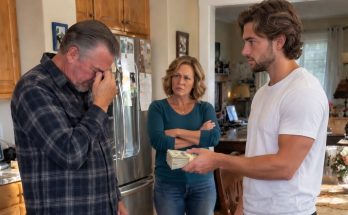
I came home in a wheelchair after the accident, expecting my husband to help me adjust to a life I barely recognized.
Instead, two suitcases were waiting on the porch.
“Get out. Take your kids. I don’t need you anymore.”
I didn’t argue.
I only smiled.
Daniel mistook my silence for defeat.
He had no idea what was already on its way.
When the hospital transport van stopped outside my house in Columbus, Ohio, I noticed the luggage before I noticed my husband.
Two suitcases sat neatly on the porch.
Daniel stood beside them with his arms crossed.
My twelve-year-old daughter, Lily, sat silently beside me in the van. My eight-year-old son, Noah, held the backpack he had brought to visit me throughout six weeks of rehabilitation.
A delivery truck had hit me while I was driving home from work.
The spinal injury left me unable to move my legs.
Doctors couldn’t tell me whether that would ever change.
Daniel looked at my wheelchair.
Then at the children.
“Get out,” he said. “Take your kids. I don’t need you anymore.”
Even the transport driver stared at him.
I said nothing.
I smiled.
Daniel clearly thought I was too stunned to fight back.
What he didn’t know was that three days earlier, while I was still at the rehabilitation center, our bank had called about several suspicious transfers from our joint savings.
He also didn’t know that Rebecca Sloan, an attorney who worked with my employer, had already helped me freeze what remained.
Most importantly, Daniel had forgotten one very important detail.
The house belonged to me.
My father had purchased it years earlier and left it solely to me when he died.
Daniel had lived there for nine years.
His name had never appeared on the deed.
“Mom?” Lily whispered.
“I’m okay,” I told her.
Daniel stepped closer.
“You heard me, Claire. I changed the locks. Go stay with your sister.”
My eyes moved toward the new deadbolt.
Then back to him.
“You changed the locks on my house?”
His expression tightened.
“It’s our house.”
“No,” I said quietly. “It’s mine.”
Right then, a black sedan pulled in behind the transport van.
Rebecca stepped out first.
A county deputy followed her carrying a folder.
Daniel’s face changed immediately.
Rebecca walked onto the porch and handed him a copy of the deed, notice of the frozen accounts, and a formal demand requiring him to restore my access to the property.
The deputy looked toward the new lock.
“Sir, if Ms. Carter is the sole owner and legal occupant, you cannot lock her out without a court order.”
Daniel stared from the documents to me.
“You planned this?”
“No,” I said. “You did.”
His confidence began to crack.
Then Rebecca opened another folder.
“We also need to discuss the $38,000 transferred from the marital savings account to an account in your name last month.”
Daniel went pale.
The driver lowered the wheelchair ramp.
I rolled toward my house.
My children followed.
For six weeks, Daniel had assumed my accident had made me helpless.
Before the day ended, he was going to learn how expensive that assumption could become.
Daniel didn’t leave quietly.
For the next twenty minutes, he argued with the deputy.
Then Rebecca.
Then me.
He insisted that being my husband gave him the right to stay.
Rebecca calmly explained that marriage didn’t give him the right to exclude the titled owner from her own property.
The deputy made it equally clear that changing the locks while I was hospitalized had created a problem Daniel apparently hadn’t considered.
Eventually, he unlocked the door.
The inside of the house told me almost everything else.
Half our photographs had disappeared.
Daniel’s clothes had been moved into the downstairs guest room.
Empty wine bottles crowded the recycling bin.
On the kitchen counter were restaurant receipts, two expensive shopping bags, and a handwritten note signed with one woman’s name.
Vanessa.
Lily noticed before I could turn it over.
“Who’s Vanessa?”
Daniel snapped, “Go upstairs.”
“She stays with me,” I said.
He glared.
“You’re making this worse.”
“No, Daniel. I’m finally looking at what you made.”
Rebecca photographed everything visible in the rooms.
She had already warned me not to search Daniel’s private devices or accounts.
We didn’t need to.
The financial records gave us enough to start with.
Daniel had transferred $38,000 from our joint savings in four separate transactions.
Some of that money was insurance money intended to make the house accessible after my injury.
The rest included years of savings for Lily and Noah.
Daniel claimed he’d moved it “for household expenses.”
Rebecca laid copies of the bank statements across the dining table.
“Then documenting the expenses should be simple.”
Daniel said nothing.
That evening, my sister Rachel arrived with groceries and stayed with the children while Rebecca helped me organize documents.
Daniel packed a duffel bag and announced he was staying at a hotel “until everyone calmed down.”
Before leaving, he leaned toward me.
“You think a wheelchair makes you powerful because people feel sorry for you?”
I met his eyes.
“No. Paperwork makes me powerful because you signed your name to everything.”
His jaw tightened.
Then he walked out.
The next morning, I filed for divorce.
It wasn’t revenge.
It was protection.
Rebecca referred me to a family-law attorney named Marcus Hale.
By noon, Marcus had requested temporary orders involving custody, access to money, preservation of marital assets, and Daniel’s financial disclosures.
He also warned me not to expect some instant courtroom victory.
Courts worked through evidence, procedure, and time.
That didn’t bother me.
For years, I had handled compliance audits for a medical equipment company.
I knew how to build a record.
So that’s exactly what I did.
Bank statements.
Texts.